
Transport
Horse Transport within the EU: Documents, TRACES, and Registration
What documents you need for horse transport within the EU, when the official veterinary examination takes place, and the registration deadlines and fees cited by individual veterinary offices in Germany.
Equidara editorial team · 10 November 2026 · 5 min read
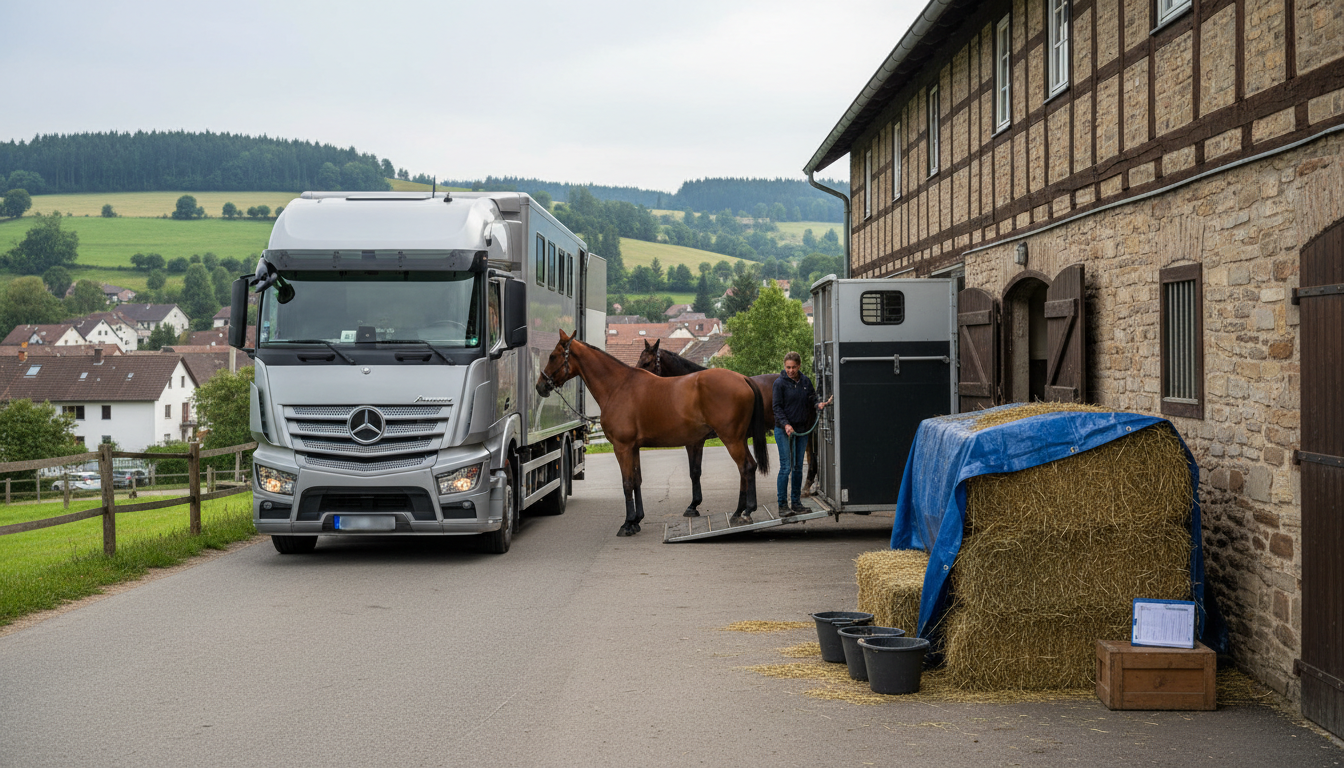
For horse transport within the EU, you generally need an official veterinary health certificate. Exceptions can only be granted by the competent authority. The veterinary offices in the examples below also require the equine passport. The clinical examination must take place within 48 hours or on the last working day before departure. This deadline is not the registration deadline with the veterinary office. In the examples below, you must register the transport several days earlier. The local procedural examples in this article are from Germany.
What Documents Does Your Horse Need?
Equine Passport and Health Certificate
According to the European Commission, every horse being moved to another EU Member State must generally be accompanied by a health certificate following the EQUI-INTRA-IND or EQUI-INTRA-CON model. This applies regardless of the purpose of travel.
The district of Munich in Bavaria requires the equine passport to be carried in addition to the health certificate for horses traveling abroad. This also applies to temporary holiday and competition trips. Therefore, not only plan for the certificate but also have the equine passport ready for the examination and the journey.
What Does “TRACES Horse” Mean?
The Veterinary Office Waldshut in Baden-Württemberg explains: The official veterinary health certificate is colloquially known as a TRACES certificate because it must be created in TRACES NT. For this, the official veterinarian examines the horse at the loading point and checks the equine passport.
Therefore, the certificate does not replace the passport. In the procedure of the district of Munich, the official veterinarian clinically examines the horse for freedom from disease and then issues the certificate. Furthermore, the authority assesses the planned transport from an animal welfare perspective.
TRACES Procedure: Separate Registration and Examination
First, Contact the Responsible Veterinary Office
According to the City of Munich, you should submit your application to the veterinary office responsible for your horse's location. The city's online form applies exclusively to horses within the Munich city area.
Local registration deadlines vary:
- In the City of Munich, registration must take place no later than three working days before departure.
- In the district of Waldshut, the certificate must be applied for at least five working days before the start of transport. Those who miss the deadline will not be processed there.
- In Mönchengladbach, North Rhine-Westphalia, the form should be submitted as early as possible, but no later than 14 days before departure, if a TRACES certificate is required.
The registration of involved parties also varies among offices. According to Munich's regulations, animal owners, transporters, transport companies, and stables, among others, must be registered in TRACES NT. In Waldshut, individuals and companies with an address in the district do not need to be pre-registered. Parties based abroad must be registered by their respective competent veterinary authority there.
The Official Veterinary Examination Follows
In the procedure of the City of Munich, an official veterinary on-site inspection takes place within 48 hours before departure. This includes checking the horse's health status and fitness for transport. For this, you will need the equine passport. Afterwards, you will receive the certificate.
If the horse has not been in the Munich city area for 14 days at the time of this examination, the city requires a preliminary certificate or TRACES certificate from the veterinary office at the previous location.
How Long Is the Health Certificate Valid?
According to the European Commission, the certificate is generally valid for ten days. An extension to 30 days is possible if both conditions are met:
- The horse is accompanied by its lifetime identification document with a valid validation mark or valid license.
- An individual animal health certificate following the EQUI-INTRA-IND model is issued.
Such a certificate with 30 days validity allows for multiple entries into other Member States and return to the departure establishment. The longer validity does not automatically apply to every horse.
The competent authorities of the destination Member State may grant exceptions from certain animal health requirements for cross-border sporting purposes. They may exempt registered equines from the certificate requirement.
Transporter, Authorization, and Longer Journeys
According to the European Commission, equines may only be transported between EU Member States by an officially registered transporter with a unique registration number. Additional animal welfare regulations may apply.
The City of Mönchengladbach explains that registration as a transporter of ungulates is required for both commercial and private transport. Depending on the duration of transport, it may require a logbook, certificate of competence, and authorization certificate in addition to the TRACES certificate. During inspections, you must present the transport documents carried.
The district of Munich uses its own term in its procedural description: For transports exceeding eight hours, a transport plan must be submitted there. The veterinary office responsible for your horse will inform you which documents are necessary for your journey.
For the legal classification of your specific transport, please contact a lawyer.
Horse Transport Costs: Local Fees for the Certificate
The City of Munich states a fee of 68.50 Euros for the standard case of one to four horses transported to EU Member States. Different fees apply for special cases. The district of Waldshut charges for the certificate based on time spent: 101 Euros per hour, calculated per commenced quarter-hour. Both amounts are local figures from the offices and are subject to change. You will learn the applicable amount from your responsible veterinary office upon registration. These figures concern the official procedure, not the price of the transport itself. For a transport inquiry, you can use Move-your-animal.
Distinction: Transport to a Country Outside the EU
For third countries, according to the district of Munich, the health conditions and certificate forms of the receiving state are decisive. As an animal owner, you must inquire about these with their authorities or embassies. The EU requirements for health certificates described here cannot therefore be simply transferred to a journey to a third country.
Common questions
Do I need a health certificate even for attending a competition?
Generally, yes. According to the European Commission, the certificate requirement applies regardless of the purpose of travel. The competent authorities of the destination Member State may grant exceptions, for example, for registered equines.
Do I only need to apply for TRACES 48 hours before departure?
No. The 48-hour deadline concerns the clinical examination; alternatively, the European Commission mentions the last working day before departure. Local deadlines apply for registration, such as three working days in the City of Munich, at least five working days in the district of Waldshut, and no later than 14 days in Mönchengladbach.
Is the health certificate always valid for 30 days?
No. Generally, it is valid for ten days. For 30 days, the horse needs a lifetime identification document with a valid validation mark or valid license, as well as an individual certificate following EQUI-INTRA-IND.
Does a private transporter also need to be registered?
According to the City of Mönchengladbach, registration as a transporter of ungulates is required for both commercial and private transport.
Sources
- Europäische Kommission – FAQ zu Pferdetransporten innerhalb der EU: Gesundheitsbescheinigungen, 48-Stunden-Frist und Gültigkeit (food.ec.eur
- Landeshauptstadt München, Veterinäramt – Anmeldung, Equidenpass, amtstierärztliche Untersuchung, TRACES-Registrierung und örtliche Gebühren
- Landkreis Waldshut, Veterinäramt – Ausstellung der Gesundheitsbescheinigung, Untersuchung am Verladeort, Antragsfrist und örtliche Gebühren
- Stadt Mönchengladbach, Fachbereich Verbraucherschutz und Tiergesundheit – Reisen mit Pferden: Transportpapiere, Befähigungs- und Zulassungsn
- Landkreis München – Internationale Pferdetransporte anmelden und amtstierärztliche Gesundheitsbescheinigung beantragen (landkreis-muenchen.d (19.03.2026)
Written by Equidara editorial team. Last checked: 10 November 2026.
- Long-Distance Horse Transport: Watering, Travel Duration, and Rest Periods under EU Law — Eight hours is the basic limit. Longer journeys are subject to specific conditions. Find out about the watering intervals and rest periods for unregistered domestic equids, and the special rules for foals, rail, and sea transport.
- Cross-Border Horse Transport: Paperwork, Haulers, and Liability in Case of Damage — Transporting a horse across an internal EU border requires an equine passport, an animal health certificate, and a TRACES entry. Equally important is your choice of hauler, as legal liability only covers a fraction of a valuable horse's worth.
- Equine Passport and Slaughter Exclusion: What Treatment and Sale Mean — A necessary treatment can permanently alter your horse's slaughter status. Here, you'll learn how exclusion differs from a withdrawal period and which passport entries are crucial when selling.
- Illegal Horse Trading: How to Verify Provenance and Documents — Official and media reports describe cases where equine passports and lab reports are alleged to have been manipulated. Here's what you can check regarding identity, provenance, and health records, and what a suspicion does not yet prove.
Related
- Request horse transport — Route, horse, date: carriers send you a quote.
- Find animal transport — Move your animal arranges transports in Europe.
- Trailers and transporters — Horse trailers, trucks, carriages and accessories.