
Transport
Long-Distance Horse Transport: Watering, Travel Duration, and Rest Periods under EU Law
Eight hours is the basic limit. Longer journeys are subject to specific conditions. Find out about the watering intervals and rest periods for unregistered domestic equids, and the special rules for foals, rail, and sea transport.
Equidara editorial team · 6 October 2026 · 4 min read
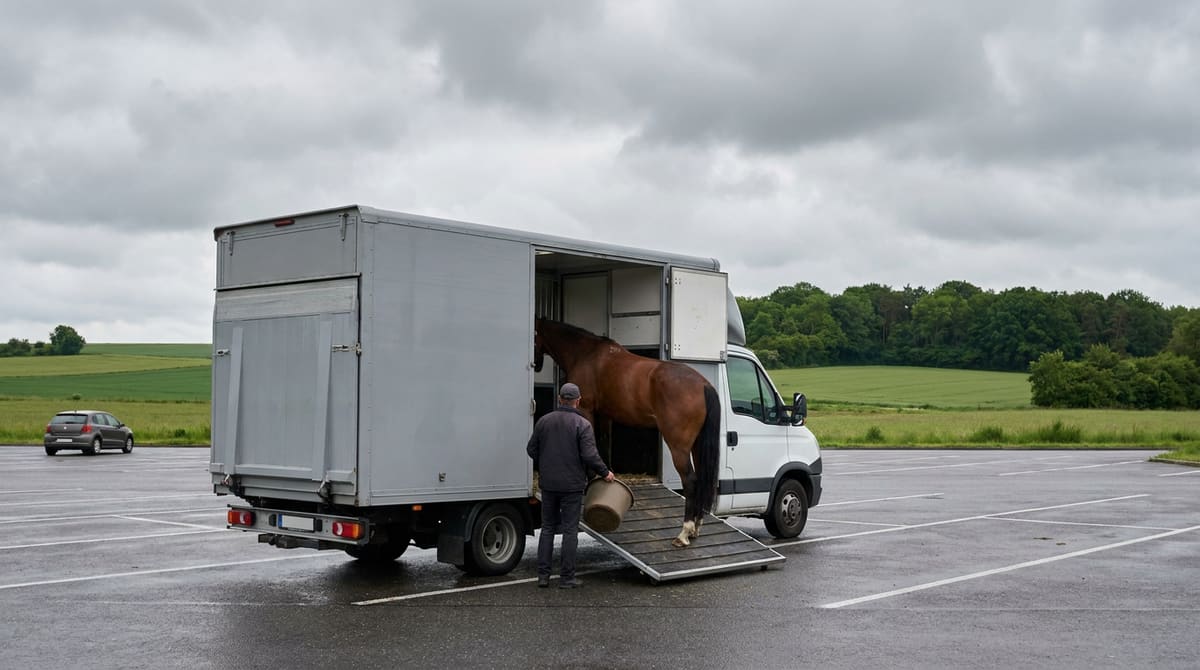
For domestic equids other than registered equids, the maximum travel duration is generally eight hours. If the additional requirements of Chapter VI of Regulation (EC) 1/2005 are met, this period can be extended. For these horses, journeys of up to 24 hours are then permitted, with watering every eight hours and feeding if necessary. A separate regulation applies to unweaned, milk-fed foals. Air transport is exempt from this section.
Which Horses and Journeys Are Covered by the Regulation?
The legal basis is Annex I Chapter V Section 1 of Regulation (EC) 1/2005. According to the consolidated version available on PRIMAMCP, this section applies to domestic equids other than registered equids. All subsequent time limits refer to animals falling under this section.
When you're planning your transport, first clarify whether your horse falls into the covered categories or if it's a registered equid. You cannot simply apply the deadlines described here to registered equids. They also do not apply to air transport.
For legal clarification regarding your specific transport, consult a lawyer.
Eight Hours as the Basic Limit, Longer Journeys Under Specific Conditions
Point 1.2 generally limits the travel duration to eight hours. Point 1.3 permits an extension if the additional requirements of Chapter VI are met.
If a vehicle as specified in Point 1.3 is used, Point 1.4 letter c allows for a maximum of 24 hours of transport for the covered domestic equids. During this time, the animals must be watered every eight hours and fed if necessary. For unweaned, milk-fed foals, letter a applies instead.
For your planning, this means you distinguish between three time limits:
- Eight hours is the general maximum travel duration.
- Up to 24 hours is only permitted under the additional conditions.
- During these longer journeys, horses must be watered every eight hours and fed if necessary.
Special Rest Period for Unweaned Foals
For unweaned, milk-fed foals falling under this section, a different sequence applies when a vehicle as specified in Point 1.3 is used. After nine hours of transport, they must receive an adequate rest period of at least one hour. This break is for watering and feeding if necessary. After this, another nine hours of transport are permissible.
Therefore, the rule of up to 24 hours with watering every eight hours does not apply to these foals.
After the Travel Duration: Unload and Rest for at Least 24 Hours
Once the stipulated travel duration is reached, animals falling under this section must be unloaded, fed, and watered. Following this, they must rest for at least 24 hours.
This rest period is distinct from the care provided during the journey. The obligation explicitly includes unloading. Watering during transit does not replace the required rest period.
Special Rules for Rail and Sea Transport
Rail Transport
For rail transport of the covered animals, a travel duration exceeding eight hours is generally not permitted. However, if the requirements of Points 1.3 and 1.4 are met, with the exception of the rest period requirements, the respective travel duration according to Point 1.4 applies.
Sea Transport and Direct Liner Services
For sea transport, the travel duration for the covered animals may only exceed eight hours if the requirements of Points 1.3 and 1.4 are met. This excludes the requirements for travel duration and rest periods.
A special rule applies to direct liner services by ship between two geographical points within the Community. If vehicles are loaded onto the ship without the animals being unloaded, a twelve-hour rest period is required after unloading at or near the port of destination. This applies if the duration of the sea transport does not comply with the general rules of Points 1.2 to 1.4.
Limited Extension and Rule for Slaughter Animals
In the interest of the animals, the travel duration according to Points 1.3, 1.4, and 1.7 letter b may be extended by two hours. The proximity of the destination must be particularly considered. This is not a blanket time allowance.
For the transport of slaughter animals, Member States may stipulate a non-extendable maximum duration of eight hours if the place of departure and destination are within their own territory. This possibility exists notwithstanding Points 1.3 to 1.8. Whether a state makes use of this is not specified in this section.
Common questions
How long may horses be transported under this section?
For domestic equids other than registered equids, eight hours is the general rule. If a vehicle as specified in Point 1.3 is used and the additional requirements of Chapter VI are met, up to 24 hours are permitted. A separate regulation applies to unweaned, milk-fed foals. Air transport is excluded.
How often must horses be watered during a longer journey?
For transport under Point 1.4 letter c, the covered domestic equids must be watered every eight hours and fed if necessary. This requires a vehicle as specified in Point 1.3. For unweaned, milk-fed foals, letter a applies.
What rest period applies to unweaned, milk-fed foals?
If they fall under this section and a vehicle as specified in Point 1.3 is used, they must receive an adequate rest period of at least one hour for watering and feeding if necessary, after nine hours of transport. After this, another nine hours of transport are permissible.
Must horses be unloaded from the vehicle after the stipulated travel duration?
Yes. Animals falling under this section must be unloaded, fed, and watered, and then rest for at least 24 hours.
Sources
- Anhang I.13 REG_2005_1 – KAPITEL V ZEITABSTÄNDE FÜR DAS FÜTTERN UND TRÄNKEN SOWIE BEFÖRDERUNGSDAUER UND RUHEZEITEN 1. Hausequiden, Hausrinder, Hausschafe, Hausziegen und Hausschweine — // PRIMAMCP (Konsolidierte Fassung, Stand: 14.12.2019)
Written by Equidara editorial team. Last checked: 6 October 2026.
- Selling a Horse Outside the EU: Tests, Quarantine, and Where to Get Binding Information — Within the EU, a passport, health certificate, and TRACES are sufficient. However, once your horse leaves the Union, the destination country dictates the rules, and these can change. We'll cover which examinations are frequently required, how quarantine works, and where to obtain truly binding information.
- Cross-Border Horse Transport: Paperwork, Haulers, and Liability in Case of Damage — Transporting a horse across an internal EU border requires an equine passport, an animal health certificate, and a TRACES entry. Equally important is your choice of hauler, as legal liability only covers a fraction of a valuable horse's worth.
- Loading Your Horse: Avoiding Stress and Training Safely — Loading training works best in short, calm steps. Preparation, the right equipment, and knowing your horse's limits are key.
Related
- Request horse transport — Route, horse, date: carriers send you a quote.
- Find animal transport — Move your animal arranges transports in Europe.
- Trailers and transporters — Horse trailers, trucks, carriages and accessories.