
Health & Therapies
Kissing Spines in Horses: Correctly Interpreting X-ray Findings in the Pre-Purchase Exam
An abnormal X-ray alone doesn't tell you if your horse has back pain. Learn what signs to look for and why a clinical examination is crucial for proper assessment.
Equidara editorial team · 17 October 2026 · 4 min read
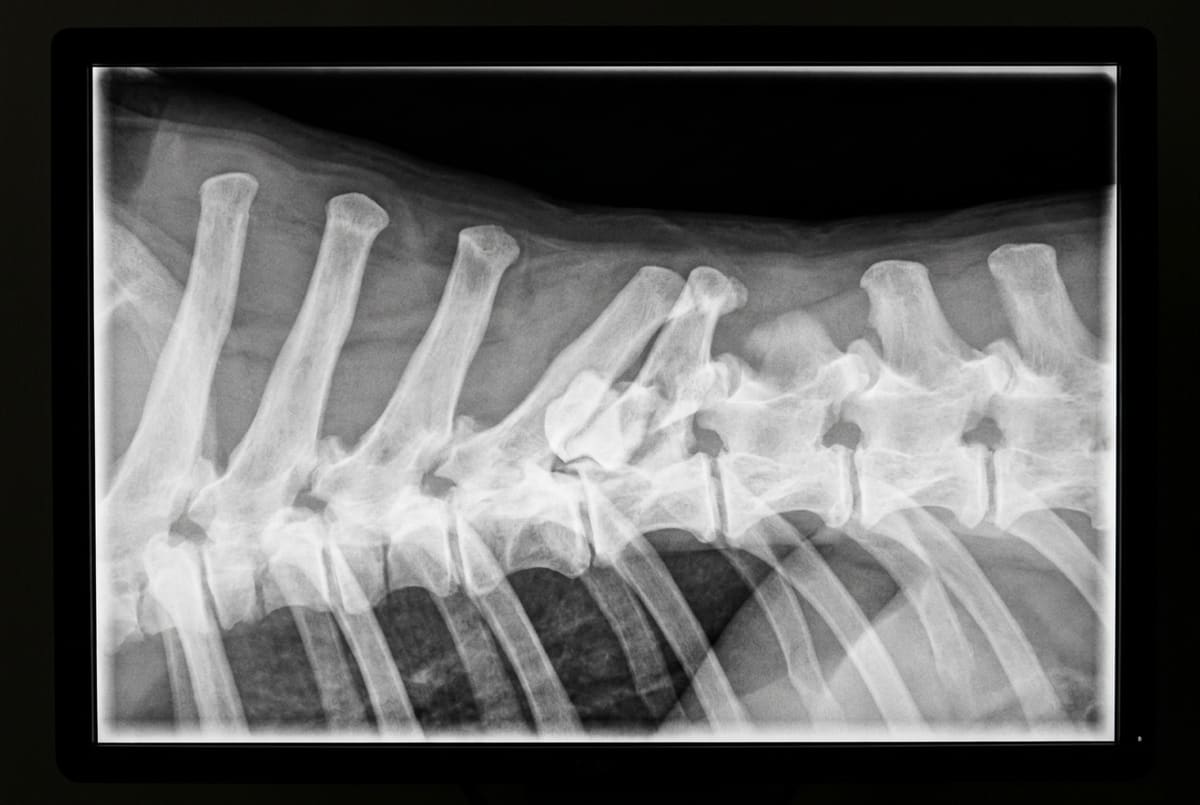
If an X-ray during a pre-purchase examination (PPE) reveals changes indicative of Kissing Spines, you cannot conclude that your horse is experiencing back pain based on this alone. Even significant changes can occur without clinical symptoms. Therefore, a clinical back examination is essential for proper assessment. If you notice any potential signs of pain while riding or saddling, have them checked by a veterinarian.
What Kissing Spines Means
The term Kissing Spines refers to changes in the dorsal spinous processes of the thoracic or lumbar spine. These include bone remodeling, such as osteophytes (bony outgrowths) and bone resorption, particularly at the cranial and caudal ends of the spinous processes. In severe cases, so-called pseudoarthroses (false joints) can develop.
According to the University Animal Hospital Zurich, the veterinary clinic of the University of Zurich in Switzerland, these changes are particularly common in the saddle region. However, they can also occur in the caudal thoracic vertebrae (last withers vertebrae) and the lumbar area.
The clinic states that Thoroughbreds and horses with short backs are particularly often affected. Changes are also not uncommon in dressage horses. General back pain, however, is distinct from this: it affects sport and leisure horses equally. According to the clinic, age does not play a significant role in this.
What the X-ray Finding in the PPE Reveals
An X-ray shows bony changes. However, it does not, by itself, answer whether these changes cause pain. According to the University Animal Hospital Zurich, the radiological severity of Kissing Spines rarely correlates with clinical symptoms.
For you as a buyer, this means: do not automatically equate a notable back finding with a painful back. Conversely, Kissing Spines can cause varying degrees of back pain and a significant reduction in performance. Restricted back mobility can have a particularly negative impact on jumping.
Therefore, have the X-ray findings explained to you along with the results of the clinical back examination. For proper assessment, it's not just what's visible on the image that counts, but also what symptoms and examination findings the horse presents.
Signs You Might Notice While Riding
Back problems can manifest differently while riding, during handling, and on the lunge. The University Animal Hospital Zurich describes, among other things:
- Resistance during grooming or saddling.
- Riding difficulties and dull movement.
- Lack of impulsion from the hindquarters.
- Constant tail swishing or head shaking.
- Irregularities in gait, such as pacing and disunited canter.
- Mild lameness, a stiff hindlimb gait, or toe dragging due to reduced hindquarter action.
On the lunge, exaggerated tension in the long back muscles and difficulty trotting with good flexion can be noticeable.
These observations are potential signs of back problems, but not specific proof of Kissing Spines. Discuss such abnormalities with your veterinarian instead of trying to diagnose them yourself based on a single sign.
How the Veterinarian Diagnoses Back Issues
According to the University Animal Hospital Zurich, diagnosing a back condition involves a clinical and orthopedic examination with particular attention to the back. The saddle is also thoroughly inspected.
According to the clinic, X-rays and ultrasound typically follow. Both procedures assess different structures:
- X-rays show bony changes in the dorsal spinous processes, vertebral bodies, and small vertebral joints (facet joints).
- Ultrasound allows for the assessment of soft tissues such as muscles and ligaments.
In some cases, a scintigraphic examination (bone scan) is also necessary. You should discuss which examinations are required for your horse with your treating veterinarian.
What Treatment for Back Problems Involves
Back pain can cause tension and lead to the horse using its back muscles less. Further muscle atrophy can worsen the back problem. The University Animal Hospital Zurich therefore recommends an individually tailored plan for building back muscle, developed by the examining orthopedist.
The saddle is also important: for horses with back problems, it should be symmetrical, well-padded, and custom-fitted. Therefore, include a saddle assessment in the veterinary examination.
In severe cases of Kissing Spines, surgery may be considered, according to the clinic. This involves removing one or more dorsal spinous processes. Whether this procedure is suitable for your horse and what you can expect from it must be assessed by your veterinarian on a case-by-case basis.
Common questions
Does a Kissing Spines finding on an X-ray always mean pain?
No. Even significant radiological changes can occur without clinical symptoms. According to the University Animal Hospital Zurich, the radiological severity rarely correlates with clinical symptoms.
Can I recognize Kissing Spines by my horse's behavior while riding?
Not definitively. Riding difficulties, tail swishing, head shaking, or a lack of impulsion from the hindquarters can indicate back problems. However, they are not specific proof of Kissing Spines and should be investigated by a veterinarian.
Why is a clinical examination important in addition to X-rays?
Not every visible change causes pain. Therefore, a clinical back examination is essential for properly assessing an X-ray finding.
Is surgery always performed for Kissing Spines?
No. According to the University Animal Hospital Zurich, surgery may be considered in severe cases, involving the removal of one or more dorsal spinous processes. Whether the procedure is appropriate for your horse and what you can expect from it will be assessed by your veterinarian on a case-by-case basis.
Sources
- Universitäres Tierspital Zürich – Rückenschmerzen beim Pferd: Veränderungen der Dornfortsätze und tierärztliche Abklärung. tierspital.uzh.ch
- Titelfoto: Jacobi, Eugen, Hoffotograf in Metz, Wikimedia Commons
- Lizenz des Fotos: CC BY 4.0

Written by Equidara editorial team. Last checked: 17 October 2026.
- The Horse Pre-Purchase Exam: Explaining the Basic and Extensive PPE — The basic Pre-Purchase Exam (PPE) covers the clinical examination, while the extensive PPE includes X-rays. Learn what's examined and how to clarify the scope, commission, and cost coverage in advance.
- Equine asthma: how to recognise it and what helps in the stable — If your horse has been coughing for weeks, equine asthma is often the cause, once known as heaves or COPD. How the mild form differs from the severe one, what helps against hay dust and what it means when buying.
- Laminitis in horses: causes, warning signs and what to do straight away — Laminitis is an emergency. We explain what happens inside the hoof, which horses are at risk, how to recognise an episode, how to prevent it and what a past bout of laminitis means when you buy.
- Colic in horses: how to spot the signs and what to do until the vet arrives — Colic is the most common emergency in horses. How to recognise it, what to do and avoid until the vet arrives, which values the vet needs on the phone and what past colic surgery means when buying.
Related
- Services and jobs — Farrier, vet, training, horse share.
- Saddles and accessories — For the horse: saddles, rugs, bridles, hoof protection.