
Health & Therapies
Colic in horses: how to spot the signs and what to do until the vet arrives
Colic is the most common emergency in horses. How to recognise it, what to do and avoid until the vet arrives, which values the vet needs on the phone and what past colic surgery means when buying.
Equidara editorial team · 21 September 2026 · 6 min read
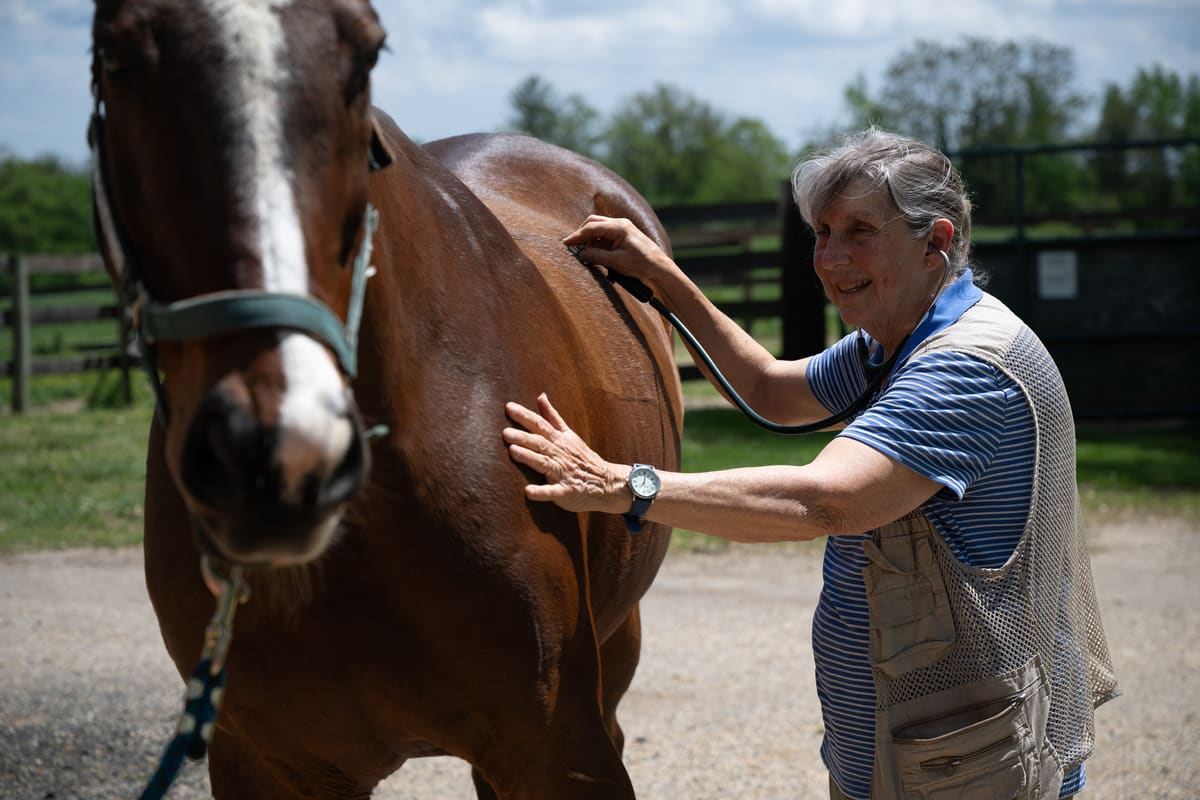
Colic means abdominal pain, and in horses it is always a case for the vet. Call as soon as your horse paws, looks round at its belly, rolls, or eats less and passes fewer droppings. Until the vet arrives, take away all feed, leave the water, check pulse, breathing and temperature, and give no medication unless the vet explicitly tells you to.
What lies behind colic
Colic is not a disease in itself. The word covers any pain in the abdomen, usually from the gut, sometimes from the liver or kidneys. That is how the University of Florida's owner guide describes it. Most cases of colic are mild. Even so, according to the British Horse Society, colic is the most common emergency and the most common cause of death in horses worldwide.
The tricky part: a harmless impaction and a twisted gut often start in a similar way. According to the Merck Veterinary Manual, the signs do not show which part of the gut is affected. Only an examination can tell whether surgery is needed.
Signs: from mild to severe
Some horses become dangerous when they are in pain, others show only small changes, says the British Horse Society. So get to know your horse well while it is healthy.
Mild and early signs
- It eats less or nothing at all.
- It passes fewer droppings, or they look different.
- It curls its upper lip (flehmen).
- It seems dull, holds its head low and lies down more than usual.
Clear signs
- It paws, looks round at its flank or kicks at its belly.
- It lies down, gets up again and rolls.
- It box-walks or circles, or sweats for no obvious reason.
- It stretches out as if to urinate.
- It grinds its teeth, or its belly looks bloated.
Serious warning signs
According to the University of Florida, pain that does not ease is the most important sign that surgery may be needed. According to Merck, horses with no gut sounds, distended intestines or red mucous membranes tend to do worse. Pale or bluish membranes point to a lack of oxygen, grey ones to poor blood flow. Mild signs that last for several days also need to be checked by a vet.
Until the vet arrives: what to do
- Call the vet straight away. The British Horse Society advises sending your location at the same time, for example as a map pin.
- Take away all feed. Leave the water.
- Wear a hat and gloves. Keep the horse on a lunge line in a safe area, or put it in a stable without buckets or other objects it could injure itself on.
- Walk it only if it is willing, and never force it. If it lies quietly, let it lie. According to the British Horse Society, lying down and rolling do not make colic worse.
- Check pulse, breathing and temperature, look at the gums and write everything down with the time.
What not to do
- No medication on your own initiative. Several diseases can cause colic-like signs, says Penn State University. Give pain relief only if the vet explicitly tells you to.
- Do not give oil, do not pass a tube and do not give an enema. Oil in the lungs can cause fatal pneumonia.
- Do not walk your horse or yourself to exhaustion.
- Do not feed anything, not even treats, until the vet allows it.
What the vet needs to know on the phone
The University of Florida gives these normal values for adult horses:
| Value | Normal in an adult horse |
|---|---|
| Pulse | 24 to 48 beats per minute |
| Breathing | 10 to 24 breaths per minute |
| Temperature (rectal) | about 37.2 to 38.6 °C |
| Mucous membranes (gums) | pink and moist |
| Capillary refill time | under 2 seconds |
| Droppings | usually 6 to 10 well-formed piles in 24 hours |
Capillary refill time is how long it takes for a spot on the gum pressed white with a finger to turn pink again. The values vary a little from horse to horse, so measure them on healthy days too.
Also have this ready:
- since when the horse has shown which signs
- when it last passed droppings and what they looked like
- whether it is eating and drinking
- what it is fed and whether anything has recently changed in feed, management or exercise
- previous colic, operations and other illnesses
Common causes
According to the University of Florida, the most common causes are problems with gut function: gas stretching the gut, spasms in the gut wall and impactions. Less often the gut moves out of place, twists or becomes trapped. This cannot be specifically prevented and often needs surgery. Inflammation and ulcers, for example in the stomach, can also cause colic.
The risk of impaction rises if a horse drinks too little, eats poor-quality hay, takes in a lot of sand or chews badly because of dental problems. The British Horse Society also names older age, recent changes in diet or management, and previous colic. According to Penn State, stabled horses are more likely to colic than horses kept at pasture.
Prevention: feeding, water, routine
Colic cannot be prevented completely, but you can lower the risk:
- Fresh, clean water must always be available.
- Forage is the basis, ideally around the clock and of good quality.
- Split concentrate feed into two or three meals. Penn State gives an upper limit of 0.5 per cent of body weight per meal, so 2.5 kg for a 500 kg horse.
- Change feed over 10 to 14 days so that the microbes in the hindgut can adjust.
- A fixed routine, exercise and plenty of turnout help.
- Have the teeth checked once a year, every six months in older horses.
- Have faecal samples tested and deworm according to a plan with your vet, including against tapeworms.
Colic in the history: what it means for buying and insurance
Past colic does not have to rule out a purchase, but you should know about it. According to the British Horse Society, horses that have had colic are at higher risk, especially after colic surgery.
During the operation, the abdomen is opened under general anaesthesia, displaced gut is moved back and damaged gut is removed. The horse then stays in the clinic until the stitches are out and needs around three months of rest, writes the equine clinic of Freie Universität Berlin. According to the University of Florida, most horses then return to their previous level of performance. Merck puts the survival rate after colic surgery at 50 to more than 80 per cent.
Before buying, ask the seller directly about colic and operations. In the pre-purchase examination form of the Burg Müggenhausen equine clinic, for example, the seller declares previous illnesses and operations in writing, and the vet notes any conspicuous scars. After colic surgery, ask to see the clinic report and discuss it with the vet doing the pre-purchase examination.
According to the German consumer advice centre Verbraucherzentrale, pet health insurers generally only insure healthy animals and sometimes ask for a veterinary report if there are pre-existing conditions. For illnesses there is usually a waiting period of three months from the start of the policy. So before buying, check with the insurer whether it will cover a horse after colic surgery and whether colic is excluded.
Common questions
Is it all right for a horse with colic to roll?
According to the British Horse Society, lying down and rolling do not make colic worse. Remove buckets and other objects the horse could injure itself on, and do not put yourself in danger. Either way, call the vet straight away.
Can I give my horse a painkiller for colic?
Only if your vet explicitly tells you to. Several diseases can cause colic-like signs, and whenever possible the vet examines the horse before it is given any medication.
What values are normal in an adult horse?
According to the University of Florida, an adult horse has a pulse of 24 to 48 beats and 10 to 24 breaths per minute, and a temperature of about 37.2 to 38.6 °C. The gums are pink and moist. Measure the values on healthy days too, because they vary a little from horse to horse.
Can I buy a horse that has had colic surgery?
Yes, most horses return to their previous level of performance after about three months of rest. The risk of further colic is higher, though. Ask to see the clinic report, discuss it with the vet doing the pre-purchase examination and check beforehand whether an insurer will cover the horse.
Sources
- A Horse Owner's Guide to Colic, Amanda M. House (University of Florida College of Veterinary Medicine)
- Colic in Horses, James N. Moore (Merck Veterinary Manual)
- Colic in horses (The British Horse Society) (16.07.2026)
- Colic: What are the Signs and How to Manage? (Penn State Extension) (25.04.2024)
- Erkrankungen des Magen-Darm-Traktes (Pferdeklinik, Fachbereich Veterinärmedizin der Freien Universität Berlin)
- Protokoll über eine Kaufuntersuchung beim Pferd (Pferdeklinik Burg Müggenhausen)
- Krankenversicherungen für Haustiere: sinnvoll oder überflüssig? (Verbraucherzentrale) (22.01.2025)
- Titelfoto: USDA (Christophe Paul), Wikimedia Commons
- Lizenz des Fotos: gemeinfrei (Werk der US-Bundesbehörde USDA)

Written by Equidara editorial team. Last checked: 30 September 2026.
- Equine asthma: how to recognise it and what helps in the stable — If your horse has been coughing for weeks, equine asthma is often the cause, once known as heaves or COPD. How the mild form differs from the severe one, what helps against hay dust and what it means when buying.
- Laminitis in horses: causes, warning signs and what to do straight away — Laminitis is an emergency. We explain what happens inside the hoof, which horses are at risk, how to recognise an episode, how to prevent it and what a past bout of laminitis means when you buy.
- What is my horse worth? How to arrive at a justifiable price — A horse's value isn't determined by what you've invested. It's shaped by training, health, character, documentation, and demand. Learn how to evaluate these points individually, back them up with comparable listings, and create a price range that buyers will take seriously.
- Buying a Horse Abroad: Essential Questions to Ask Before Your Deposit — Within the EU, the paperwork is straightforward: an equine passport, health certificate, and TRACES. But the questions you ask *before* that are far more critical. Clarifying who is selling you the horse, which legal jurisdiction applies, who arranges the pre-purchase exam, and the payment schedule will determine your legal standing should a dispute arise.
Related
- Services and jobs — Farrier, vet, training, horse share.
- Saddles and accessories — For the horse: saddles, rugs, bridles, hoof protection.