
Health & Therapies
Equine asthma: how to recognise it and what helps in the stable
If your horse has been coughing for weeks, equine asthma is often the cause, once known as heaves or COPD. How the mild form differs from the severe one, what helps against hay dust and what it means when buying.
Equidara editorial team · 21 September 2026 · 6 min read
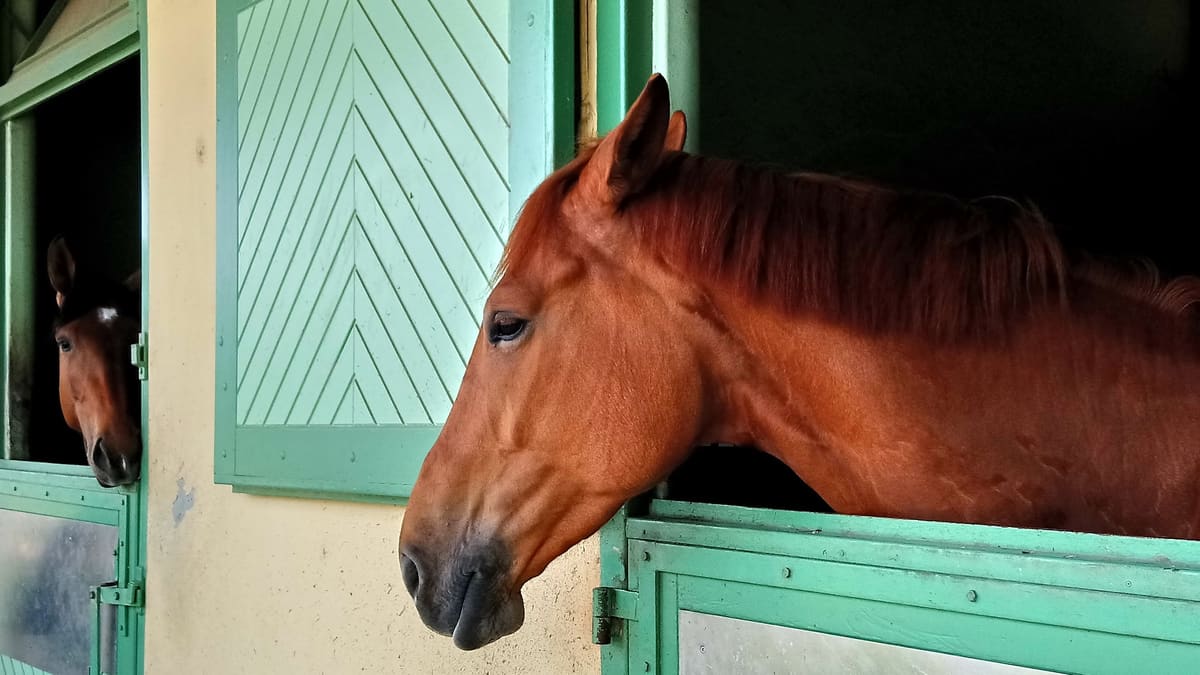
Equine asthma is a chronic inflammation of the lower airways, triggered mainly by dust and mould spores from hay and bedding. Typical signs are coughing, nasal discharge and a drop in performance. The severe form used to be called heaves, recurrent airway obstruction (RAO) or COPD, the mild form inflammatory airway disease (IAD). The severe form lasts for life, but it can usually be kept well under control: with less dust, more fresh air and a treatment plan set by your vet.
Mild to moderate or severe
Since the 2016 consensus statement of the American College of Veterinary Internal Medicine (ACVIM), both forms have been grouped under the name equine asthma.
With mild to moderate asthma, the horse has been coughing occasionally for more than three weeks or performs less well. At rest it breathes normally, and this is how the consensus statement tells it apart from the severe form. Horses of any age can be affected, young horses more often. According to the Merck Veterinary Manual, up to 80 percent of pleasure horses and racehorses are affected at some point in their lives. Most of them recover.
With severe asthma, the horse struggles to breathe even at rest and coughs often. It mainly affects horses over seven years of age. According to the University Animal Hospital Zurich, a complete cure is not possible, but with lifelong changes to housing and feeding and with medication the disease can usually be controlled well. The hospital also warns that, without treatment, the mild form can progress to the severe one.
How to recognise equine asthma
The most common signs are:
- a cough that keeps coming back over weeks
- nasal discharge
- a drop in performance, especially during hard work
According to a fact sheet from the University of Florida, young horses sometimes cough only when working and look completely healthy at rest.
With severe asthma, laboured breathing at rest, flared nostrils and the heave line are added. The heave line is a ridge of muscle along the edge of the ribs. It develops because the abdominal muscles have to help with breathing out and become stronger in the process. Horses that have been ill for a long time or are poorly controlled are often thin.
Fever is not normally part of the picture. If your horse has a fever, is dull or is eating poorly, an infection is more likely.
If your horse is breathing hard at rest, flaring its nostrils and pumping with its belly, call your vet straight away. Even with a mild cough that does not go away, the Zurich animal hospital advises calling in a vet early.
Causes: hay, bedding and stable air
In affected horses, the airways are hypersensitive to fine dust. The bronchi produce more mucus, and the muscles around the airways contract. The dust contains moulds, endotoxins and other very fine particles.
According to the consensus statement, the most important source is feed, above all hay. Feeding dry hay increases the risk of inflammation in the lungs. Straw and dust in closed stables add to this. According to the University of Florida, hay from round bales is particularly dusty.
The summer pasture form
A subtype of severe asthma affects horses at pasture, in hot, humid climates and mainly in summer. According to Merck, it is best known from the southeastern United States and has also been described in the UK. Grass pollen or fungal spores are suspected as triggers. These horses are better off in a dust-free stable and should only go out on mowed pasture during the cooler times of day.
How your vet makes the diagnosis
In the severe form, the history and clinical examination are often enough. In the mild form there is little to see from the outside, so further tests are needed.
With an endoscope, the vet can see how much mucus lies in the windpipe. In a bronchoalveolar lavage (BAL), the vet flushes saline into the deep airways, draws it back out and has the inflammatory cells counted. Merck calls BAL the test of choice. According to the consensus statement, a sample from the windpipe is not an adequate substitute. The equine clinic at Freie Universität Berlin also writes that BAL often gives better results in cases that are hard to diagnose.
What helps in everyday life
Your horse should breathe in as little dust as possible. According to the University of Florida, many horses with the mild to moderate form can be managed with changes to housing and feeding alone.
- Keep your horse outside as much as possible. For stable-associated asthma, the University of Florida recommends keeping the horse on pasture full time.
- Soak or steam the hay. According to the consensus statement, soaking reduces exposure to respirable dust by about 60 percent. For very sensitive horses this is often not enough, Merck writes. Hay cubes, pellets, haylage or a complete pelleted feed are then options.
- Feed hay from the ground and not from round bales. According to the consensus statement, feeding from a hay net puts more than four times as much dust into the breathing zone as feeding the same hay from the ground.
- Use low-dust bedding. Switching from straw to cardboard halves respirable dust, according to the consensus statement. Shavings are another option.
- Let the air in. Open stable doors and a more open stable design improve ventilation in every season.
- Take your horse outside while the stable is being mucked out or swept. Hay should not be stored above the stables.
Treatment is decided by your vet. Usually these changes are combined with medication: corticosteroids against the inflammation and drugs that open the airways, either inhaled or given systemically. According to Merck, bronchodilators on their own are not an appropriate treatment.
What equine asthma means when buying a horse
A horse with asthma is not automatically unsuitable. According to the University of Florida, many are good pleasure, trail or even competition horses if the owner is prepared for lifelong care. The Zurich animal hospital also writes, however, that the more severe the symptoms already are, the poorer the outlook, especially for sport.
Asthma can be missed at a viewing. When the disease is well controlled, the signs can be very subtle, according to Merck. Here is what to look out for:
- Ask about coughing, nasal discharge and medication in recent months. If the hay is soaked or the horse is bedded on shavings instead of straw, ask why.
- Watch the horse being worked and listen for coughing. The pre-purchase examination at the University of Veterinary Medicine Vienna includes an exercise test on the lunge. The University of Cambridge veterinary hospital explains that some respiratory problems only become obvious during strenuous work.
- If you have a suspicion, arrange an endoscopy of the airways with lavage samples. Vetmeduni Vienna offers this as an extension of the pre-purchase examination.
- Have a blood sample taken. Vetmeduni Vienna tests it for doping-relevant substances on request. In Cambridge, the sample is stored and tested for drugs if questions arise after the sale.
A pre-purchase examination is a snapshot, as Vetmeduni Vienna points out, and not a reliable prognosis.
If you are buying a foal or a broodmare, ask about the parents. Equine asthma has a hereditary component: according to the University of Florida, about 10 percent of horses with healthy parents develop it, and 44 percent if both parents are affected.
Common questions
Can equine asthma be cured?
The severe form cannot be cured, but it can usually be controlled well with low-dust management and medication. Most horses with the mild to moderate form recover. Call your vet early, because without treatment the mild form can progress to the severe one.
How do I tell mild from severe asthma?
With mild to moderate asthma, the horse coughs occasionally or performs less well but breathes normally at rest. With severe asthma, it struggles to breathe even at rest, often with flared nostrils and a heave line.
Does soaking the hay help?
Yes. According to the ACVIM consensus statement, soaking reduces exposure to respirable dust by about 60 percent, and steaming also clearly reduces dust. For very sensitive horses this is often not enough; hay cubes, pellets or haylage are then options.
Can I buy a horse with asthma?
Yes, many horses with asthma are good pleasure or even competition horses if you are prepared for lifelong care. Ask about coughing and medication, have the horse examined under exercise during the pre-purchase examination and, if in doubt, arrange an endoscopy with lavage samples.
Sources
- Inflammatory Airway Disease of Horses – Revised Consensus Statement, Couëtil et al. (ACVIM, Journal of Veterinary Internal Medicine) (24.01.2016)
- Asthma in Horses, Kara M. Lascola (Merck Veterinary Manual)
- Equines Asthma (RAO, COPD) (Universitäres Tierspital Zürich)
- Erkrankungen der oberen und tiefen Atemwege (Pferdeklinik, Freie Universität Berlin)
- Understanding Equine Asthma (Heaves), VM142, Sally DeNotta und Amanda M. House (University of Florida IFAS Extension)
- Ankaufsuntersuchung (Klinik für Pferde, Veterinärmedizinische Universität Wien)
- Pre-purchase exam (The Queen's Veterinary School Hospital, University of Cambridge)
- Titelfoto: Philippe Alès, Wikimedia Commons
- Lizenz des Fotos: Creative Commons CC BY-SA 4.0

Written by Equidara editorial team. Last checked: 30 September 2026.
- Laminitis in horses: causes, warning signs and what to do straight away — Laminitis is an emergency. We explain what happens inside the hoof, which horses are at risk, how to recognise an episode, how to prevent it and what a past bout of laminitis means when you buy.
- Colic in horses: how to spot the signs and what to do until the vet arrives — Colic is the most common emergency in horses. How to recognise it, what to do and avoid until the vet arrives, which values the vet needs on the phone and what past colic surgery means when buying.
- What is my horse worth? How to arrive at a justifiable price — A horse's value isn't determined by what you've invested. It's shaped by training, health, character, documentation, and demand. Learn how to evaluate these points individually, back them up with comparable listings, and create a price range that buyers will take seriously.
- Buying a Horse Abroad: Essential Questions to Ask Before Your Deposit — Within the EU, the paperwork is straightforward: an equine passport, health certificate, and TRACES. But the questions you ask *before* that are far more critical. Clarifying who is selling you the horse, which legal jurisdiction applies, who arranges the pre-purchase exam, and the payment schedule will determine your legal standing should a dispute arise.
Related
- Services and jobs — Farrier, vet, training, horse share.
- Saddles and accessories — For the horse: saddles, rugs, bridles, hoof protection.