
Health & Therapies
Laminitis in horses: causes, warning signs and what to do straight away
Laminitis is an emergency. We explain what happens inside the hoof, which horses are at risk, how to recognise an episode, how to prevent it and what a past bout of laminitis means when you buy.
Equidara editorial team · 21 September 2026 · 6 min read
Laminitis is inflammation of the sensitive tissue inside the hoof, which can cause the coffin bone to come loose from its attachment in the hoof capsule. Today the most common triggers are metabolic and hormonal disorders such as equine metabolic syndrome, often combined with too much sugar from grass or concentrate feed. If your horse stands stiffly, won't pick up its feet and its hooves feel warm, call the vet at once. Until the vet arrives, keep the horse on soft ground and don't move it.
What happens inside the hoof
The coffin bone hangs inside the hoof capsule from fine laminae that interlock like the teeth of two combs. Laminitis damages these laminae, as the Merck Veterinary Manual describes. The University of Zurich animal hospital calls it an aseptic inflammation of the sensitive laminae, meaning no germs are involved.
Once the attachment fails, the coffin bone can tip because the deep digital flexor tendon pulls on it. Vets call this rotation. The coffin bone can also sink and, in severe cases, push through the sole. The front feet are affected most often.
According to the Zurich animal hospital, the horse at first looks almost normal after the trigger, even though damage is already building up in the hoof. This phase lasts a few hours, or several days when the laminitis follows a systemic illness.
The most common triggers
Hormones and metabolism: EMS and PPID
According to the Merck Veterinary Manual, hormonal causes are now the most common, above all equine metabolic syndrome (EMS). At its core is insulin dysregulation: the horse has too much insulin in its blood, or its body responds poorly to it. Typical signs are obesity, a cresty neck and fat pads around the tailhead, but lean horses can have EMS too. Ponies are affected particularly often.
The second hormonal disease is PPID, formerly known as equine Cushing's disease. It is caused by a benign tumour in the pituitary gland and mostly affects horses aged 18 and over. Look out for a long coat that is no longer shed, along with muscle loss and heavy sweating. If a horse with PPID also has insulin dysregulation, its laminitis risk is high.
Feed, pasture and fructan
Sugars, starch and fructans are together called non-structural carbohydrates, or NSC. If a horse eats too much of them, whether from concentrate feed or grass, the excess ferments too quickly in the hindgut. That can trigger laminitis. A guide from Oregon State University states that in the USA, 46 percent of reported laminitis cases are caused by eating too much lush, fast-growing pasture. Grass stressed by cold or drought can be especially high in NSC.
Supporting limb and concussion laminitis
Overload from unsuitable training or hard ground can also cause laminitis (Zurich animal hospital). If a horse spares an injured leg for a long time, the healthy leg that carries all the weight can develop laminitis.
Poisoning, foaling, colic and medication
Other triggers include poisoning, a retained placenta, colic and certain medicines (Zurich animal hospital). The Merck Veterinary Manual names corticosteroids, especially in susceptible horses, and, as the classic poisoning, bedding made from black walnut shavings.
How to recognise laminitis
- Sawhorse stance: the horse stretches its front legs far forward and shifts its weight onto the hindquarters to take pressure off the toes.
- Short, stiff steps. Many horses don't want to pick up their feet and are in obvious pain when turning.
- A bounding pulse in the digital arteries, easy to feel at the fetlock.
- Warm hooves, especially at the coronary band.
- The horse seems dull and eats less.
Check the pulse at your horse's fetlock regularly while it is healthy. That way you will notice sooner when it starts bounding.
What to do straight away
The Zurich animal hospital calls laminitis an absolute emergency.
- Call the vet immediately, even at night or at the weekend.
- Don't move the horse. No leading, no lungeing, no turnout in the paddock.
- Put it in a stable with deep, soft bedding.
- Take away the concentrate feed. Agree with the vet how much hay it should get.
- Ask on the phone whether you should start cooling the hooves. According to Merck, cooling with ice is currently the most effective treatment for reducing damage to the laminae.
The vet treats the underlying disease and the pain, supports the frog and sole and X-rays the feet. According to the Zurich animal hospital, the symptoms should ease within 2 to 14 days, and about 10 percent of patients develop complications.
Prevention: weight, pasture, hay
The Zurich animal hospital advises regular weight checks, and Oregon State University recommends a body condition score of 4 to 6. In a British study of just over 1,000 horses and ponies (Pollard et al., 2019), animals that had gained weight developed laminitis more often.
For grazing, Oregon State University advises:
- Increase turnout slowly: start with 15 minutes, then add 15 minutes every three to five days.
- Feed low-NSC hay first, never turn out a hungry horse.
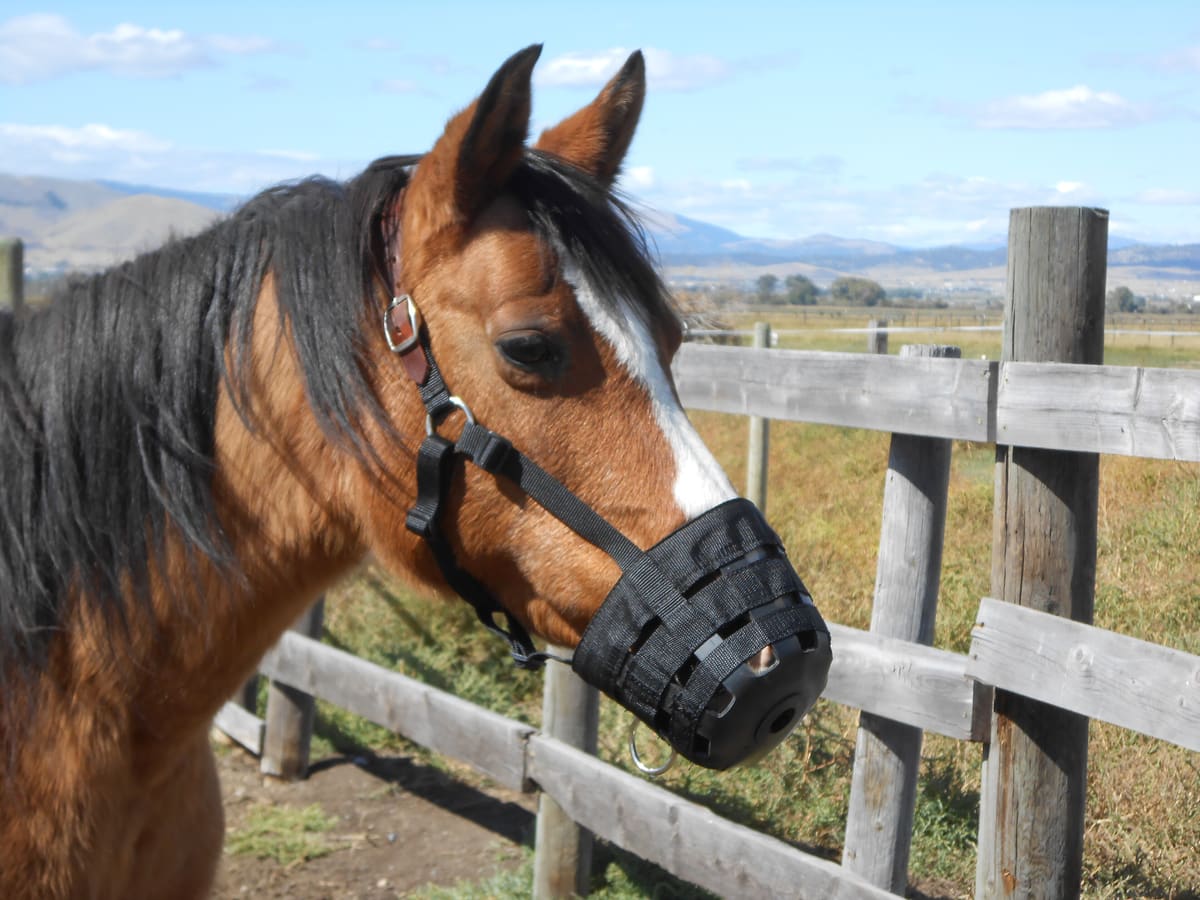
- Overweight horses and ponies may need a grazing muzzle every time they are turned out.
- Graze between 3 and 10 a.m., when NSC levels are lowest.
- Keep horses off pasture for several weeks after the first autumn frost.
According to Merck, horses with EMS almost always need severe grazing restriction.
For hay, Oregon State University considers an NSC content below 10 percent safe; a hay analysis gives you the figure. Soaking helps: 60 minutes in lukewarm water removes 30 to 35 percent of the soluble sugar. Then drain off the water and rinse the hay.
According to Merck, exercise improves insulin sensitivity, but in a horse with EMS only once the laminitis has resolved. The British study also found more laminitis cases when more than eight weeks passed between farrier visits.
Previous laminitis when buying a horse
A horse that has had laminitis before is more likely to get it again. The authors of the British study see consistent evidence for three risk factors: a previous episode of laminitis, weight gain and soreness after trimming or shoeing. So ask the seller directly about past episodes, blood tests and remedial shoeing.
Take a close look at the hooves as well. In chronic laminitis the horn grows more slowly at the toe, and the growth rings in the hoof wall converge towards the toe. Other signs are a widened white line and a flat or convex sole (Merck).
For the pre-purchase exam, the radiography guideline of the German Society for Equine Medicine (GPM) from 2018 includes a lateral view and an oblique view from the front for the front feet, and recommends removing the shoes for them. If the hoof wall and coffin bone diverge by more than 3 degrees, the guideline lists this as rotation. From 5 degrees the finding is marked “risk”, meaning it is considered to carry a risk of lameness.
The guideline only applies to sound, warmblood-type riding horses aged three and over, and according to the GPM the clinical examination remains the most important basis. If you see signs of EMS or PPID, such as a cresty neck or, in an older horse, a long coat, talk to the vet about adding a blood test. For EMS the vet measures insulin, for PPID the hormone ACTH.
Common questions
Is laminitis an emergency?
Yes. Call the vet at once, put the horse on deep, soft bedding and don't move it. Take away the concentrate feed and ask on the phone whether you should start cooling the hooves.
Which horses are most likely to get laminitis?
Overweight horses and ponies, horses with equine metabolic syndrome and older horses with PPID are most at risk. A horse that has had laminitis before is also more likely to get it again.
Does soaking hay help?
Yes, soaking lowers the sugar in hay. According to Oregon State University, 60 minutes in lukewarm water removes 30 to 35 percent of the soluble sugar. Hay with an NSC content below 10 percent, as shown by an analysis, is considered safe.
Can I buy a horse that has had laminitis?
It depends on the individual horse, but the risk of another episode is higher. Have the feet X-rayed during the pre-purchase exam, ask about the history, blood tests and shoeing, and discuss the findings with your vet.
Sources
- Hufrehe (Universitäres Tierspital Zürich, Pferdekliniken)
- Laminitis in Horses (Merck Veterinary Manual, Brian Beasley, Stand Juni 2024)
- Equine Metabolic Syndrome (Merck Veterinary Manual, François-René Bertin und Ashley G. Boyle, Stand August 2025)
- Hypertrichosis Associated With Adenomas of the Pars Intermedia in Horses, PPID (Merck Veterinary Manual, Janice E. Kritchevsky und Joyce Carnevale, Stand Mai 2025)
- A horse owner's guide to pasture-associated laminitis, EM 9354 (Oregon State University Extension Service, Scott Duggan und Troy Downing, Juni 2022)
- Identification of modifiable factors associated with owner-reported equine laminitis in Britain using a web-based cohort study approach (Pollard, Wylie, Verheyen, Newton; BMC Veterinary Research) (12.02.2019)
- Röntgen-Leitfaden (2018): Leitfaden für die röntgenologische Beurteilung bei der Kaufuntersuchung des Pferdes (Gesellschaft für Pferdemedizin, gültig ab 1.1.2018)
- Titelfoto: Montanabw, Wikimedia Commons
- Lizenz des Fotos: Creative Commons CC BY-SA 4.0

Written by Equidara editorial team. Last checked: 30 September 2026.
- PPID in the Senior Horse: Recognizing Signs, the ACTH Test, and Daily Care — PPID (Equine Cushing's Disease) primarily affects horses over 15 years old. Learn how to recognize the signs, how your vet uses the ACTH test for diagnosis, and what you can do in daily life to help.
- Equine asthma: how to recognise it and what helps in the stable — If your horse has been coughing for weeks, equine asthma is often the cause, once known as heaves or COPD. How the mild form differs from the severe one, what helps against hay dust and what it means when buying.
- Colic in horses: how to spot the signs and what to do until the vet arrives — Colic is the most common emergency in horses. How to recognise it, what to do and avoid until the vet arrives, which values the vet needs on the phone and what past colic surgery means when buying.
- What is my horse worth? How to arrive at a justifiable price — A horse's value isn't determined by what you've invested. It's shaped by training, health, character, documentation, and demand. Learn how to evaluate these points individually, back them up with comparable listings, and create a price range that buyers will take seriously.
Related
- Services and jobs — Farrier, vet, training, horse share.
- Saddles and accessories — For the horse: saddles, rugs, bridles, hoof protection.