
Forgotten remedies
Equine Mites: A Look at Sulfur Powder, Washes, and Lime Sulfur
Flowers of sulfur, daily washing, lime sulfur: Many stables still rely on old remedies for mites on horses' legs. Learn how these traditional methods are used and what modern veterinary medicine offers today.
Equidara editorial team · 4 October 2026 · 4 min read
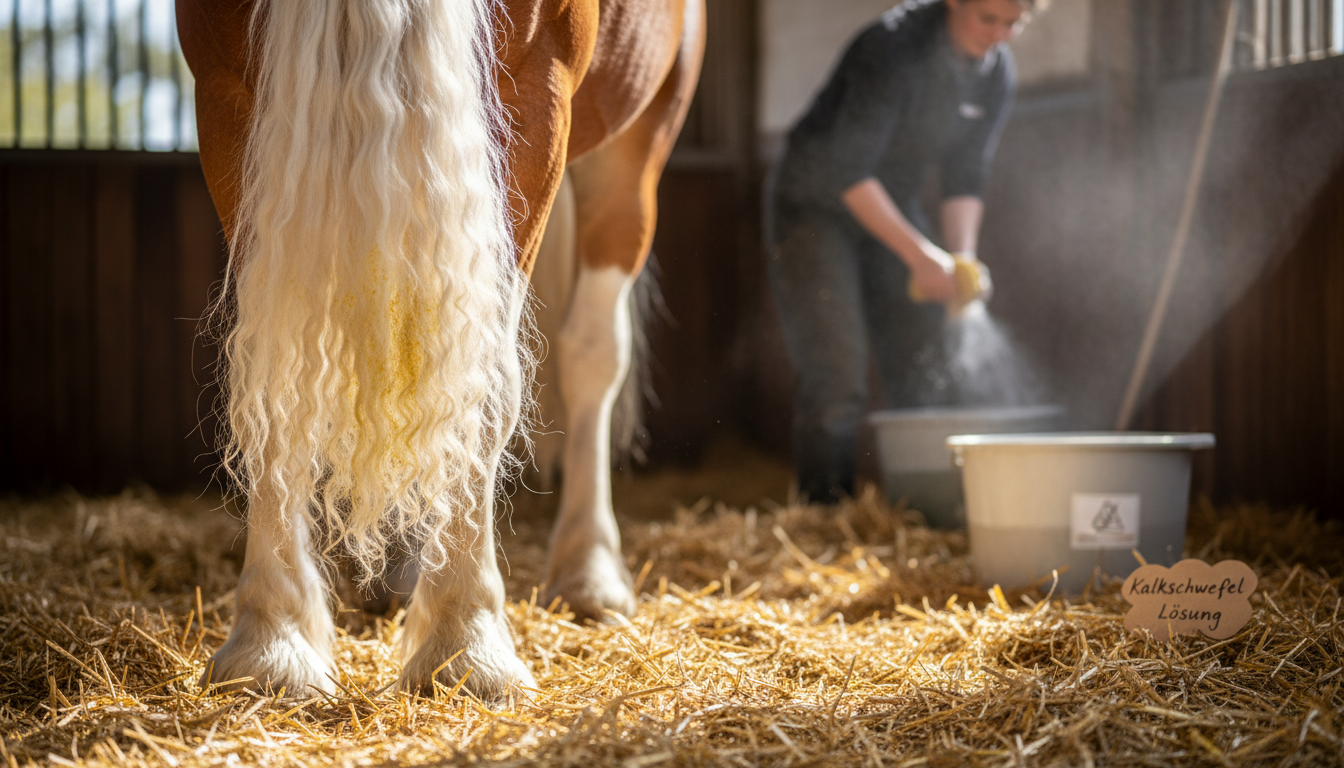
Old stable remedies for mites on horses' legs rely on flowers of sulfur, daily washing, and lime sulfur. Topical washes with approved antiparasitics like permethrin or selenium disulfide are now standard veterinary practice. Flowers of sulfur has a long tradition against mites, biting lice, and sucking lice. According to the editorial team, lime sulfur is approved for horses in the MSD Veterinary Manual, but it is not listed as a veterinary medicinal product in the Zurich overview for Chorioptes bovis.
Examining Old Stable Wisdom
A common stable wisdom combines flowers of sulfur, a lice and flea treatment, and daily washing. The idea behind it: the sulfur is supposed to exfoliate the skin and harm mites, the insecticide kills the parasites, and washing removes crusts. Today, these three components can be evaluated differently.
Flowers of sulfur is finely ground, purified sulfur. Historically, sulfur was used as a keratolytic, antimicrobial, and antiparasitic agent. In veterinary medicine, it was considered a remedy for mites, biting lice, and sucking lice. A product data sheet suggests a small amount per day internally for large animals over ten to fourteen days. Externally, flowers of sulfur is mixed with olive oil in a 1:2 ratio and applied two to three times daily to affected skin areas. These quantities come from a manufacturer's data sheet. Discuss internal administration with your veterinarian.
Lice and flea treatments from the small animal sector are often not approved for horses. The University of Zurich lists approved active ingredients against Chorioptes in horses: Cypermethrin, Deltamethrin, Flumethrin, and Permethrin as a spray or wash treatment, as well as Fipronil, Phoxim, and Selenium Disulfide. These agents are prescription-only. They do not replace old small animal remedies from the stable's medicine cabinet.
Daily washing alone removes crusts but does not kill mites. Washing is useful as preparation: For crusted areas, soften the skin with lukewarm water and mild soap, gently remove the crusts, and then treat the exposed skin.
What is Chorioptic Mange?
Chorioptes mites primarily infest the pastern and feathering of horses. Typical signs include intense rubbing, stomping, and crusts on the legs. Mud fever (Mauke), however, is a bacterial skin inflammation that usually causes weeping, foul-smelling areas in the pastern without severe itching. Often, both conditions occur together. Your veterinarian differentiates them with a skin scraping and, if necessary, a bacterial culture. Without this diagnosis, it's not clear what you are treating.
What Veterinarians Use Today
The most effective therapy combines a systemic dewormer with a topical treatment and simultaneous stable hygiene. As a systemic active ingredient, ivermectin is used orally as a paste, which is effective against Sarcoptes, Psoroptes, and, at higher doses, also against Chorioptes. For pure Chorioptic mange, doramectin is often used as an injection because it is believed to penetrate the skin surface better. Both active ingredients are prescription-only. Treatment is usually repeated after two weeks to target freshly hatched larvae.
Topical washes with approved antiparasitics are used externally. Selenium-sulfur shampoos, permethrin-containing solutions, or fipronil sprays act as contact poisons on the mites. It is important to trim or completely clip the long feathering hair on the fetlocks beforehand, as the active ingredients will otherwise not reach the skin. Plan for five to seven applications at intervals of four to seven days. Secondary infections often require additional antibiotics or a local antifungal agent.
The University of Zurich also recommends treating contact animals and decontaminating the environment: cleaning stable floors, grooming tools, and tack with an acaricide or heat treating them. Mites can survive off the host for about ten to twelve weeks.
What About Lime Sulfur?
Lime sulfur, also known as sulfurated lime solution, is an old acaricide and fungicide. It contains calcium polysulfide and has been used in agriculture since the 19th century, occasionally also in veterinary medicine. Its effect is based on the toxic properties of sulfur and the strong alkalinity of polysulfides. In the EU, lime sulfur is approved as a plant protection active ingredient in some countries, but not consistently. For horses, the editorial team refers to the MSD Veterinary Manual: there, lime sulfur is approved for horses. The University of Zurich does not list lime sulfur in its overview against Chorioptes bovis in horses. If you intend to use lime sulfur on your horse, discuss it with your veterinarian and clarify the approval for the specific product.
Where the Limits Lie
Flowers of sulfur can irritate the skin if applied in too high a concentration or too often. Tea tree oil in higher concentrations is a skin irritant and can worsen symptoms. Lime sulfur has a pH of 10 and releases hydrogen sulfide. This can irritate the skin and respiratory tract. For competitive sports: Check your federation's current doping list to see if a product is permitted. Call the veterinarian immediately if the horse rubs itself raw, develops large bald patches, shows a fever, or if several horses in the stable are affected. Untreated mite infestation can become chronic and lead to secondary infections.
Common questions
How do I recognize Chorioptic mange in horses?
Typical signs include severe itching, stomping, rubbing at the fetlocks, and crusts. Mud fever, on the other hand, shows weeping, foul-smelling areas without severe itching. Often both occur together. Only your veterinarian can definitively differentiate them with a skin scraping and, if necessary, a bacterial culture.
Can I administer flowers of sulfur internally?
A manufacturer's data sheet suggests a small amount per day for large animals over ten to fourteen days. Discuss internal administration with your veterinarian beforehand.
Does flowers of sulfur also help against mud fever?
Sulfur acts as a keratolytic, antimicrobial, and antiparasitic agent. However, mud fever is a bacterial skin inflammation, while mites are a parasitic infestation. The two require different treatments. Your veterinarian will differentiate them.
When should the veterinarian be called?
Immediately, if the horse rubs itself raw, develops large bald patches, shows a fever, or if several horses in the stable are affected. Untreated mite infestation can become chronic and lead to secondary infections.
Sources
- AntiparasiticScout: Pferd, Pony - Chorioptes bovis (29. September 2026)
- Milben beim Pferd: Erkennen, Behandeln, Vorbeugen (29. September 2026)
- Backs Schwefelblüte 600 g (29. September 2026)
- Schwefelkalk (29. September 2026)
- Schwefel (August) (29. September 2026)
- 1738
Written by Equidara editorial team. Last checked: 6 October 2026.
- Flowers of sulfur for horses: the body's clean-up crew — Part 1 of the “Forgotten remedies” series: what flowers of sulfur is, how it is used internally and externally, what amount has worked in my practice and which parts are scientifically proven.
- Linseed and Linseed Mash for Horses: How to Properly Prepare This Traditional Home Remedy — Linseed mash is a time-honored home remedy for digestion and skin health. Here, you'll find preparation instructions from the University of Zurich, the daily dosage for your horse, and important considerations.
Related
- Services and jobs — Farrier, vet, training, horse share.
- Saddles and accessories — For the horse: saddles, rugs, bridles, hoof protection.