
Forgotten remedies
Flowers of sulfur for horses: the body's clean-up crew
Part 1 of the “Forgotten remedies” series: what flowers of sulfur is, how it is used internally and externally, what amount has worked in my practice and which parts are scientifically proven.
Melissa Hinze · 30 September 2026 · 5 min read
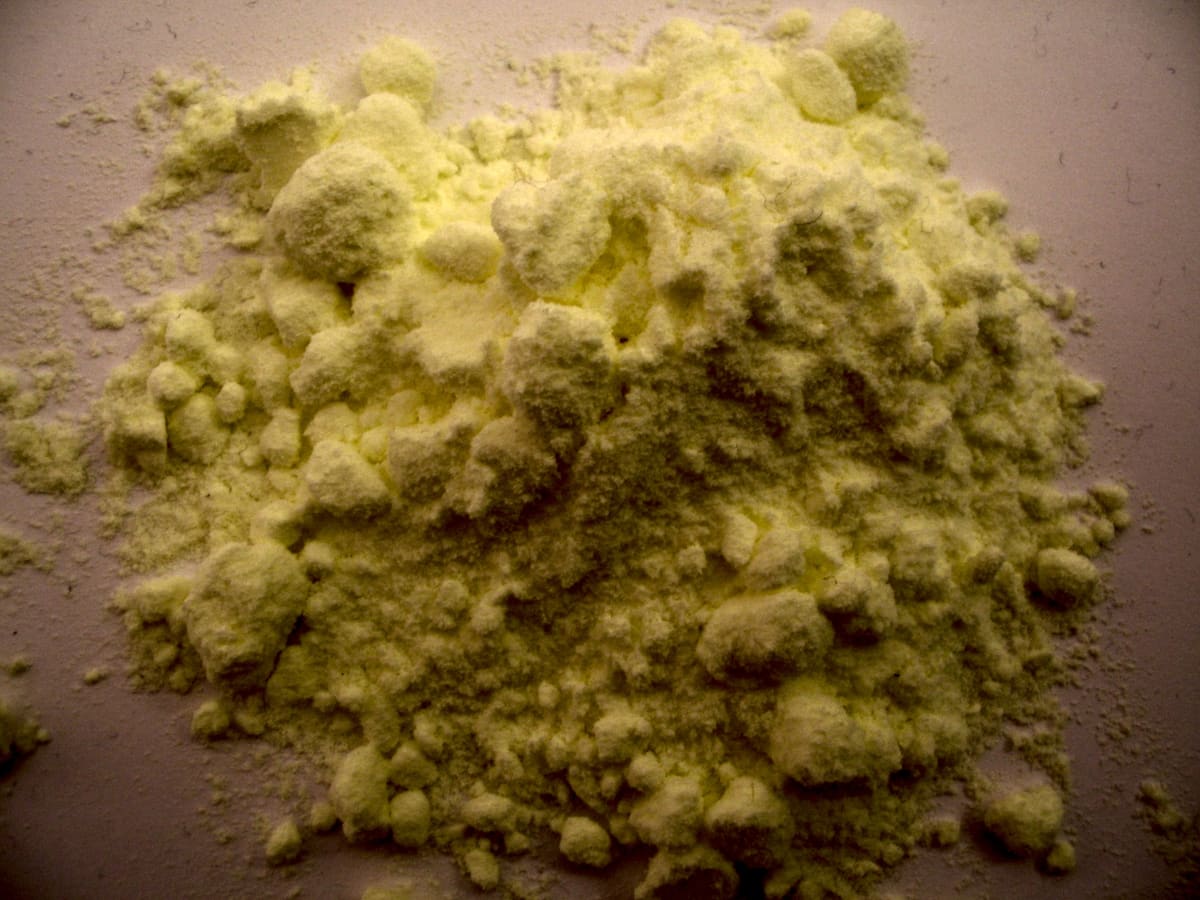
Flowers of sulfur is pure sulfur in the form of a fine yellow powder. Sulfur is one of the seven macrominerals a horse needs from its feed. In natural medicine, flowers of sulfur is an old home remedy for skin, hooves and gut that hardly anyone knows today. The “Forgotten remedies” series starts with it. I describe how I use it and point out what is proven and what is experience.
What flowers of sulfur is
Flowers of sulfur is inorganic sulfur in its pure form, meaning it is not bound to any other substance. The organic sulfur MSM (methylsulfonylmethane), by contrast, is a compound that contains carbon, hydrogen and oxygen as well as sulfur, according to the chemical database PubChem.
How much a horse absorbs from flowers of sulfur itself has not been studied. That is what the National Research Council (NRC) writes in its standard work on the nutrient requirements of horses. According to the NRC, horses cover their requirement through the sulfur-containing amino acids methionine and cystine in their feed. For mammals in general, the European Food Safety Authority (EFSA) describes how swallowed sulfur is partly converted to hydrogen sulfide in the gut, absorbed and then excreted mainly in the urine.
Sulfur in the horse's body
Sulfur is a building block of cells and tissues and is involved in many metabolic processes. According to the NRC, it is found in almost all proteins and enzymes, and also in biotin, thiamine, insulin and chondroitin sulfate. The Merck Veterinary Manual lists methionine and biotin as necessary for healthy hoof growth.
Sulfur is closely linked to keratin, the material hooves and hair are made of. Sulfur bridges between the cysteine units hold the keratin chains together. A study in the Journal of Animal Science found that the sulfur content of the hoof wall is related to its tensile strength. That is why sulfur has traditionally also been used for skin and hoof problems.
External use: sulfur paste for mud fever and eczema
For mud fever or other problem areas on the skin, I mix a paste of olive oil and flowers of sulfur in a ratio of 2:1. It often eases the symptoms quickly, which is why it has also worked well for eczema. Important: the paste must not go on mucous membranes.
External use has the longest tradition and the soundest basis. In humans, sulfur ointment with 5 to 10 percent sulfur is still a recognised treatment for scabies, in other words for mites, as the WHO and the US health agency CDC state. For horses, a lime sulfur solution is approved against Chorioptes mites, according to the MSD Veterinary Manual. These mites cause the most common form of mange in horses, often in draught horses, and can look like mud fever. Lime sulfur, however, is a different product from flowers of sulfur. If mud fever won't clear up, have it checked whether mites are behind it.
Internal use: a course of sulfur
Internally, I use flowers of sulfur for two main reasons: for mite or worm infestations with eczema, and for gut restoration.
The explanation you hear in practice for a course of sulfur goes like this: a fairly high amount of flowers of sulfur makes the parasites leave the horse's body because they think their host is dying. This usually shows as scurf on the affected patches of skin and as the itching easing off. For gut restoration, flowers of sulfur is said to push back the “bad” gut bacteria and make room for the healthy ones, strengthen the gut wall and bind fermentation products and toxins. In natural medicine, it is also said to bind heavy metals and to help with detoxing in Lyme disease.
None of this is proven. We found no studies, in horses or in humans, that looked at an effect against worms or mites when given internally, gut restoration, the binding of heavy metals or help with Lyme disease. A faecal egg count shows whether a horse has worms and how many. A course of sulfur does not replace it.
On the amount: in my experience, the amounts on many packs are too low, and then there is no effect. I give about two heaped tablespoons a day for four to six weeks, and the same for the gut. That is my experience, not a tested dosage, and all information is given without guarantee.
Start carefully. Flowers of sulfur stimulates an overloaded gut to detoxify, and depending on how overloaded it is, this can cause bloating. The droppings start to smell “sour”, and diarrhoea can also occur. In naturopathic practice, flowers of sulfur is fed until the droppings no longer smell sour.
How much is too much?
Too much sulfur is harmful. The NRC summarises a case that M. J. Corke described in the journal Veterinary Record in 1981: twelve horses were accidentally given 200 to 400 g of flowers of sulfur at once. Within twelve hours they became dull, and many developed colic, yellowish mucous membranes, yellowish nasal discharge and laboured breathing. Two of the twelve horses died.
For comparison: for a 500 kg horse at maintenance, the Merck Veterinary Manual gives about 15 g of sulfur a day, based on the NRC recommendation. If its protein requirement is met, a horse gets this sulfur from its normal feed. The NRC estimates the upper limit for the whole ration at 0.5 percent of dry matter, which would be 50 g at 10 kg of dry matter a day. This limit, however, is derived from data on other species. No study has looked at horses specifically.
How many grams a heaped tablespoon holds depends on the spoon. Weigh the amount once, talk it over with your vet or animal naturopath, and stop immediately if your horse becomes dull, shows signs of colic or gets yellowish mucous membranes.
Sulfur in Colosan
Sulfur is also found in products that many people have at the stable. According to the manufacturer SaluVet, the veterinary medicine Colosan contains 0.25 g of sulfur in linseed oil per 10 g, along with anise, fennel, caraway and cinnamon oil. It is authorised as a traditional medicine for the supportive treatment of feed-related bloating and gastrointestinal upsets. Sulfur can also be found in some supplements for the stomach, gut, skin and hooves. Going back to the origins can often save you from buying expensive feed products.
Common questions
Is flowers of sulfur the same as MSM?
No. Flowers of sulfur is pure, inorganic sulfur. MSM (methylsulfonylmethane) is an organic compound that contains carbon, hydrogen and oxygen as well as sulfur.
How do I use flowers of sulfur externally?
For mud fever or other problem areas on the skin, you mix a paste of olive oil and flowers of sulfur in a ratio of 2:1 and apply it. It must not go on mucous membranes. If mud fever won't clear up, have it checked whether mites are behind it.
Can sulfur harm my horse?
Yes, in large amounts. One described case involved twelve horses that were accidentally given 200 to 400 g of flowers of sulfur; two died. So start small, weigh the amount and stop immediately if your horse becomes dull, shows signs of colic or gets yellowish mucous membranes.
Does a course of sulfur replace a faecal egg count?
No. Only a faecal egg count shows whether a horse has worms and how many. Whether flowers of sulfur given internally has any effect against worms has not been studied.
Sources
- Nutrient Requirements of Horses, 6. Auflage (National Research Council, 2007), S. 69–70, 87 und 192
- Nutritional Requirements of Horses and Other Equids (Merck Veterinary Manual, Nettie R. Liburt und Ashley G. Boyle, Stand Februar 2026)
- The Basics of Equine Nutrition (Rutgers Equine Science Center, Carey A. Williams)
- Spörndly-Nees, Jansson, Pökelmann, Pickova, Ringmark: Chemical composition of horse hooves with functional qualities for competing barefoot (Journal of Animal Science, 2023)
- Mange in Horses (MSD Veterinary Manual, Jennifer K. Ketzis, Stand September 2024)
- Scabies, Fact Sheet (Weltgesundheitsorganisation, 31.05.2023)
- Clinical Care of Scabies (CDC, 18.12.2023)
- Peer review of the pesticide risk assessment of the active substance sulfur (EFSA Journal 2023)
- Dimethyl sulfone, MSM (PubChem CID 6213)
- Colosan: Information für Pferdebesitzer (SaluVet GmbH)
- Titelfoto: Serpens, Wikimedia Commons (Farben bearbeitet)
- Lizenz des Fotos: Creative Commons CC BY 3.0

Written by Melissa Hinze. Last checked: 5 October 2026.
- Linseed and Linseed Mash for Horses: How to Properly Prepare This Traditional Home Remedy — Linseed mash is a time-honored home remedy for digestion and skin health. Here, you'll find preparation instructions from the University of Zurich, the daily dosage for your horse, and important considerations.
- Equine Mites: A Look at Sulfur Powder, Washes, and Lime Sulfur — Flowers of sulfur, daily washing, lime sulfur: Many stables still rely on old remedies for mites on horses' legs. Learn how these traditional methods are used and what modern veterinary medicine offers today.
- Hoof Care Through the Seasons: What Dry and Wet Hooves Need — Too dry and the horn crumbles; too wet and it softens. Here's how to keep your horse's hooves balanced throughout the year: with proper management, mucking out, regular checks, and scheduled appointments.
Related
- Services and jobs — Farrier, vet, training, horse share.
- Saddles and accessories — For the horse: saddles, rugs, bridles, hoof protection.