
Forgotten remedies
Activated Charcoal for Horses: Why the Vet Comes First in Cases of Poisoning
Activated charcoal can bind certain toxins in the gut. For a poisoned horse, its administration should always be handled by a veterinarian. Learn what you can do until the vet arrives and understand the limitations of charcoal.
Equidara editorial team · 4 November 2026 · 4 min read
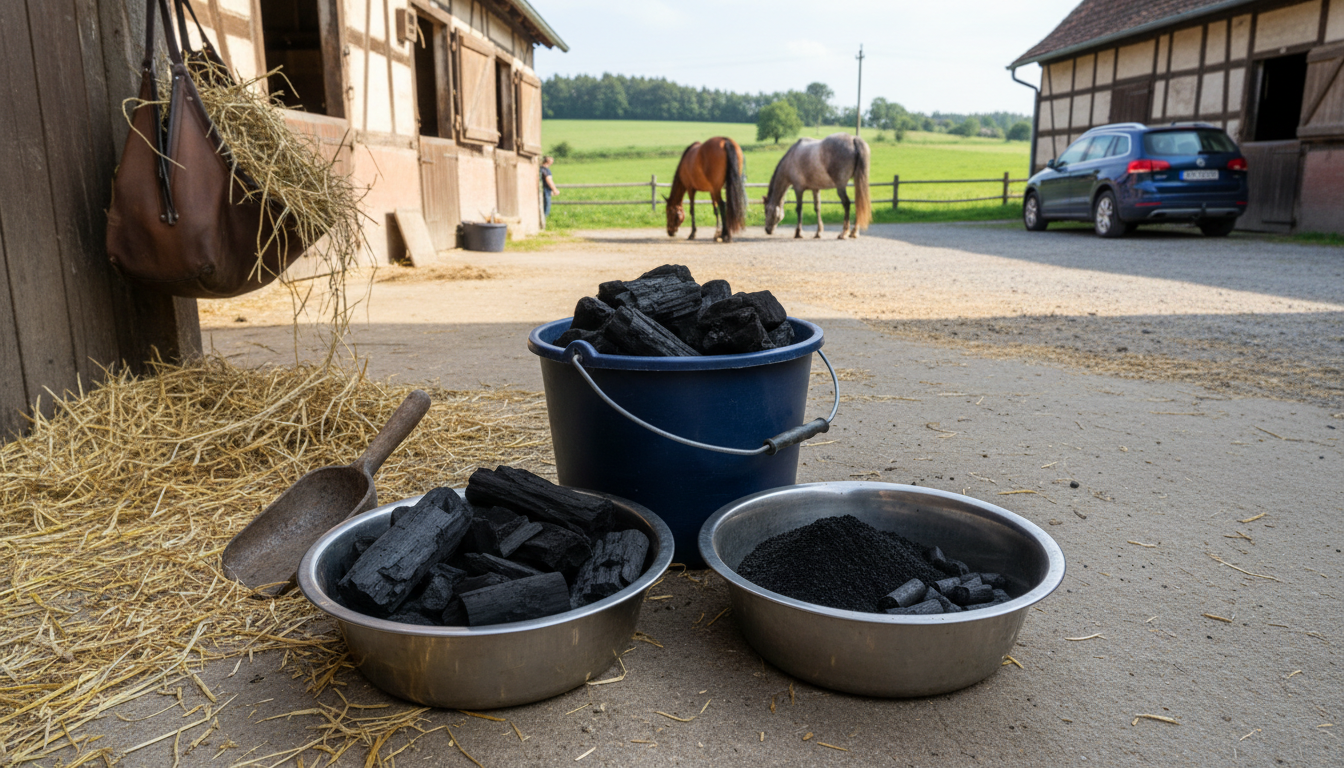
If you suspect poisoning, call your veterinarian immediately. Activated charcoal can bind certain toxins in the intestines, but it is not effective against all types of poisoning. Whether and how it is used is a decision for your vet. Therefore, do not attempt to self-medicate your horse with charcoal. Until help arrives, your main priorities are to prevent further ingestion of the toxin, secure the suspected source of poisoning, and provide a safe environment for your horse.
What Activated Charcoal Can Do in Cases of Poisoning
According to CliniPharm of the University of Zurich, activated charcoal, when administered orally, binds certain medications or toxins. This aims to prevent them from being absorbed from the digestive tract into the bloodstream. CliniPharm and CliniTox (mentioned below) are specialized information resources from Switzerland.
The technical term for this binding is adsorption: substances adhere to the surface of the charcoal. The word “certain” is crucial. Activated charcoal does not bind every toxin. Therefore, for treatment, it's important to know what the horse came into contact with and how it ingested the substance.
Why the Veterinarian Must Come First
According to CliniTox of the University of Zurich, emergency treatment initially involves removing the horse, and potentially its stable and pasture mates, from any possible sources of poisoning. This is followed by immediate life-saving therapy. Measures to prevent further absorption of the toxin from the digestive tract only follow once vital signs are stable.
Therefore, charcoal administration is not automatically the first step in treatment. First, the veterinarian assesses what immediate measures the horse needs. If it is confirmed that the horse has ingested a toxin, the following information is crucial for further treatment:
- Which toxin was ingested?
- How did it enter the body?
- What quantity was ingested?
- When did the ingestion occur?
- How frequently was the substance ingested?
What You Can Do Until the Vet Arrives
CliniTox recommends the following measures for owners to take until the veterinarian arrives:
- Prevent your horse from ingesting any more of the toxin.
- Secure the suspected source of poisoning.
- Do not feed the horse.
- Offer water freely.
- Place the horse in a soft, well-bedded stall.
This protected environment is intended to prevent injuries during potential colic episodes or seizures. Also, check if stable or pasture mates have access to the same potential source of poisoning, and keep them away from it as well.
Preparation and Administration by the Veterinarian
For veterinary treatment aimed at reducing toxin absorption from the gastrointestinal tract, CliniPharm on gastrointestinal decontamination specifies an activated charcoal dosage for horses of 1 to 3 grams per kilogram of body weight. It describes a 20 to 30 percent suspension in water, meaning 200 to 300 grams per liter. Administration is performed via a nasogastric tube.
This describes veterinary application. Dosage, preparation, and administration are interconnected and are not instructions for you to administer charcoal to your horse yourself.
According to CliniPharm, activated charcoal should be given rapidly in the acute phase of poisoning for optimal effect. This, too, is not a reason to administer it yourself before the vet arrives: stabilizing the horse and assessing the toxin are part of the treatment process.
Why Further Doses May Follow
Some toxins are excreted with bile and then reabsorbed from the intestines. To interrupt this reabsorption, activated charcoal can be given again at eight-hour intervals in veterinary poisoning management for horses, according to CliniTox.
For such substances, CliniPharm also states that a later administration can be beneficial. A repeat dose is therefore a targeted decision by the veterinarian and not a general schedule for the stable.
What You Should Be Aware Of
Activated charcoal has clear limitations. CliniTox lists, for horses, certain heavy metals, glycols, alcohols, nitrite, alkalis, and acids as substances it does not bind. CliniPharm, in its general description not specific to horses, also excludes poisonings by corrosive substances, cyanide, iron, mineral acids, and organic solvents from the broad application range of charcoal.
In cases of poisoning, avoid vegetable oils such as castor oil. According to CliniTox, they can increase the absorption of fat-soluble toxins. Instead, have the details of the suspected ingestion and the secured source of poisoning ready for the veterinarian.
Common questions
Can I give my horse activated charcoal myself if I suspect poisoning?
Do not attempt self-treatment. Call your veterinarian first. In the described treatment process, vital signs are stabilized first, followed by measures to prevent further toxin absorption.
Does activated charcoal bind all toxins?
No. CliniTox lists, for horses, certain heavy metals, glycols, alcohols, nitrite, alkalis, and acids as exceptions. The ingested substance is therefore important for treatment decisions.
What should I do until the vet arrives?
Prevent further toxin ingestion and secure the suspected source of poisoning. Do not feed the horse, offer water freely, and place it in a soft, well-bedded stall.
Can I give castor oil in case of poisoning?
No. According to CliniTox, vegetable oils such as castor oil should not be used for horse poisonings because they can increase the absorption of fat-soluble toxins.
Sources
- Universität Zürich, CliniTox: Management von Vergiftungen beim Pferd – Erstmaßnahmen und tierärztliche Behandlung (www-vetpharm.uzh.ch)
- Universität Zürich, CliniPharm: Aktivkohle – Indikationen bei Vergiftungen und Grenzen der Giftbindung (vetpharm.uzh.ch)
- CliniPharm Wirkstoffe: Gastrointestinale Dekontamination
Written by Equidara editorial team. Last checked: 4 November 2026.
- Calendula for Horses: Salve, Infusion, and Addressing Scratches — What the Phytokodex describes about calendula salve and infusion, and why crusts, pus, or lameness in the pastern area require veterinary attention.
- Black Seed Oil or Salicylic Oil for Sweet Itch: What the 1999 Study Actually Examined — Black seed oil and salicylic oil are not the same. Discover which oil the 1999 study tested and why stable management, insect repellents, and sweet itch rugs are crucial for managing sweet itch.
- Herbal Remedies for Your Competition Horse: What You Should Check Before Administration — Even with herbal remedies, competition rules apply. Here's what the FN and FEI say about substances, withdrawal periods, and supplements.
- Honey for Horses: From Ancient Home Remedy to Medical Grade Wound Honey — Honey has a long history in wound care. Learn what sets medical grade wound honey apart, its described applications, and when your horse needs a vet.
Related
- Buy a horse with pre-purchase exam documents — Sale horses where the pre-purchase exam report is available directly in the listing.
- Services and jobs — Farrier, vet, training, horse share.
- Saddles and accessories — For the horse: saddles, rugs, bridles, hoof protection.