
Feeding & Care
Mash and Hay Cobs: When They Make Sense for Your Horse
Mash provides energy and can be beneficial after digestive issues or illness. Hay cobs are helpful when a horse can no longer chew hay adequately. The key factors are your horse's needs, preparation, and the overall diet.
Equidara editorial team · 20 October 2026 · 4 min read
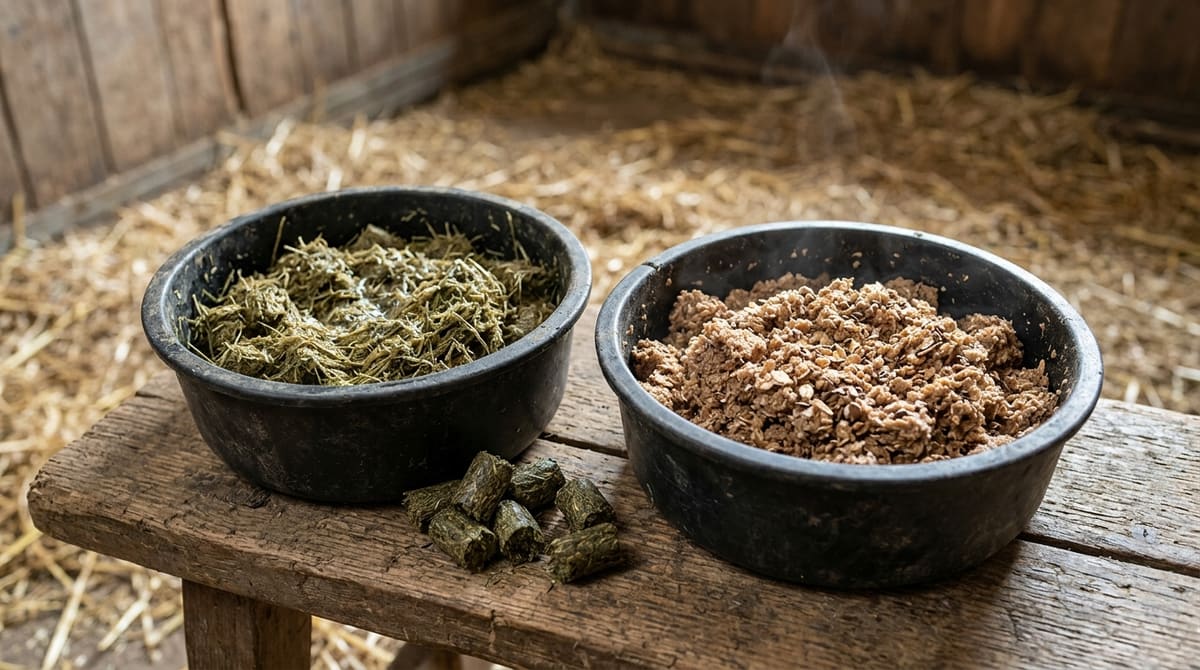
Mash can be a good option for horses with digestive problems, after a prolonged illness, or for weight gain. Hay cobs, on the other hand, are particularly useful if your horse can no longer adequately chew its forage. These two feeds serve different purposes. Whether they are suitable depends on your horse's individual needs and its current diet. If your horse shows any health concerns, always consult your veterinarian first before introducing a supplementary feed without a proper diagnosis.
Mash: Which Horses Can Benefit?
According to agrarheute, traditional mash consists of linseed (flaxseed) and, for example, wheat or oat bran. This mixture was originally used to support and stimulate digestion. As stated by agrarheute, mash can help horses with digestive issues or those recovering from a prolonged illness. However, it does not replace veterinary consultation. It's always best to discuss with your vet whether it's suitable for your horse's specific situation.
Mash also provides energy. Agrarheute suggests it can therefore aid in weight gain for underweight horses and help maintain body condition in older horses. The crucial factor isn't age alone, but whether the additional energy aligns with your horse's needs.
According to Bayerisches Landwirtschaftliches Wochenblatt, grain-rich and thus energy-dense mash is not recommended for easy keepers or overweight horses and ponies that are lightly worked or not worked at all.
Preparing and Incorporating Mash Correctly
Before feeding, always follow the preparation instructions on the package. Agrarheute notes that these instructions can vary depending on the manufacturer.
Most varieties, according to agrarheute, should be fed no more than two to three times per week. This can be deviated from if your veterinarian recommends otherwise or if the manufacturer states that daily feeding is unproblematic.
Agrarheute cites two reasons for caution with frequent feeding:
- With bran-containing mash, continuous or overly frequent feeding can disrupt the phosphorus-to-calcium ratio. Bran contains many times more phosphorus than calcium.
- The phytate present in mash can inhibit zinc absorption in the gut, potentially leading to a zinc deficiency.
Therefore, more mash isn't automatically the right solution if you suspect an additional need. Always consider its composition and the rest of your horse's diet.
Hay Cobs: When Chewing Becomes Difficult
In older horses with impaired chewing function, problems often become apparent when transitioning from grass to hay in autumn. The Internationale Gesellschaft zur Funktionsverbesserung der Pferdezähne, or IGFP, explains that hay is tougher and may then no longer be adequately broken down and digested.
The IGFP lists the following warning signs in horses with dental problems:
- Weight loss,
- quids (chewed and spat-out wads of feed),
- numerous inadequately chewed fecal fibers longer than four millimeters,
- possibly diarrhea.
According to the IGFP, feeding must be adjusted at the latest when such signs appear. Also, have the cause diagnosed by a veterinarian.
If your horse can no longer adequately break down forage, the IGFP states that it must initially be partially replaced by pre-chopped hay in the form of hay cobs. Concentrates or beet pulp alone cannot compensate for weight loss in this situation.
Soaking Hay Cobs and Estimating Quantity
The IGFP recommends a ratio of one part feed to two parts water for hay cobs and for meadow flakes, which soak faster. After about 30 minutes, they should have disintegrated and can be fed.
Always soak hay cobs fresh. Do not prepare them overnight, as they can begin to ferment. You should not feed them dry due to the risk of choke.
To estimate the necessary amount of hay cobs, the IGFP advises first determining how much hay your horse actually consumes in 24 hours:
- Weigh the amount of hay offered.
- Weigh the leftovers after 24 hours.
- The difference is the amount consumed.
Depending on the dental situation, a complete transition to hay cobs may be necessary. If your horse is entirely dependent on hay replacers, the amount must be divided into at least four meals. However, hay should always be offered for enrichment, even if the horse only quids it.
Keeping the Entire Diet in View
In issue 03/2023 of the magazine “Pferd und Mensch” by the Deutsche Reiterliche Vereinigung, good quality hay in sufficient quantities is considered the foundation of feeding. Supplements should match the horse's needs and the composition of the basic forage. To prevent over- and under-supplementation, the supply of energy, protein, as well as macro and trace elements should be calculated based on the entire ration. This includes hay, individual feedstuffs, and all supplementary feeds.
An older horse also needs time and peace to eat. If it is pressured or disturbed in a group, the IGFP states it must be separated for feeding. A timely adjusted feeding plan with an acclimatization period can adequately nourish a horse even with poor teeth. However, if it continues to lose weight due to pain or other health problems, a veterinarian should be consulted again.
Common questions
Can my horse get mash daily?
According to agrarheute, most mash varieties should be fed no more than two to three times per week. Exceptions apply if your veterinarian recommends otherwise or if the manufacturer states that daily feeding is unproblematic.
Is mash suitable for easy keepers?
According to Bayerisches Landwirtschaftliches Wochenblatt, grain-rich and thus energy-dense mash is not recommended for easy keepers or overweight horses and ponies that are lightly worked or not worked at all.
Can I feed hay cobs dry?
No. The IGFP advises against it due to the risk of choke. Hay cobs should always be soaked fresh and not prepared overnight, as they can begin to ferment.
Can hay cobs completely replace hay?
According to the IGFP, this may be necessary depending on the dental situation. If a horse is entirely dependent on hay replacers, the amount must be divided into at least four meals. However, hay should always be offered for enrichment, even if the horse only quids it.
Sources
- Bayerisches Landwirtschaftliches Wochenblatt: Fütterung von Mash – nicht für jedes Pferd empfehlenswert – wochenblatt-dlv.de (22.01.2024)
- agrarheute: Mash-Fütterung bei Pferden – was Pferdebesitzer beachten sollten – agrarheute.com (21.02.2024)
- Internationale Gesellschaft zur Funktionsverbesserung der Pferdezähne e. V.: Fütterung bei Zahnproblemen und Einsatz von Heucobs – igfp-ev.d
- Deutsche Reiterliche Vereinigung, Magazin Pferd und Mensch: Supplemente in der Pferdefütterung – magazin.pferdesport-deutschland.de (03/2023)
Written by Equidara editorial team. Last checked: 24 October 2026.
Fachlich geprüft von Melissa Hinze, Pferdezüchterin und Pferdehändlerin, Gründerin von Equidara.
- Calculating Concentrate Requirements: How Weight, Workload, and Breed Make a Difference — Energy requirements alone don't tell you how much concentrate to feed. Here's how to factor in weight, breed, and workload, and account for the energy provided by forage.
- Stable Water Supply: Needs, Waterers, and Frost Protection — Water should always be available. Learn what's important for waterers, pipes, and water quality, and how to correctly interpret technical specifications for frost protection.
- Equine Coat Change: What's Normal and How to Adjust Your Horse's Diet — Your horse sheds its coat in spring and autumn. Here, you'll discover what triggers this change, how the coat protects the skin, and what's crucial for their diet during this time.
- Hoof Care Through the Seasons: What Dry and Wet Hooves Need — Too dry and the horn crumbles; too wet and it softens. Here's how to keep your horse's hooves balanced throughout the year: with proper management, mucking out, regular checks, and scheduled appointments.
Related
- Saddles and accessories — For the horse: saddles, rugs, bridles, hoof protection.
- Available stalls — Boarding, open stable, self-care, with monthly price.