
Feeding & Care
Calculating Concentrate Requirements: How Weight, Workload, and Breed Make a Difference
Energy requirements alone don't tell you how much concentrate to feed. Here's how to factor in weight, breed, and workload, and account for the energy provided by forage.
Equidara editorial team · 22 October 2026 · 5 min read
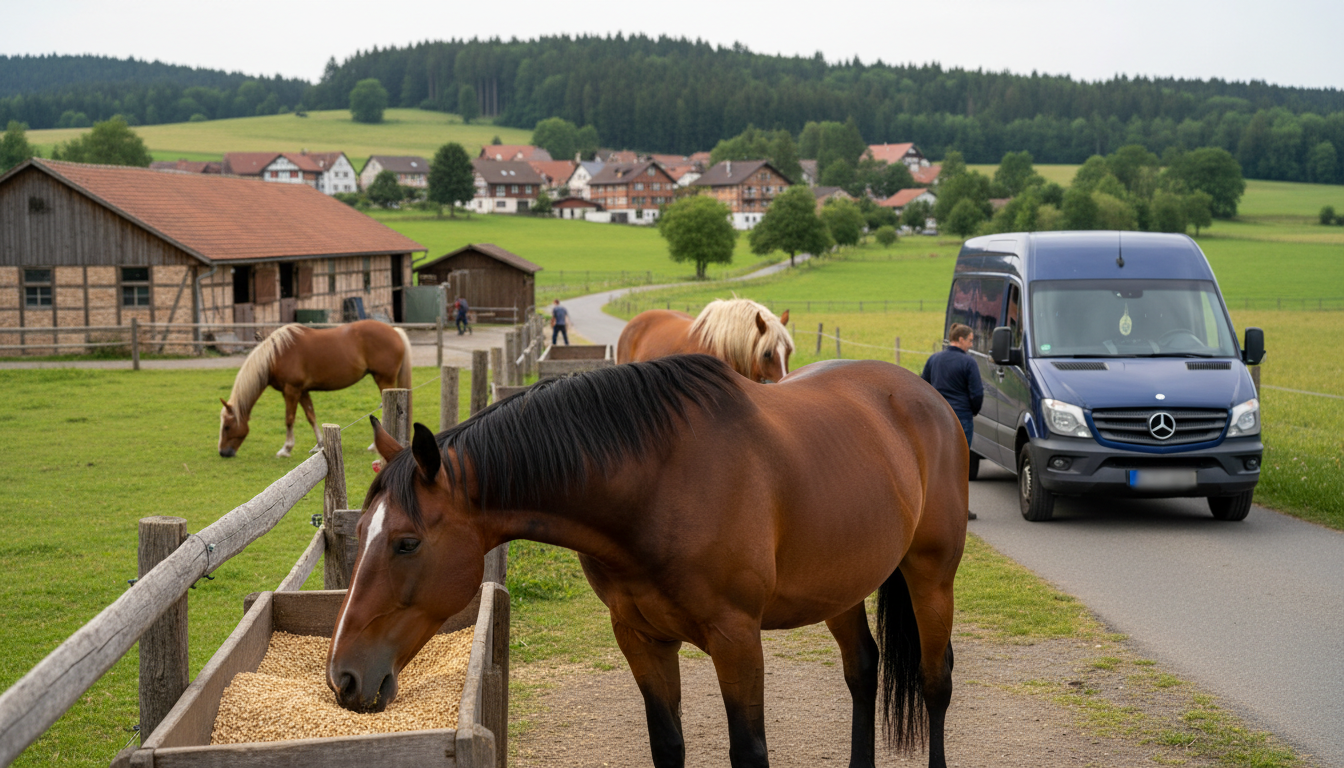
You determine your horse's concentrate requirements based on its energy needs and the energy already supplied by the rest of its diet. Weight, breed, and actual workload establish the baseline. Management, weather, and body condition can alter this. Therefore, a simple requirement table alone won't tell you how many kilograms of concentrate your horse needs.
Weight and Breed: Determining Maintenance Requirements
Maintenance requirements describe the energy and nutrients a horse needs for its bodily functions at rest. Additional performance demands create extra requirements, explains the Arbeitskreis Pferd.
Body weight isn't simply factored into the calculation proportionally. Because heat dissipation and body mass aren't linearly related, the source refers to energy requirements based on metabolic body weight. For this, body weight in kilograms is raised to the power of 0.75.
For adult horses in the thermoneutral zone of −15 to +25 °C, the Arbeitskreis Pferd states the following factors:
| Horse Type | Maintenance Requirements in MJ ME per kg Metabolic Body Weight per Day |
|---|---|
| Warmblood | 0,52 |
| Thoroughbred | 0,64 |
| Pony | 0,4 |
| Other Breeds | 0,4–0,5 |
The calculation is: Body weight in kg raised to the power of 0.75 × appropriate factor = daily energetic maintenance requirements in MJ ME. These values apply to the specified conditions, not universally to every horse.
ME stands for metabolizable energy. In Germany, horse feeds have been evaluated at this energy level since 2014. However, only net energy is available for maintenance metabolism and additional performance, according to the Arbeitskreis Pferd. Therefore, ensure that requirements and feed values are stated on the same evaluation basis.
Work Intensity: Classifying the Actual Workload
Not every ridden horse automatically falls into the light work category. The Arbeitskreis Pferd still classifies turnout and leisurely, irregular riding without extended periods of increased tempo as maintenance.
The source describes the other categories as follows:
- Light Work: approximately one hour of quiet training per day.
- Moderate Work: approximately one to two hours of training per day with more intense phases.
- Heavy Work: several hours of intense exertion daily.
For a riding horse with a 600 kg body weight, the daily requirement table lists the following energy needs:
| Workload | Daily Requirement in MJ ME |
|---|---|
| Maintenance | 63–77 |
| Light Work | 90 |
| Moderate Work | 107 |
| Heavy Work | 120–150 |
These are energy requirements, not concentrate amounts. The values refer to the specified body weight. The Arbeitskreis Pferd warns against overestimating the needs of leisure horses. If the workload significantly decreases, nutrient supply must also be reduced.
From Energy Requirements to Concentrate Amounts
For the calculation, in addition to the requirements, you need the feed amounts and their energy content. The distinction between fresh weight and dry matter is crucial. Fresh weight refers to the feed including its water, while dry matter is the portion without water.
According to the Arbeitskreis Pferd, dry matter regulates how much a horse eats more strongly than fresh matter during feed intake. Therefore, a kilogram measurement without this distinction is insufficient for the calculation.
The Deutsche Landwirtschafts-Gesellschaft lists these energy contents in its table:
| Feedstuff | MJ ME per kg Dry Matter |
|---|---|
| Medium Quality Hay | 7,1 |
| Oats | 11,1 |
| Compound Feed | 11,1 |
So, these values do not apply to the weighed feed including water. The hay value is for medium quality, and the table values do not automatically describe your specific feed.
The energy calculation generally proceeds as follows:
- Determine the daily requirement appropriate for weight, horse type, and workload.
- Calculate the energy of the rest of the ration from its dry matter and corresponding energy contents.
- Subtract this energy from the daily requirement. Only a remaining energy deficit needs to be covered by additional feed.
- Divide the energy deficit by the energy content of the intended concentrate. If values are given per kilogram of dry matter, you will initially get a dry matter amount, not a fresh weight amount.
Roughage must therefore be included in the calculation before you determine a concentrate amount. The revised DLG model calculations for nutrient excretion also assume significantly higher roughage intake and dry matter usage compared to earlier calculations.
Checking the Calculation for the Individual Horse
Breed influences more than just maintenance requirements. According to the Arbeitskreis Pferd, smaller breeds consume more feed dry matter per unit of body mass than larger ones. Work also increases dry matter intake. However, total intake and concentrate amount are not the same: the source states that a 600 kg warmblood with unlimited feed supply consumes an average of 11.4 kg of feed dry matter daily for maintenance or pregnancy, and 15.6 kg for work.
Additionally, horse type, temperament, age, and management must be considered. Lots of movement, such as in group housing in a large area, increases requirements compared to less movement. For robust breeds, the source mentions deductions due to their better insulation from relatively more subcutaneous fat tissue. Cold, wet conditions require additions.
Therefore, assess the energy supply for each individual horse. For a high body condition score and a tendency towards overweight, the Arbeitskreis Pferd suggests deductions; for the opposite situation, additions. The calculated amount remains a starting point that must match the actual workload and body condition.
Common questions
Does every ridden horse need a ration for light work?
No. The Arbeitskreis Pferd still classifies leisurely, irregular riding without extended periods of increased tempo as maintenance. Approximately one hour of quiet training daily is considered light work there.
Why does breed influence energy requirements?
According to the Arbeitskreis Pferd, Thoroughbreds have a higher basal metabolic rate than horses with less urge to move, such as cold-blooded horses. Robust breeds are better insulated by relatively more subcutaneous fat tissue and therefore receive deductions. The source lists different maintenance factors for adult warmbloods, thoroughbreds, ponies, and other breeds in the thermoneutral zone of −15 to +25 °C.
Can I directly convert energy requirements into kilograms of oats?
Not without including the rest of the ration. Furthermore, the DLG states the oat value of 11.1 MJ ME per kilogram of dry matter, not per kilogram of fresh weight.
What changes if my horse works significantly less?
According to the Arbeitskreis Pferd, nutrient supply must follow the actual workload and be reduced if the work significantly decreases.
Sources
- Deutsche Landwirtschafts-Gesellschaft (DLG): Fütterung und Nährstoffausscheidungen von Pferden – dlg.org (08/2024)
- Arbeitskreis Pferd: Bedarfszahlen für Energie und Protein nach Gewicht, Rasse und Arbeitsbelastung – ak-pferd.de
- Arbeitskreis Pferd: Bedarfszahlen für Futtermengen und Einfluss von Körpermasse und Leistung – ak-pferd.de
Written by Equidara editorial team. Last checked: 24 October 2026.
Fachlich geprüft von Melissa Hinze, Pferdezüchterin und Pferdehändlerin, Gründerin von Equidara.
- Mash and Hay Cobs: When They Make Sense for Your Horse — Mash provides energy and can be beneficial after digestive issues or illness. Hay cobs are helpful when a horse can no longer chew hay adequately. The key factors are your horse's needs, preparation, and the overall diet.
- Stable Water Supply: Needs, Waterers, and Frost Protection — Water should always be available. Learn what's important for waterers, pipes, and water quality, and how to correctly interpret technical specifications for frost protection.
- Equine Coat Change: What's Normal and How to Adjust Your Horse's Diet — Your horse sheds its coat in spring and autumn. Here, you'll discover what triggers this change, how the coat protects the skin, and what's crucial for their diet during this time.
- Hoof Care Through the Seasons: What Dry and Wet Hooves Need — Too dry and the horn crumbles; too wet and it softens. Here's how to keep your horse's hooves balanced throughout the year: with proper management, mucking out, regular checks, and scheduled appointments.
Related
- Saddles and accessories — For the horse: saddles, rugs, bridles, hoof protection.
- Available stalls — Boarding, open stable, self-care, with monthly price.