
Animal welfare
Wild Horses in Europe: Populations, Conservation Status, and Management
Not every free-roaming horse herd automatically holds legal wild status. Discover how populations differ and how the Dülmen Wild Horses are preserved and managed.
Equidara editorial team · 21 October 2026 · 4 min read
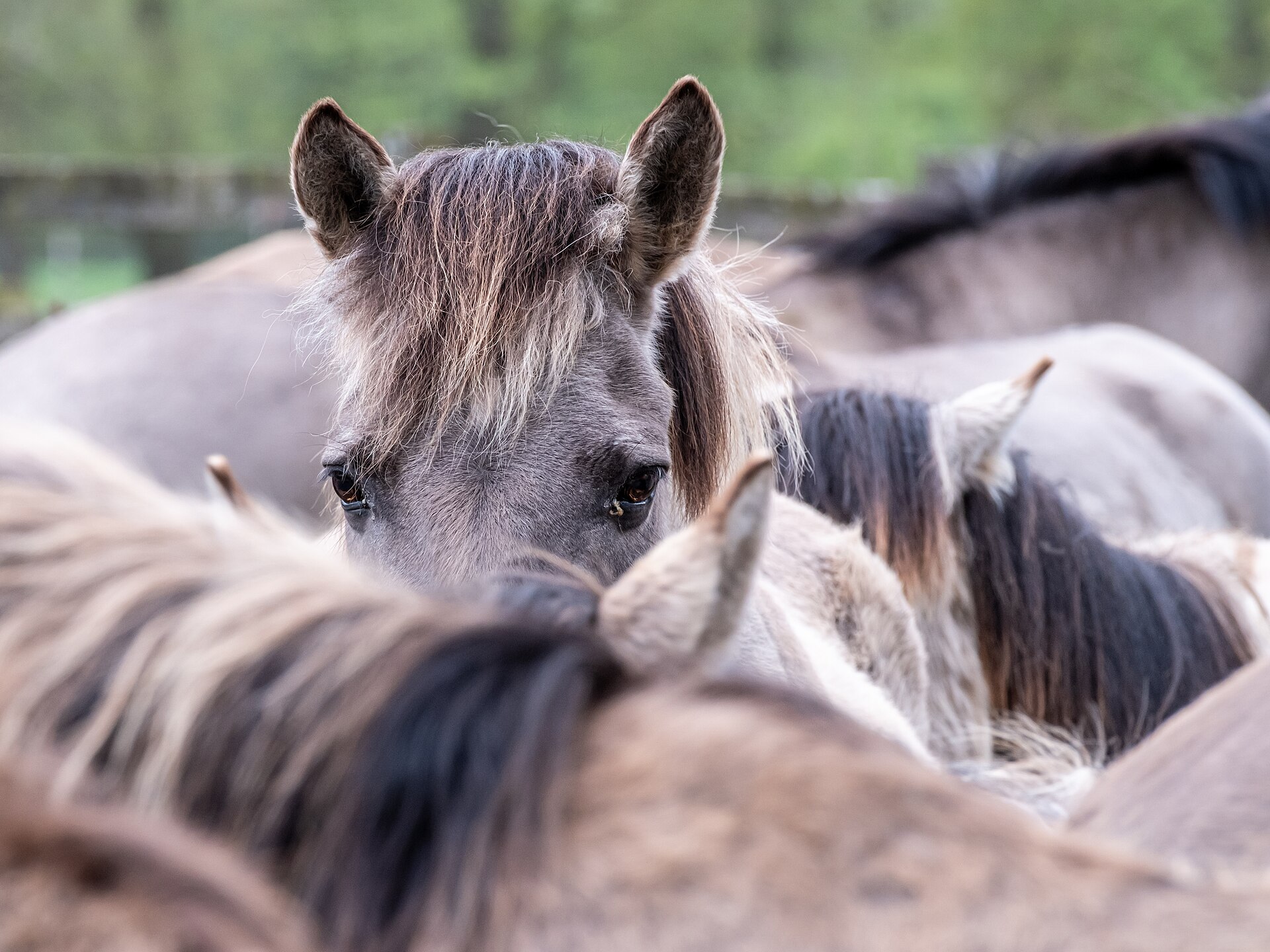
Europe's wild horse populations vary in origin, husbandry, and management. Some live within enclosures and are actively managed, while others roam freely. Whether a herd possesses formal legal wild status is not determined by its lifestyle. Therefore, when you want to categorize populations and their protection, differentiate between their way of life, conservation goals, and legal status.
What Does 'Wild Horse' Mean in Europe?
According to Rewilding Europe, the European wild horse type, the Tarpan, has been extinct since 1909. However, the genetic heritage of European wild horses has survived in domesticated forms. The organization describes the Przewalski's horse, originally native to the steppes of Central Asia, as the last remaining true wild horse in the world.
In rewilding efforts, which involve restoring natural processes, the horses introduced do not, according to Rewilding Europe, have to precisely match the extinct European wild horse. The goal is to establish populations that can survive without human management and fulfill the ecological role of their predecessors. This represents an objective of the approach, not a description of all existing herds.
The organization identifies sturdy, robust, pony-sized horses, whose breeding or selection has been minimally influenced by humans, as suitable. They report on natural grazing by horses in project landscapes across Portugal, Spain, Croatia, Ukraine, and Bulgaria.
Understanding Populations Correctly
Dülmen Wild Horses: A Managed Population
According to the scientific study on Dülmen Wild Horses and other populations, the Dukes of Croÿ have managed the Dülmen Wild Horses as an independent population since 1856 within the fenced Merfelder Bruch near Dülmen in North Rhine-Westphalia.
The study provides the following population and offspring figures:
- approximately 530 horses in total,
- including around 380 mares of reproductive age,
- 80–100 female horses aged 1–3 years,
- 50–60 foals per year.
These figures describe the population at the time of the study. The current herd size may differ, as foals are born and young stallions are removed annually. The ranges refer to different categories: one to an age group within the population, the other to annual offspring.
Koniks: Distinguishing Between Studbooks and Free-Roaming Herds
For Polish Koniks, the study includes registry data from the Polish studbook: in 2022, approximately 1760 mares, 183 stallions, and 1540 foals were registered. These figures are explicitly not a count of a free-roaming population. A studbook records registered breeding animals and their offspring, whereas a population count surveys a specific population.
According to the study, the Polish Konik breeding program operates with a closed studbook. It aims to preserve all six paternal lines and as many as possible of the 35 maternal lines known in 1962. Of these, only 16 reportedly still exist. Such figures pertain to breeding and genetic preservation, not solely to free-roaming horses.
Conservation Status: Separating Threat Level and Legal Status
According to Rewilding Europe, Przewalski's horses were released for the first time in the Iberian Highlands project landscape in Spain in 2023. The organization describes them as an endangered subspecies of wild horse. This statement refers to their threat level, not a uniform legal status for all free-roaming horses in Europe.
For the free-roaming horses in the Bulgarian Rhodopes, Rewilding Europe reports collaboration with the European Commission, the Bulgarian government, and local authorities. The goal is to achieve formal legal wild status. As presented by the organization, this is an ongoing endeavor, not an accomplished status.
Thus, the term 'wild horse' is not automatically a legal classification. For specific legal questions, consult with a lawyer.
How Is the Dülmen Population Managed?
The scientific study describes several interconnected measures for the Dülmen Wild Horses:
- Yearling colts are removed from the herd each year and publicly sold on the last weekend of May.
- For each breeding season, two to three stallions are introduced for 2–3 months for natural breeding.
- The number of pregnant mares is controlled by regulating the duration of stallion access.
- After each breeding season, the stallions are separated from the mare herd. Approximately 3–6 stallions are kept in a separate pasture, several kilometers away from the area of the mares, foals, and young horses.
To prevent father-daughter pairings, stallions are used for a maximum of three consecutive breeding seasons, according to the study. After this, they permanently leave the Merfelder Bruch. Management here thus includes removals and the targeted control of reproduction.
What Are the Underlying Conservation Goals?
The main goal for the Dülmen Wild Horses, as stated in the scientific study, is to preserve their genetic ability to cope with natural selection pressure. To achieve this, the horses live under harsh natural conditions. Genetic analyses revealed high diversity and a clear distinction from the 17 other horse populations studied.
In rewilding, the ecological function is also a key aspect. According to Rewilding Europe, through their grazing, horses create space for open-land species, including shrubs, herbs, and grasses, as well as the insects and birds that depend on them. The organization links this effect to certain conditions: large herbivores only shape a landscape if their populations are large enough and the species involved are diverse enough.
Common questions
Are Europe's free-roaming horses automatically legally wild animals?
No, their lifestyle alone does not determine this. Rewilding Europe presents achieving formal legal wild status for the horses in the Bulgarian Rhodopes as an ongoing endeavor, not an accomplished status. For legal questions, consult with a lawyer.
How is the reproduction of the Dülmen Wild Horses managed?
According to the scientific study, two to three stallions are used for 2–3 months per breeding season. The number of pregnant mares is controlled by regulating the duration of their access to the mare herd. A stallion covers for a maximum of three consecutive seasons.
Are the numbers in the Polish Konik studbook a wild horse population count?
No. The scientific study explicitly distinguishes the registry data from a count of free-roaming horses.
What is Rewilding Europe's goal with horses?
According to Rewilding Europe, the aim is to create populations that can survive without human management and take on the ecological role of extinct European wild horses.
Sources
- Fachstudie zu Dülmener Wildpferden und weiteren Populationen: Genetik, Bestandsangaben und Zuchtmanagement – pmc.ncbi.nlm.nih.gov (31.07.2024)
- Rewilding Europe – Europäische Pferdepopulationen, Wiederansiedlung und rechtlicher Wildstatus; Bestandsangabe für die Rhodopen mit Stand En
- Titelfoto: Dietmar Rabich, Wikimedia Commons
- Lizenz des Fotos: CC BY-SA 4.0

Written by Equidara editorial team. Last checked: 24 October 2026.
Fachlich geprüft von Melissa Hinze, Pferdezüchterin und Pferdehändlerin, Gründerin von Equidara.
- Illegal Horse Trading: How to Verify Provenance and Documents — Official and media reports describe cases where equine passports and lab reports are alleged to have been manipulated. Here's what you can check regarding identity, provenance, and health records, and what a suspicion does not yet prove.
- Horse Sanctuaries: Checking Forever Homes, Funding, and Care — A permanent home requires clear agreements. Here's how to check what a farm promises, what you should clarify regarding payment, and which care regulations apply to an organic farm in Germany.
- Equine Passport: Who Issues It for Sport Horses, Breeding Stock, and Leisure Horses — Every horse kept in the EU requires registration and an equine passport. The issuing authority depends on whether your horse is registered as a breeding animal or a sport horse. This also includes transponders and entry into the database.
- EU Animal Transport Regulation: Travel Times and Controls for Slaughter Horses — In Germany, strict transport regulations apply to slaughter horses. Find out what travel times are permitted, which authorities conduct checks, and what documents you need to carry with you.
Related
- Wanted — Who is currently looking for something — from horse to stall.
- Find animal transport — Move your animal arranges transports in Europe.
- Buy and pay safely — How to recognize fraud schemes.