
Animal welfare
EU Animal Transport Regulation: Travel Times and Controls for Slaughter Horses
In Germany, strict transport regulations apply to slaughter horses. Find out what travel times are permitted, which authorities conduct checks, and what documents you need to carry with you.
Equidara editorial team · 30 September 2026 · 3 min read
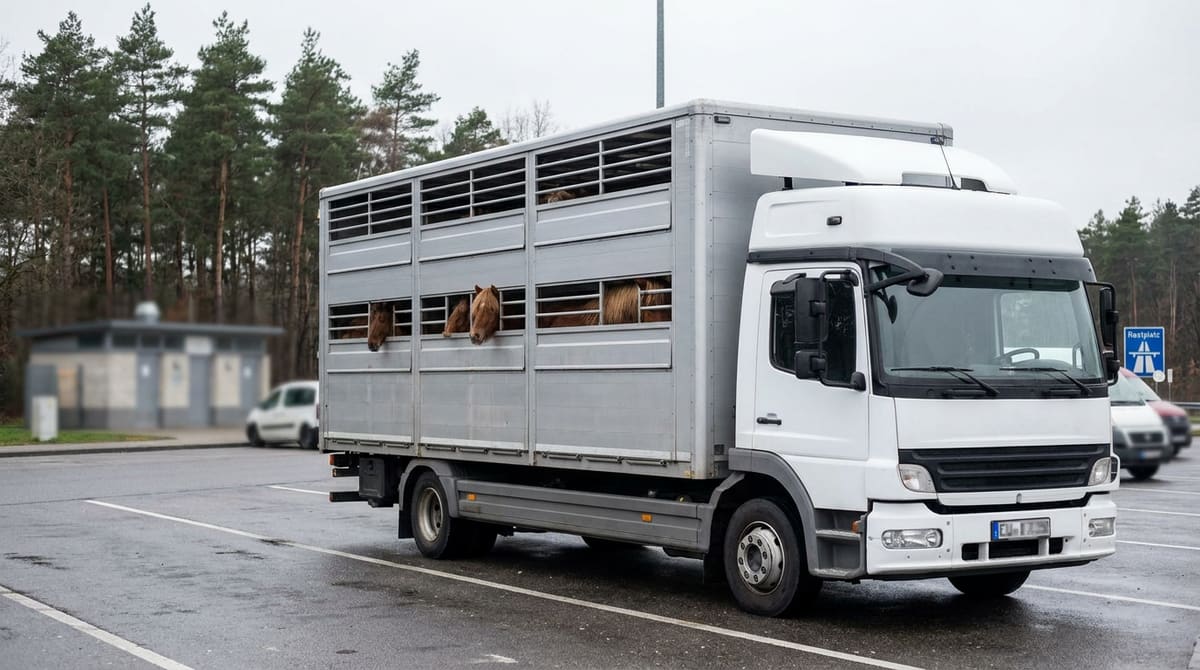
Legal Basis: Regulation (EC) 1/2005 and National Supplements
The transport of live vertebrate animals within the EU is governed by Regulation (EC) 1/2005. In Germany, the Animal Welfare Transport Regulation (Tierschutztransportverordnung – TierSchTrV) supplements these provisions, tightening them for domestic transports.
Maximum Travel Times for Slaughter Horses
The EU Regulation stipulates a maximum transport duration of 24 hours for horses (equids), with water and, if necessary, feed to be offered every eight hours. However, member states can enact stricter rules for animals intended for slaughter.
In Germany, according to § 10 TierSchTrV, the following applies:
- Domestic transports of animals for slaughter – including slaughter horses – may last a maximum of eight hours.
- If the outside temperature can exceed 30 °C during transport, the permitted transport duration is reduced to four and a half hours.
These times apply from the start of loading until the end of unloading. Exceptions are only permitted in unforeseen circumstances. The temperature regulation has been in effect since November 25, 2021, and obliges transport operators to check the weather forecast before commencing a journey.
Long Journeys: Licensing Requirements and Journey Log
Transports lasting longer than eight hours ('long journeys') are subject to additional requirements:
- The transport operator requires a Type 2 authorization (Article 11 of Regulation (EC) 1/2005).
- The vehicle must be technically inspected and approved for long-distance transport (Article 18).
- An officially approved journey log must be kept.
- The operator must submit emergency plans for transport incidents.
For domestic transports of slaughter horses, these requirements are generally not relevant, as the travel time is limited to eight hours, thus not constituting a long journey. However, for cross-border transports of slaughter horses lasting longer than eight hours, the EU provisions apply in full.
Documents You Must Carry
The equine passport must be carried during every transport. Additionally, veterinary health documents, such as a TRACES certificate for intra-community transports, may be required depending on the destination.
Checks: Who Checks What?
The competent authorities – in Germany, the veterinary offices of the districts (Landkreise) and independent cities (kreisfreie Städte), often in conjunction with the police – conduct random and risk-based checks. They examine:
- Fitness for transport of the animals (before loading, and as part of animal health checks for long journeys)
- Compliance with travel and rest times
- Authorization of the transport operator and, if applicable, the vehicle
- Presence and correctness of accompanying documents (equine passport, journey log)
- Condition of the means of transport (space allowance, ventilation, temperature)
- Care of the animals during transport
Checks can take place at the point of departure, en route (e.g., at rest stops or border crossings), or at the destination (slaughterhouse). Violations can result in fines, prohibition of further travel, or the unloading of the animals.
Competent Authorities
In Germany, the veterinary offices of the districts (Landkreise) and independent cities (kreisfreie Städte) are responsible for supervising animal transports. They also issue authorizations for transport operators and vehicles. For long journeys involving third countries, the border inspection post is additionally involved. The police assist with mobile checks on the road.
What to Do in Case of Transport Delays?
If an animal transport is delayed for more than two hours, the competent authority is obliged to ensure the animals' welfare (food, water, and if necessary, unloading and housing). Transport operators must account for such situations in their emergency plans.
This guide provides an overview. For binding legal advice, please consult a lawyer.
Common questions
How long can a slaughter horse be transported in Germany?
A maximum of 8 hours. If the outside temperature can exceed 30 °C during the journey, it's only 4.5 hours. The time counts from the first loading to the last unloading.
What documents do I need for a slaughter horse transport?
The equine passport must be carried during every transport. Depending on the destination, additional health documents (e.g., TRACES) may be required. For long journeys exceeding 8 hours, an officially approved journey log is mandatory.
Who checks compliance with transport regulations?
In Germany, the veterinary offices of the districts (Landkreise) and independent cities (kreisfreie Städte) are responsible, often in cooperation with the police. They check fitness for transport, travel times, documents, and the condition of the means of transport.
What happens if the permitted transport duration is exceeded?
Authorities can prohibit further travel, order the animals to be unloaded, and impose fines. Repeated violations can lead to the loss of the transport authorization.
Sources
- Verordnung (EG) Nr. 1/2005 des Rates über den Schutz von Tieren beim Transport (2005)
- Tierschutztransportverordnung (TierSchTrV) (2009)
- Handbuch Tiertransporte – Kontrollstelle Tierschutz-Schlachtverordnung (FLI) (Dezember 2025)
- Merkblatt zur Verordnung (EG) 1/2005 – Landwirtschaft Baden-Württemberg
- Merkblatt zu landwirtschaftlichen Tiertransporten – Oberbergischer Kreis
- Landratsämter der Landkreise/ Stadtverwaltungen der kreisfreien Städte des Freistaats Thüringen Veterinär- und Lebensmittelüberwachungsämter
Written by Equidara editorial team. Last checked: 4 October 2026.
- Equine Passport: Who Issues It for Sport Horses, Breeding Stock, and Leisure Horses — Every horse kept in the EU requires registration and an equine passport. The issuing authority depends on whether your horse is registered as a breeding animal or a sport horse. This also includes transponders and entry into the database.
- Life After the Finish Line: Retraining, Rehoming, and Sanctuary Projects for Ex-Racehorses — Thoroughbreds often retire from racing at a young age, requiring expert retraining before they can transition into new careers as riding horses. We take a closer look at the dedicated retraining programs, rehoming efforts, and sanctuary projects that give these incredible athletes a second chance at life.
- Electric Car as a Towing Vehicle for Your Horse Trailer: Technology, Range, and Charging — Modern electric cars are capable of towing heavy horse trailers. Whether one is right for your hauling needs depends on the vehicle's towing limits, its range with a trailer, and available charging options on your route.
- Circus Lessons with Your Horse: Common Mistakes in the Bow and Spanish Walk — What to pay attention to when teaching the Bow and Spanish Walk, why warming up is essential, and how to handle breaks and unsolicited tricks.
Related
- Wanted — Who is currently looking for something — from horse to stall.
- Find animal transport — Move your animal arranges transports in Europe.
- Buy and pay safely — How to recognize fraud schemes.