
Animal welfare
Carriage Horses in Berlin: Regulations on Operating Hours, Heat, and Inspections
Berlin's guidelines limit operating hours, regulate breaks, and require carriage rides to stop at 30 degrees Celsius in the shade. Additionally, there are specifications for equipment, documentation, and inspections.
Equidara editorial team · 29 October 2026 · 5 min read
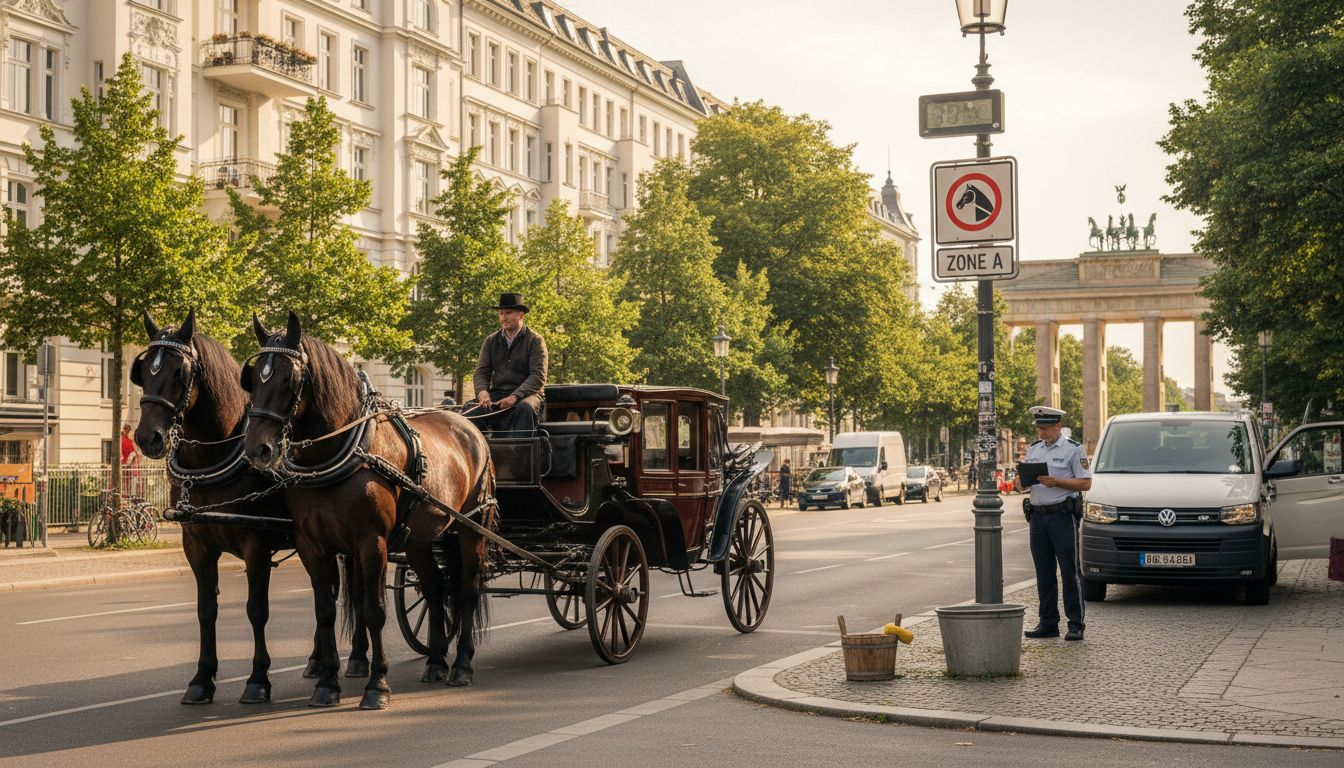
For carriage horses in Berlin, the guidelines issued by the Berlin Senate Department limit the total operating time to a maximum of nine hours per day. If the temperature reaches 30 degrees Celsius in the shade, carriage rides must cease immediately. Fixed break times, provisions for water supply, and annual harness inspections are also mandated. These guidelines apply exclusively to Berlin, Germany.
Permits and Suitability of Horses
According to the Berlin Senate Department, commercial horse-drawn carriage operations require a permit as per Section 11, Paragraph 1, Sentence 1, Number 8 c) of the Animal Welfare Act. This permit is issued by the veterinary authority responsible for the business's location.
Berlin's guidelines only permit healthy, well-conditioned, and well-cared-for horses aged 60 months or older to be used as draft horses. Their training, conditioning, and temperament must be suitable for city traffic and passenger transport. Younger horses may only be used for training purposes: alongside a calm, experienced school horse and not on a daily basis.
The horses' weight and performance capacity must also match the permissible total weight. The permissible total weight of the harnessed carriage must not exceed twice the combined body weights of the horses pulling it.
Operating Hours and Free Movement
Berlin's guidelines stipulate that the daily total operating time includes not only the actual tours but also harnessing, travel to the starting point, return travel, and unharnessing. Collectively, these activities must not exceed nine hours.
In addition, fixed closing times apply to the entire carriage operation, including these activities:
- From April to September, operations are permitted only until 9:00 PM at the latest.
- From October to March, operations are permitted only until 7:00 PM at the latest.
Outside of operating hours, each horse must receive two hours of free, self-directed movement daily. For this, the guidelines require a sufficiently large turnout area with unpaved ground.
After six consecutive days of operation, each horse should receive a 24-hour rest period. This must include at least two hours of free, self-directed movement in such a turnout area.
Breaks: Duration, Location, and Care
For operations, Berlin's guidelines outline two possible break regulations:
- At least two uninterrupted breaks, each lasting a minimum of half an hour.
- One uninterrupted break of at least one hour.
The first break must begin no later than four hours after harnessing. These breaks are intended for undisturbed feeding and watering.
The break location must be a covered standing area or a shaded spot. It requires natural, unpaved ground and tying facilities. Its exact location must be communicated to the responsible authority.
For the break, horses must be fully unharnessed and wear a halter instead of a bridle. An inspection for pressure sores and chafing is also mandated. This must be documented in the logbook as per Appendix 1. Important for timekeeping: unharnessing and harnessing do not count towards the break time.
At the standing area, a suitable, usable drinking water source must be demonstrated. Alternatively, good quality drinking water in sufficient quantity, at least 25 liters per horse, must be carried. A water bucket and appropriate feed, especially roughage, in sufficient quantity and quality must demonstrably be available at the break location or carried in the carriage.
Heat Protection: Watering and Ride Stoppage
On days with a maximum daily temperature of at least 25.0 degrees Celsius, horses must be watered at least every two hours, according to Berlin's guidelines. If necessary, they should be sprayed with water for cooling.
If the air temperature reaches or exceeds 30 degrees Celsius in the shade during the day, carriage rides must cease immediately. A functional thermometer must be carried.
Inspections and Documentation
Equipment and Harness
Before each outing, Berlin's guidelines require an inspection of bridles, bits, reins, harness, and traces. Checks are performed for dirt, damage, and proper fit, especially for blinkers and collars used.
All harnesses used in Berlin must undergo an annual harness inspection. This includes, among other things, successfully completing a Class A dressage test, including rein-back.
An experienced horse-person must constantly accompany the team as a co-driver. Even during breaks, the team must never be left unattended.
Technical Safety
Before initial operation, Berlin's guidelines require a technical safety inspection. This must be carried out by an officially recognized expert or inspector from a Technical Inspection Body for Motor Vehicle Traffic or an inspection engineer from an officially recognized monitoring organization.
During this inspection, the maximum permissible passenger seating capacity or the maximum permissible load weight is determined or confirmed and entered into the logbook. Further inspections are required as needed, at the latest according to the details of the last inspection report.
Logbook and Required Documents
The Berlin logbook must contain at least the information specified in the template in Appendix 1. Before each outing, the inspection of all equipment and harnessing must be recorded. The current book must be tamper-proof, have numbered pages, and be carried in the carriage.
The technical inspection report and the driver's proof of expertise must also be carried. For the proof of expertise, a certified copy is sufficient. These documents and the logbook must be presented to the competent veterinary or regulatory authority responsible for traffic monitoring upon request.
In cases of serious violations or repeated non-compliance with Berlin's carriage guidelines, the competent authority may revoke the permit according to Section 11, Paragraph 1, Sentence 1, Number 8 c) of the Animal Welfare Act. For legal questions regarding your operation, please consult a lawyer.
Common questions
Does the journey to the starting point count towards operating hours in Berlin?
Yes. According to Berlin's guidelines, the maximum nine hours of daily total operating time include harnessing, travel to the starting point, tours, return travel, and unharnessing.
At what temperature must carriage rides in Berlin end?
As soon as the air temperature reaches or exceeds 30 degrees Celsius in the shade during the day, rides must cease immediately, according to Berlin's guidelines.
Are carriage horses in Berlin allowed to remain harnessed during breaks?
No. Berlin's guidelines require complete unharnessing and a halter instead of a bridle. Unharnessing and harnessing do not count towards the break time.
How often must Berlin's carriage teams undergo a harness inspection?
Annually. According to Berlin's guidelines, they must successfully complete a Class A dressage test, including rein-back, among other requirements.
Sources
Written by Equidara editorial team. Last checked: 29 October 2026.
- Illegal Horse Trading: How to Verify Provenance and Documents — Official and media reports describe cases where equine passports and lab reports are alleged to have been manipulated. Here's what you can check regarding identity, provenance, and health records, and what a suspicion does not yet prove.
- Wild Horses in Europe: Populations, Conservation Status, and Management — Not every free-roaming horse herd automatically holds legal wild status. Discover how populations differ and how the Dülmen Wild Horses are preserved and managed.
- Horse Sanctuaries: Checking Forever Homes, Funding, and Care — A permanent home requires clear agreements. Here's how to check what a farm promises, what you should clarify regarding payment, and which care regulations apply to an organic farm in Germany.
- Equine Passport: Who Issues It for Sport Horses, Breeding Stock, and Leisure Horses — Every horse kept in the EU requires registration and an equine passport. The issuing authority depends on whether your horse is registered as a breeding animal or a sport horse. This also includes transponders and entry into the database.
Related
- Wanted — Who is currently looking for something — from horse to stall.
- Find animal transport — Move your animal arranges transports in Europe.
- Buy and pay safely — How to recognize fraud schemes.