
Sport & Results
Understanding Show Jumping Courses: Obstacles, Lines, and Judging
A show jumping course tests more than just clearing fences. Learn to understand different types of jumps, lines, and distances, and distinguish between the fundamental forms of judging.
Equidara editorial team · 13 October 2026 · 3 min read
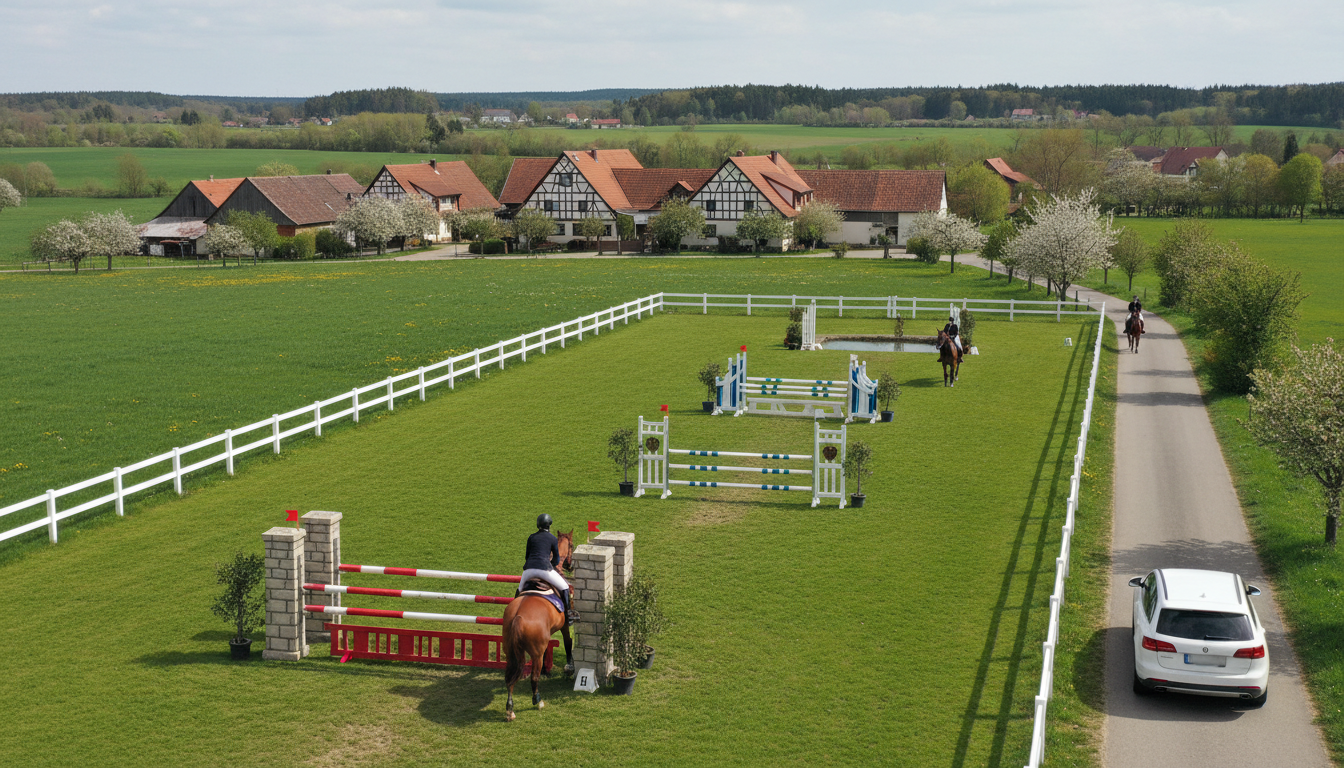
A show jumping course isn't just about individual obstacles; the paths between them are also part of the challenge. When you walk the course, you'll plan your approach, the lines you'll take, and the number of strides between fences. What gets judged depends on the type of class. In a style jumping class, your seat, aids, and the harmony of your ride are also crucial. In young horse jumping classes, the focus is squarely on the quality of the young horse.
How a Show Jumping Course is Designed
Course design involves both the obstacles themselves and their arrangement in the arena. According to the PM-Forum der Deutschen Reiterlichen Vereinigung, the German equestrian federation FN, several conditions influence the planning:
- the arena conditions and surroundings,
- the warm-up arena and the judge's stand,
- the footing,
- the available obstacle material.
Therefore, the course layout cannot be described solely by the jumps. Equally important are the turns, the sequence of obstacles, and the distances between them. The PM-Forum states that these elements are designed to test the horse's rideability and responsiveness. This refers to how well the horse can be ridden and how it responds to the aids.
Different Types of Obstacles You'll Encounter
The PM-Forum categorizes individual obstacles into verticals, spreads, long jumps, and up- and down-jumps. A vertical is an example of a high jump. The oxer belongs to the spread jumps, while the water jump is a long jump. A bank and a wall are examples of obstacles with up- and down-jumps, as seen in derbies.
These terms describe whether height, width, or ascending and descending is required. When you look at a course, this classification helps you identify the individual jumps.
The material also changes the appearance of an obstacle. The PM-Forum mentions fillers, planks, and gates. According to the PM-Forum, a water tray placed under, in front of, or behind the jump increases the difficulty.
How Obstacles are Designed and Secured
The PM-Forum refers to the FN guidelines, which apply to equestrian sport in Germany, for obstacle design: a jump should be built to be fair and inviting. This includes a clearly marked ground line and a clear top rail.
The PM-Forum also describes safety requirements. Safety cups release the rail from its adapter under a certain amount of pressure, allowing the pole to fall. This means the cup does not hold the rail under all pressure.
What You Plan When Walking the Course
When walking the course, you connect the individual obstacles into a planned path. According to the PM-Forum, show jumpers consider how they will approach the jumps, which lines they will choose between them, and how many strides they intend to ride on these sections.
Three terms will help you understand this planning:
- Approach: the path taken towards the respective obstacle.
- Line of travel: the route you take between the jumps.
- Distance: the space between obstacles, for which you plan your strides.
Therefore, don't just consider each jump in isolation. The task also includes the turn before it and the path to the next obstacle.
Why the Type of Class Matters
According to the PM-Forum, fault-and-out classes are the most common type of show jumping competition. Other types include accumulator, two-phase, team, and optimum time classes. Not every show jumping class follows the same judging approach.
Style Jumping: How You Ride the Course
In style jumping classes, the PM-Forum states that your seat and aids are judged. Additionally, harmony, rhythm, and line of travel are assessed. Here, how you ride the course with your horse is explicitly part of the evaluation. The lines you plan when walking the course are thus incorporated into the judging.
Young Horse Jumping Classes: Assessing the Horse's Quality
In young horse jumping classes, the PM-Forum explains that the assessment focuses on the basic quality of the canter, rideability, focus, and cooperation. Also considered are jumping scope, jump quality, and future potential. The horse, not the rider, is the central focus here.
Common questions
What do you plan when walking the course?
You plan the approach to the obstacles, the lines between the jumps, and the number of strides in between. This is described by the PM-Forum der Deutschen Reiterlichen Vereinigung.
What distinguishes a vertical from an oxer?
A vertical is a high jump. An oxer is a spread jump. This classification is given by the PM-Forum der Deutschen Reiterlichen Vereinigung.
What is judged in a style jumping class?
According to the PM-Forum der Deutschen Reiterlichen Vereinigung, the rider's seat and aids, as well as harmony, rhythm, and line of travel, are judged.
What do judges look for in young horse jumping classes?
According to the PM-Forum der Deutschen Reiterlichen Vereinigung, they look for the young horse's basic quality of canter, rideability, focus, cooperation, jumping scope, jump quality, and future potential.
Sources
Written by Equidara editorial team. Last checked: 24 October 2026.
Fachlich geprüft von Melissa Hinze, Pferdezüchterin und Pferdehändlerin, Gründerin von Equidara.
- Eventing Explained: How the Overall Score is Calculated — Dressage, cross-country, and show jumping combine for a single penalty score. Discover how these phases come together and why their order isn't always the same.
- USEA Hall of Fame: Irish Sport Horse Carawich Inducted — Irish gelding Carawich, who won World Championship bronze and Olympic silver with Jim Wofford, has been inducted into the USEA Hall of Fame.
- Jodie Hall McAteer and Hardessa Win the Grand Prix at HOYS — Jodie Hall McAteer and Hardessa triumph on October 11, 2026, at the Horse of the Year Show. The lead changed hands multiple times in the jump-off.
- HOYS Incidents Prompt British Showjumping to Remind Members of Conduct Rules — Following several incidents at the Horse of the Year Show, British Showjumping reminded its members of the rules regarding unaccompanied children, alcohol consumption by minors, and responsible behavior.
Related
- Buy horses — Horses for sale from all over the world, with transport search.
- Auctions — Ongoing auctions and individual lots.
- Selling a horse — Kostenlos inserieren, mit Transportsuche für den Käufer.