
Sport & Results
Eventing Explained: How the Overall Score is Calculated
Dressage, cross-country, and show jumping combine for a single penalty score. Discover how these phases come together and why their order isn't always the same.
Equidara editorial team · 17 October 2026 · 4 min read
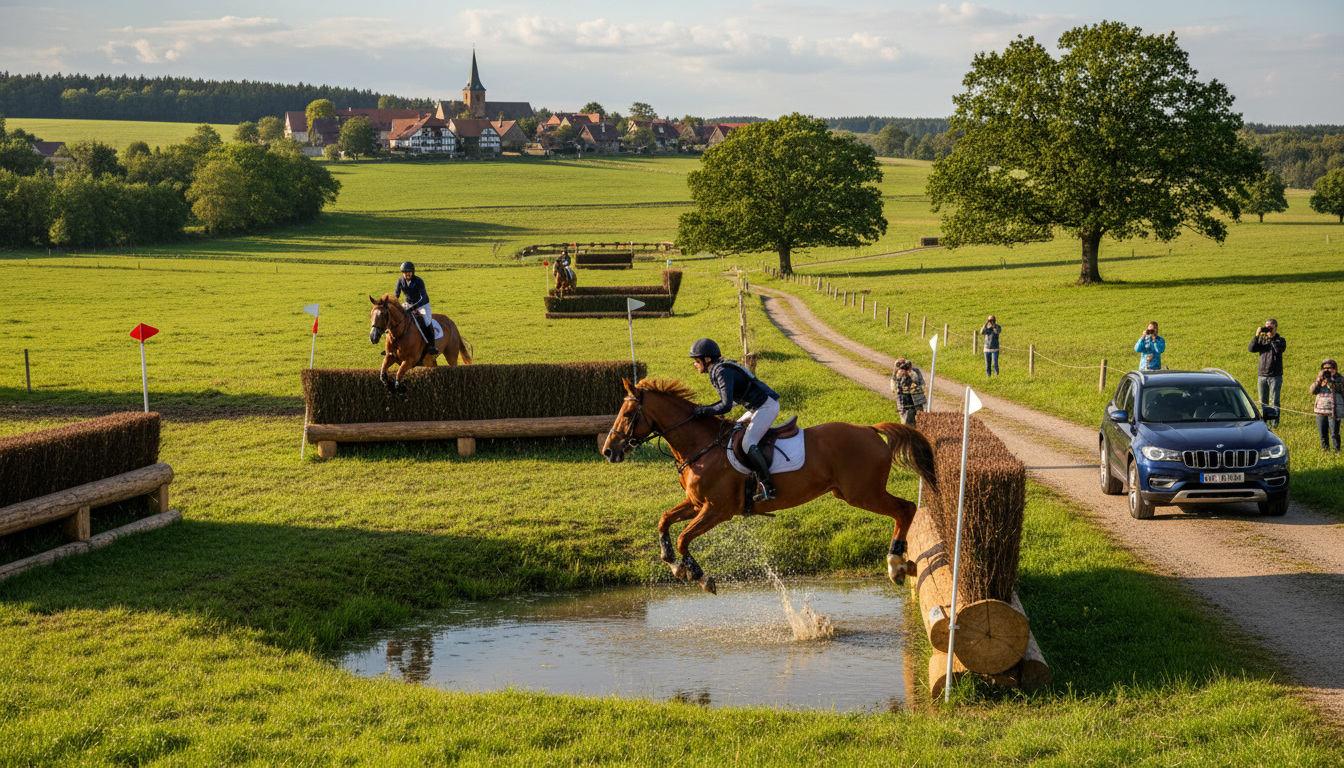
In eventing, the results from dressage, cross-country, and show jumping are combined into a single penalty score. You ride all three phases with the same horse. The winner is the competitor with the fewest penalty points at the end. The dressage score is converted into penalty points, which are then added to the penalties from cross-country and show jumping.
Three Phases, One Overall Result
The German National Equestrian Federation (FN) describes eventing as a competition comprising three equally weighted phases. Dressage, cross-country, and show jumping all contribute to the final result. What matters isn't how a pair performs in a single phase, but their total penalty score after all three challenges.
According to the rule overview from Vielseitigkeitssport Deutschland, an eventing competition can take place over one, two, or three days. The horse remains the same for all phases. However, the schedule can vary. The rule overview does not specify a date. Its calculations illustrate the principle; the current rulebooks are binding.
According to the FN, dressage always opens the competition. The rule overview states that in most national and a few international competitions, show jumping comes first, followed by cross-country. In most international competitions, however, cross-country precedes the final show jumping phase. Therefore, a fixed 'dressage, cross-country, show jumping' order does not apply to every event.
Dressage: Converting Percentages to Penalty Points
According to the German National Equestrian Federation (FN), dressage is ridden individually. For the overall scoring, its result is converted into a penalty score. Only then can it be added to the penalty scores from the other phases.
How this works is explained by the Aachen-Laurensberger Rennverein for the CHIO competition described there: The assessments from three judges yield an average score. This percentage reflects the quality of the dressage test. It is then subtracted from 100.
The rule overview from Vielseitigkeitssport Deutschland distinguishes between two calculations:
- International: 100 minus the achieved percentage points. For 70 percent, this results in 30 penalty points.
- National in Germany: 100 minus the achieved percentage points, multiplied by 1.5 and rounded to one decimal place. For 70 percent, this results in 45 penalty points. The current LPO of the FN is authoritative here.
This reverses the interpretation: for a dressage percentage, a higher score is better. After conversion, a lower penalty score is more favorable. Therefore, when comparing results lists, pay attention to whether the dressage score is shown as a percentage or already in penalty points, and whether it's a national or international competition.
Cross-Country: Obstacles and Time Are Part of the Challenge
According to the FN, the cross-country ride takes place over a course with various natural obstacles. The course must be ridden within a given time. Time penalties accrue for exceeding the optimum time and can thus alter the overall standings.
The optimum time is a target calculated from the course length and speed. The rule overview from Vielseitigkeitssport Deutschland provides the following calculation:
- Course length in meters × 60 ÷ prescribed speed in meters per minute = optimum time in seconds.
Distinguish between the optimum time and the actual time ridden: one is the target, the other is the result of your ride.
Show Jumping: Additional Penalties for the Combined Score
According to the FN, the show jumping phase follows the rules of the specialized discipline of show jumping. Its penalty score is combined with the results of the other phases.
If show jumping takes place the day after cross-country, a veterinary inspection (trot-up) is conducted beforehand, according to the rule overview from Vielseitigkeitssport Deutschland, to assess if the horse is fit to compete. During this, the horse is examined at a halt, walk, and trot. The FN describes a veterinary inspection before show jumping as the standard procedure.
The starting order can also depend on the current standings. For the CHIO competition described, the Aachen-Laurensberger Rennverein explains that dressage and show jumping penalties are first added together. This interim score then determines the starting order for the subsequent cross-country phase.
In contrast, in the World Championship format described by the FN, the final show jumping phase begins in reverse order of the interim standings. The highest-ranked rider up to that point starts last. Both procedures apply only to the specific competitions described.
Which Rules Apply to Your Specific Competition
The basic idea is straightforward: convert dressage scores, combine penalty points, and identify the lowest total. For details, Vielseitigkeitssport Deutschland explicitly refers to the current Leistungs-Prüfungs-Ordnung (LPO) and international rulebooks. If the values there differ from those in the rule overview, the official rulebooks apply.
In Germany, according to the FN on the Leistungs-Prüfungs-Ordnung, the LPO is the rulebook for competitive equestrian sport. Amendments and clarifications published between new editions also form part of the valid rulebook. Furthermore, the Special Provisions of the State Commissions can further define the requirements. Therefore, in Germany, the regulations at the respective event venue must also be observed.
For international eventing competitions, the Fédération Équestre Internationale (FEI) provides its rulebook in both a clean version and with marked changes.
Common questions
Who wins an eventing competition?
According to the FN, the competitor with the lowest total penalty score from the three phases – dressage, cross-country, and show jumping – wins.
Do I have to ride all phases with the same horse?
Yes. According to Vielseitigkeitssport Deutschland, dressage, cross-country, and show jumping must be ridden with one and the same horse.
How is 70 percent in dressage converted?
That depends on the competition. For international dressage scoring, the rule overview from Vielseitigkeitssport Deutschland states the calculation is 100 minus the achieved percentage points, so for 70 percent, it's 30 penalty points. For national competitions in Germany, it additionally mentions a factor of 1.5 with rounding to one decimal place. For 70 percent, this results in 45 penalty points. The rule overview does not specify a date. The current LPO of the FN and the FEI rulebook are binding.
Does cross-country always come before show jumping?
No. According to Vielseitigkeitssport Deutschland, in most national and a few international competitions, show jumping precedes cross-country. In most international competitions, however, cross-country comes before the final show jumping phase. Dressage always comes first, according to the FN.
Sources
- Deutsche Reiterliche Vereinigung (FN): Teilprüfungen, Ablauf und Gesamtwertung – pferdesport-deutschland.de (05.10.2026)
- Die wichtigsten Regeln im Vielseitigkeitssport – Vielseitigkeitssport Deutschland
- Aachen-Laurensberger Rennverein (CHIO Aachen): Umrechnung des Dressurergebnisses und Addition der Fehlerpunkte; veranstaltungsspezifisches A (2027)
- Deutsche Reiterliche Vereinigung (FN): Modus und Anforderungen der Vielseitigkeit am Beispiel einer Weltmeisterschaft; nur für zeitlos übert (17.08.2026)
- Deutsche Reiterliche Vereinigung (FN): Leistungs-Prüfungs-Ordnung als Grundlage nationaler Prüfungen – pferdesport-deutschland.de (14.07.2026)
- Fédération Équestre Internationale (FEI): Zugang zum internationalen Vielseitigkeitsregelwerk; maßgeblich für Dressur-, Gelände- und Springs (01.01.2026)
Written by Equidara editorial team. Last checked: 24 October 2026.
Fachlich geprüft von Melissa Hinze, Pferdezüchterin und Pferdehändlerin, Gründerin von Equidara.
- Understanding Show Jumping Courses: Obstacles, Lines, and Judging — A show jumping course tests more than just clearing fences. Learn to understand different types of jumps, lines, and distances, and distinguish between the fundamental forms of judging.
- Laudrup-Dufour and Freestyle Claim Third Straight Victory in Herning — Cathrine Laudrup-Dufour and Mount St John Freestyle clinched the World Cup Freestyle in Herning with a score of 90.000 percent. Marieke van der Putten secured second place with a personal best.
- Pau Horse Trials: Five-Star Cross-Country with Four Water Combinations — Pierre Michelet's cross-country course demands speed and precise lines. Riders will face 31 numbered obstacles over 6,270 meters.
- Abi Lyle Finishes Second in Her Eventing Debut — Olympic dressage rider Abi Lyle secured second place with Nice Try II in the GoBE80 class at Little Gatcombe. Four time penalties on the cross-country course cost the pair the win.
Related
- Buy horses — Horses for sale from all over the world, with transport search.
- Auctions — Ongoing auctions and individual lots.
- Selling a horse — Kostenlos inserieren, mit Transportsuche für den Käufer.