
Sport & Results
Circus Lessons with Your Horse: Common Mistakes in the Bow and Spanish Walk
What to pay attention to when teaching the Bow and Spanish Walk, why warming up is essential, and how to handle breaks and unsolicited tricks.
Equidara editorial team · 4 October 2026 · 4 min read
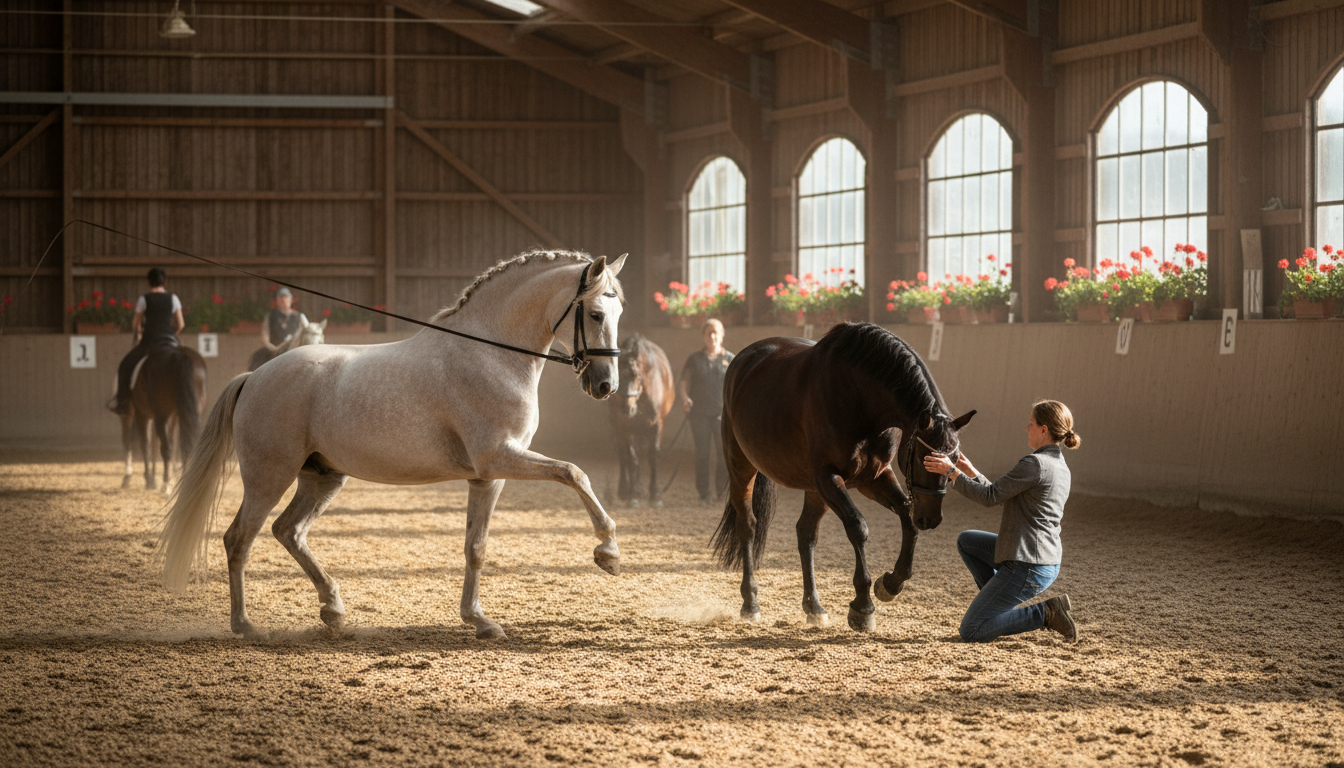
When starting out with equine circus lessons, tailor the training path to your horse, warm them up, and gradually increase the demands. According to Blue&Aline, on-site support is generally advisable. For your horse's well-being and safety, remember: Don't punish your horse if they end a trick on their own. Only reward circus movements when you've asked for them.
Starting Safely: Preparation Over Perfect Tricks
Not every training method suits every horse. Blue&Aline therefore recommends adapting the training individually, rather than rigidly adhering to a traditional approach. If you're working with a book without a good on-site trainer, the blog states you'll need a healthy dose of self-reflection. It also advises you to familiarize yourself with equine anatomy.
Before starting circus lessons, Blue&Aline recommends at least 20 minutes of warm-up. The blog compares correctly executed tricks to stretching exercises that shouldn't be attempted with cold muscles. Conversely, incorrectly performed tricks, according to Blue&Aline, can strain joints, tendons, and ligaments, thus endangering your horse's health. For any health concerns, consult your veterinarian.
Also, pay attention to the footing. According to Blue&Aline, ground that is too hard can make the exercise uncomfortable for the horse.
The Bow: Pay Attention to Form and Hold Time
In the Bow, the horse lowers its forehand and places one bent foreleg down, while the other remains stretched forward. It's not enough for the horse to simply lower itself; its posture must also be correct.
Blue&Aline describes a Bow performed like a “headstand” as a common mistake. Horses in this position are usually too narrow and unbalanced. This leads to incorrect strain on joints and can sometimes hyperextend tendons and ligaments.
The blog lists these characteristics for correct execution:
- Forelegs and hind legs are sufficiently spread apart.
- The resting leg lies evenly from the carpal joint (knee) and forms a 90-degree angle.
- The forward-stretched leg is straight and has no bend.
- The head remains relaxed and doesn't disappear under the horse's body.
According to Blue&Aline, the necessary flexibility should develop slowly. This also applies to the duration of the hold. If your horse quickly stands up again during the initial Bow, the blog states this is normal. So, don't expect them to hold the position for a long time at first.
The Spanish Walk: Involve the Hindquarters
In the Spanish Walk, the horse alternately lifts and extends its forelegs forward. Blue&Aline warns against training only this foreleg action. If the accompanying hindquarters are neglected, the horse becomes strung out and improperly balanced.
The blog describes the desired sequence as: Spanish Walk right, hind leg, Spanish Walk left, other hind leg. It does not mean two foreleg actions followed only then by the hind legs. The hindquarters should be engaged evenly.
Start with the Polka
As a preliminary exercise, Blue&Aline recommends the Polka. This involves alternating a single Spanish Walk movement (left or right) with normal walk steps. Only ask for continuous Spanish Walk steps once this preliminary exercise is truly proficient.
If your horse forgets to engage its hind legs during continuous steps, the blog recommends returning to the Polka. The expressive leg action doesn't have to be perfect immediately: According to Blue&Aline, it often develops over time, once the movement sequence is established and the horse has to consciously coordinate all four legs less.
The Lie Down and Breaks: Patience, Not Pressure
Blue&Aline's author emphasizes that a great deal of patience is needed for teaching the Lie Down. For other tricks too, she advises against expecting too much too soon. Therefore, regularly praise even small progress. According to Blue&Aline, expecting an instantly perfect trick can diminish your horse's motivation.
If your horse ends a trick on its own, the blog states this can often indicate discomfort or a lack of flexibility. Don't punish them for it; instead, gradually extend the duration.
An independent break and an unsolicited trick are two different situations: You don't punish a break. You don't reward a trick performed without a command.
Clear Commands Protect Others
According to Blue&Aline, circus lessons should only be performed on command. This also applies if your horse offers them spontaneously to get a reward.
Unsolicited tricks, even if well-executed, should not be rewarded, but rather ignored, according to the blog. Blue&Aline cites the danger that, for example, a farrier or veterinarian could be unintentionally struck by a hoof.
Common questions
How long should I warm up my horse before circus lessons?
Blue&Aline recommends at least 20 minutes. The blog compares correctly executed tricks to stretching exercises that shouldn't be attempted with cold muscles.
What should I do if my horse immediately stands up from the Bow?
According to Blue&Aline, quickly standing up during the initial Bow is normal. Flexibility and hold duration develop over time. Don't punish the independent break and gradually extend the duration.
When can I ask for continuous Spanish Walk steps?
According to Blue&Aline, only when the Polka is truly proficient. If your horse forgets to engage its hind legs during continuous steps, the blog recommends returning to the Polka.
Should I reward a voluntarily offered trick?
Blue&Aline recommends not rewarding unsolicited tricks, even if well-executed, but rather ignoring them. Circus lessons should only be performed on command.
Sources
- Die häufigsten Fehler bei Zirkuslektionen - Blue&Aline (25. April 2018)
Written by Equidara editorial team. Last checked: 4 October 2026.
- Eventing: MIM Clips to Become More Affordable — More clips for the same package price. MIMsafe is also working on reusable clips and exploring solutions for smaller cross-country obstacles.
- Equine Passport: Who Issues It for Sport Horses, Breeding Stock, and Leisure Horses — Every horse kept in the EU requires registration and an equine passport. The issuing authority depends on whether your horse is registered as a breeding animal or a sport horse. This also includes transponders and entry into the database.
- Scams Targeting Horse Sellers: How to Protect Yourself — Almost all scams boil down to one thing: getting you to hand something over – be it a refund, your horse, or your personal data – before any legitimate payment has actually landed in your account. Learn how to spot red flags in suspicious inquiries early and the golden rules to keep yourself safe.
- EU Animal Transport Regulation: Travel Times and Controls for Slaughter Horses — In Germany, strict transport regulations apply to slaughter horses. Find out what travel times are permitted, which authorities conduct checks, and what documents you need to carry with you.
Related
- Buy horses — Horses for sale from all over Europe, with transport search.
- Auctions — Ongoing auctions and individual lots.
- Selling a horse — Post listings for free, visible in eight languages.