
Health & Therapies
Strangles in horses: how it spreads, the signs and what buyers should know
Strangles is a highly contagious infection of the upper airways. We explain the signs, how it spreads and what silent carriers are, and show how to bring a new horse onto your yard safely.
Equidara editorial team · 22 September 2026 · 7 min read
Strangles is a highly contagious bacterial infection of the upper airways and the lymph nodes of the head. It usually starts with a fever, followed by nasal discharge and swollen, pus-filled lymph nodes between the jawbones. Without complications, the horse is healthy again within two to four weeks. But about one in ten stays a carrier afterwards and can infect other horses without looking ill. So a newly bought horse goes into quarantine for at least three weeks first, and you take its temperature regularly.
The bacterium and how it spreads
Strangles is caused by the bacterium Streptococcus equi subsp. equi. According to the Merck Veterinary Manual, only horses, donkeys and mules become ill with it, and it is most severe in horses aged one to five. A bulletin from the University of Maine notes that strangles often occurs where many horses come and go, for example at competitions, horse sales and livery yards.
The bacterium passes from horse to horse in several ways:
- directly from nose to nose and through droplets from nasal secretions and coughing,
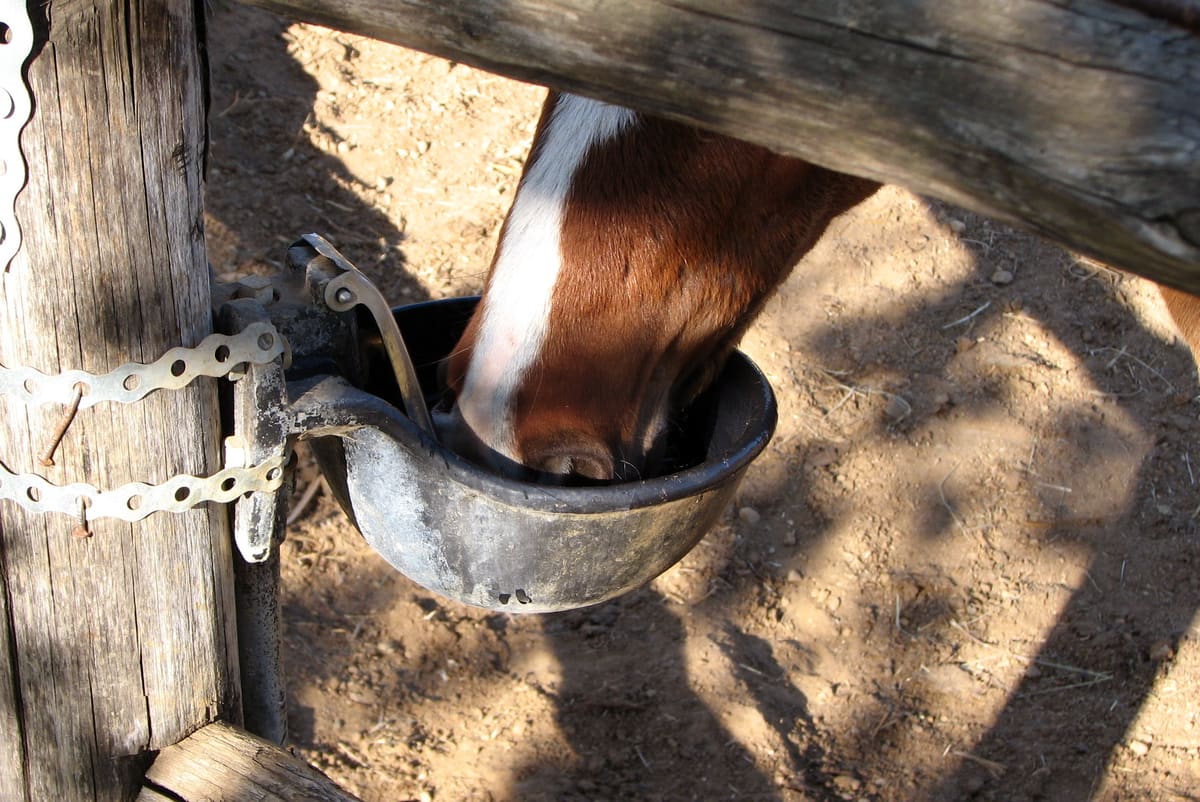
- through shared water troughs, feed buckets, grooming kit, tack and mucking-out tools,
- through the hands, clothes and boots of yard staff, riders and vets.
According to the consensus statement of the American College of Veterinary Internal Medicine (ACVIM), the bacterium stays viable in water for four to six weeks, while on fences and in soil it dies within one to three days.
Signs
According to the ACVIM, the first signs appear 3 to 14 days after infection, usually fever and dullness. The Merck Veterinary Manual gives temperatures of 39.4 to 41.1 °C. These follow:
- nasal discharge, watery at first, later greenish yellow,
- loss of appetite, coughing and difficulty swallowing,
- swollen, painful lymph nodes between the jawbones and behind the jaw.
Very large lymph nodes narrow the throat, and the horse then stretches out its head and neck and struggles to breathe. Later the abscesses may burst and release thick yellow pus, either to the outside or into the guttural pouches. Older horses with some remaining immunity may only become mildly ill, according to Merck, with mucoid nasal discharge, a cough and a mild fever. But according to the ACVIM they also shed bacteria that can make younger horses seriously ill.
According to the equine health service of the Tierseuchenkasse Baden-Württemberg, a German animal disease fund, about one per cent of cases are fatal, and 10 to 20 per cent of horses develop complications such as abscesses in internal organs, pneumonia or purpura haemorrhagica, an immune reaction. According to the ACVIM, rest in a dry, warm stable with soft, moist feed is usually enough. The equine health service advises strict box rest until at least five days after the fever has gone.
If your horse has a fever and nasal discharge, call your vet and separate it from the others at once. Breathing difficulty or problems swallowing are an emergency. Don't give antibiotics on your own: once abscesses have formed, they can delay the abscesses maturing, according to Merck. Your vet decides whether and when they are needed.
Silent carriers in the guttural pouch
According to the ACVIM consensus, on average ten per cent of the horses in an outbreak are left with pus in their guttural pouches. It can thicken into firm pus stones (chondroids) that contain live bacteria. Such horses can shed the bacterium on and off for years. According to the ACVIM, horses that look healthy may infect more horses than sick ones with visible pus. Even after the pus has dried up, horses can remain contagious for at least six more weeks.
How the vet diagnoses strangles
The vet has samples tested by PCR or culture. According to the ACVIM and the equine clinic of LMU Munich, PCR is about three times more sensitive than culture. Possible samples are a swab or needle sample from an abscess, a nasopharyngeal wash, which is more sensitive than a nasal swab, and a guttural pouch wash taken during endoscopy.
Very early on, a test can be negative, because according to the ACVIM the bacterium usually only appears on the mucous membranes 24 to 48 hours after the fever starts.
A blood test only shows that the horse has been in contact with the bacterium at some point, not whether it is ill now or a carrier. If it is positive, the ACVIM advises endoscopy of the guttural pouches with a wash sample.
Suspected case on the yard: quarantine and hygiene
LMU advises that as soon as strangles is suspected, no horses should arrive or leave, and all horse owners on the yard and all service providers should be told. In an outbreak, the ACVIM and LMU recommend a traffic light system:
- Red: horses with signs of disease,
- Amber: horses that have had contact with sick horses,
- Green: horses with no known contact.
Each group has its own buckets, grooming kit and mucking-out tools. Shared water troughs are taken out of use, and according to the ACVIM buckets are disinfected daily. Care goes from green to amber to red. Disinfect your hands before and after touching any horse, and wash your clothes and boots before you visit another yard. Paddocks where sick horses have stood stay closed for four weeks, according to LMU.
Take the rectal temperature of all horses without signs of disease twice a day and write it down. According to LMU, normal is 37.5 to 38.2 °C. A horse with a fever moves to the red group, and the vet is told. The yard vet decides when quarantine ends; according to the ACVIM, at the earliest three weeks after the last case has recovered and once all horses that were ill have tested negative.
A new horse arrives
According to the ACVIM consensus, a new horse should be kept apart from the others for at least three weeks; the British horse welfare charity Redwings gives two to three weeks. Give it its own water and its own equipment, take its temperature regularly and watch for nasal discharge. Redwings counts a resting temperature above 38.5 °C as a fever.
The ACVIM also recommends screening new horses for silent carriers, for example by guttural pouch endoscopy with a wash sample and PCR. Ask your vet whether a blood test or a guttural pouch examination should be added to the pre-purchase examination (vetting), and ask the seller whether there has been strangles on the yard recently.
A horse that has had strangles does not have to be ruled out. According to LMU, recovered horses are usually at least partly immune for several years. Only a test shows whether it is still a carrier.
How to prevent strangles
According to the ACVIM, limiting exposure to the bacterium is still the best protection. For shows and other outings away from the yard, Redwings gives this advice in its strangles guide:
- no direct contact between your horse and other horses,
- don't touch other horses yourself, or wash or sanitise your hands afterwards,
- use only your own tack, rugs and equipment,
- bring your own feed, forage and water from home,
- no communal water troughs and no shared grazing.
Back on the yard, take your horse's resting temperature regularly. People carry the bacterium too: according to Merck, farriers, trainers and vets should wear protective clothing or change their clothes before they go on to the next yard.
According to Redwings, silent carriers are more likely to shed the bacterium when they are under stress, for example when travelling, moving home or meeting new horses. A newly bought horse goes through all of this at once. The University of Veterinary Medicine Vienna lists transport and mixing young horses from different backgrounds as factors that favour outbreaks. According to Vetmeduni, how susceptible a horse is depends on the state of its immune system, for example its age and other illnesses. The University of Maine also counts stress from poor nutrition and overcrowding among the risks. Feed that meets your horse's needs, enough space and journeys kept as short as possible take some of that strain off your horse.
Does strangles have to be reported?
Not in Germany. According to LMU, there is also no legal basis for closing a yard because of strangles. When Germany's animal disease reporting rules were revised, which the Bundesrat approved on 30 January 2026, EHV-1 and equine influenza were added to the list, but strangles was not. The German Society for Equine Medicine (GPM) had applied for it to be included. The ministry refused, according to GPM partly because strangles is not listed as notifiable in EU animal health law.
Whether an outbreak becomes known therefore depends on yard owners and horse owners. LMU points out that covering it up can put other horses at risk.
Common questions
How long should a new horse be kept in quarantine?
At least three weeks according to the ACVIM consensus; the British charity Redwings gives two to three weeks. Take its temperature regularly during this time and watch for nasal discharge. Redwings counts a resting temperature above 38.5 °C as a fever.
Can a horse that looks healthy spread strangles?
Yes. According to the ACVIM, on average ten per cent of the horses in an outbreak keep pus in their guttural pouches and can shed the bacterium on and off for years. The vet can find such carriers with a guttural pouch wash and PCR.
How can I protect my horse from strangles at shows?
The British charity Redwings advises: no direct contact with other horses, only your own equipment, your own feed and water from home, and no communal water troughs. Don't touch other horses, or wash your hands afterwards. Back on the yard, take your horse's resting temperature regularly so you spot a fever early.
Is strangles notifiable in Germany?
No. Strangles was not added when the German animal disease reporting rules were revised, which the Bundesrat approved on 30 January 2026. According to LMU, there is no legal basis for closing a yard because of strangles.
Sources
- Strangles in Horses (Kara M. Lascola, Merck Veterinary Manual)
- Facts on Strangles (Streptococcus equi) Infections in Horses, Bulletin #1009 (University of Maine Cooperative Extension)
- Streptococcus equi Infections in Horses: Guidelines for Treatment, Control, and Prevention of Strangles, Revised Consensus Statement (Boyle et al., ACVIM, Journal of Veterinary Internal Medicine 2018)
- Merkblatt des Pferdegesundheitsdienstes zur Druse des Pferdes (Tiergesundheitsdienste der Tierseuchenkasse Baden-Württemberg)
- Informationen zur Druse (Klinik für Pferde der LMU München) (19.07.2023)
- What is strangles? (Redwings Horse Sanctuary)
- Strangles Speak Out! Redwings guide to Strangles, 2. Auflage 2018 (Redwings Horse Sanctuary)
- Aktuelle Informationen zu Druse-Erkrankungen bei Pferden (Universitätsklinik für Pferde, Veterinärmedizinische Universität Wien) (11.03.2015)
- Bedeutung der Druse für Ministerium nicht ausreichend (Gesellschaft für Pferdemedizin, GPM)
- EHV-1 und Equines Influenzavirus zählen künftig zu den meldepflichtigen Tierseuchen (Thieme Tiermedizin) (20.02.2026)
- Titelfoto: Adamantios, Wikimedia Commons
- Lizenz des Fotos: Creative Commons CC BY-SA 3.0

Written by Equidara editorial team. Last checked: 30 September 2026.
- Equine herpes: what EHV-1 and EHV-4 cause and what to do if you suspect it — Many horses carry equine herpesvirus without showing it. We explain the forms of EHV-1, why the thermometer matters so much, how you can prevent infection and what the 2021 outbreak in Valencia showed.
- Commission on Horse Purchases: When it Arises, Who Pays It, and When It's Forfeited — A commission isn't simply earned because someone offered assistance. It requires a brokerage agreement, a clear link between the activity and the successful sale, and a contract that is actually concluded. If you're working for both parties, you must disclose this, or your claim to the commission is at risk.
- Rescinding a Horse Purchase: Deadlines, Burden of Proof, and How the Reversal Process Works — Rescinding a contract requires a defect that was already present at the time of handover. This is almost always preceded by a deadline for the seller to remedy the defect, followed by a reversal process where the buyer doesn't just return the horse. Learn what applies when, and which mistakes can cost you your claim.
- Warranty in Horse Sales: Private, Commercial, and When You're Considered a Professional Seller — Between private individuals, warranties can be excluded, but not when selling to a consumer. The grey area lies in determining when someone is considered a professional seller, a decision not made by a form, but by the overall circumstances.
Related
- Services and jobs — Farrier, vet, training, horse share.
- Saddles and accessories — For the horse: saddles, rugs, bridles, hoof protection.