
breeds
Icelandic Horse: Gaits, Character, and FEIF Breeding Goal
The Icelandic horse is a versatile riding horse with four or five gaits. Discover what distinguishes Tölt from Flying Pace and learn about the characteristics described in the FEIF breeding goal.
Equidara editorial team · 17 October 2026 · 4 min read
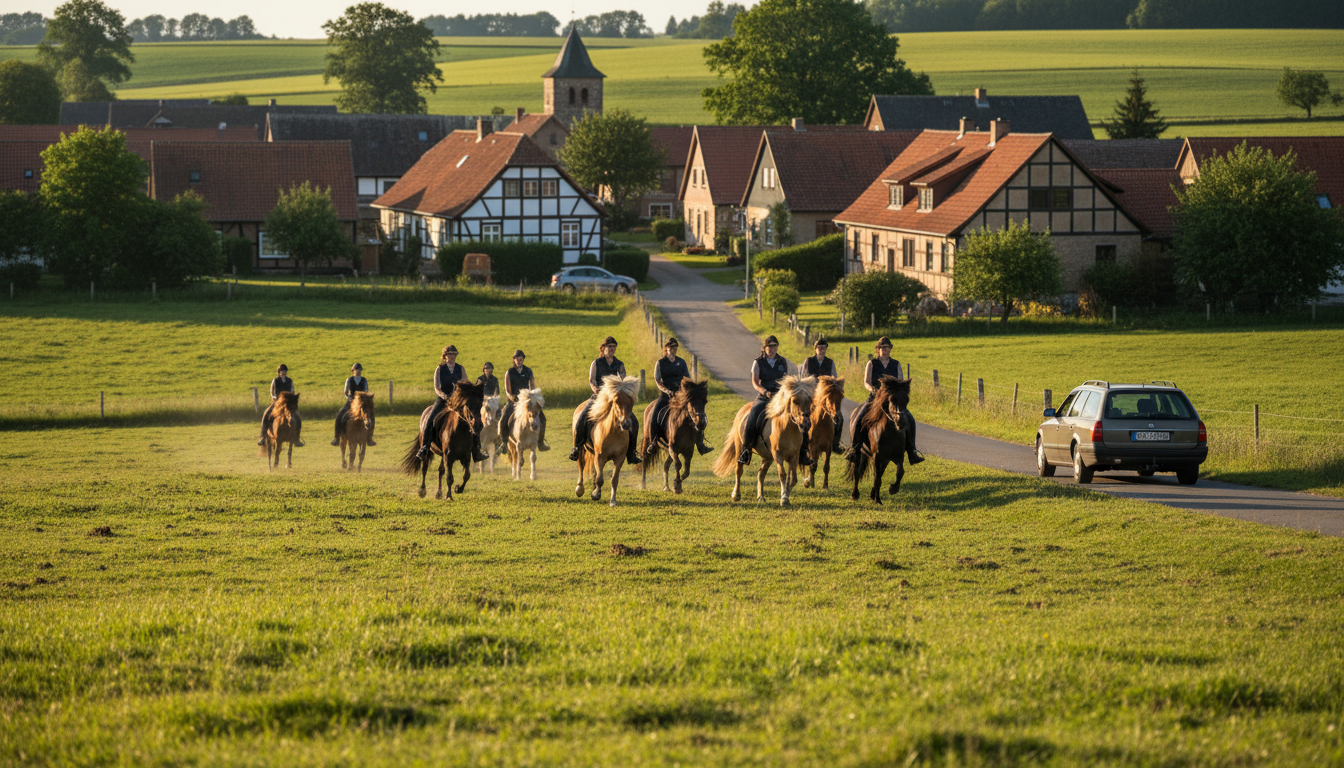
The Icelandic horse is a versatile riding horse, suitable for leisure, trail riding, and competitions. In addition to walk, trot, and canter, it masters Tölt, and many horses also perform the Flying Pace. The FEIF breeding goal and breed description apply to the breed in general. They do not provide a guarantee for an individual horse you might wish to purchase.
Origin and Appearance
According to the FEIF Breed Profile, Icelandic horses are descended from horses brought to the island during the settlement of Iceland between 874 and 930. After that, the population remained free from genetic influence of other breeds for over 1,000 years. As of October 2026, according to FEIF, more than 280,000 Icelandic horses are registered worldwide in the WorldFengur database.
The breeding goal, as presented by the German Equestrian Federation (FN), specifies a height of approximately 135 to 145 centimeters. It encompasses all existing color variations and markings. An Icelandic horse is considered purebred if its paternal and maternal lines can be directly traced back to Iceland.
The Dansk Islandshesteforening, an association from Denmark, also publishes the FEIF breed description. According to this, Icelandic horses typically measure 125 to 145 centimeters at the withers, with mares averaging 136 and stallions 138 centimeters. Fully grown Icelandic horses weigh approximately 300 to 400 kilograms. The height range in this version is thus broader than that stated by the FN. For breeding in Germany, the FN refers to the breeding goal in the current version of the FIZO.
Tölt and Flying Pace: The Additional Gaits
According to the breed description, practically all Icelandic horses possess Tölt in addition to walk, trot, and canter. Many also master the very fast, Flying Pace. In equestrian sport, this is reflected in four-gait tests without pace and five-gait tests including pace.
Tölt: Four-Beat without Suspension Phase
In Tölt, according to the FN, the footfall sequence of the walk is maintained. This results in a flowing, rhythmic movement. The rider sits comfortably even at high speeds.
For competitive Tölt, FEIF gait tests require an even four-beat without a suspension phase. At all times, one or two hooves maintain ground contact. Four-beat means that all four hooves touch down individually, one after another. In contrast, during a suspension phase, no hoof touches the ground.
Flying Pace: Fast and with Suspension Phase
In competition, the Flying Pace should exhibit a clear suspension phase and be ridden at racing speed. FEIF also points out that the action of the forelegs can create a visible four-beat character. According to the FN, Flying Pace reaches a maximum of 50 kilometers per hour.
Pace races with a flying start or from starting gates take place on straight pace tracks. The pace test, which combines gait quality and speed, is also held there. On the oval track, however, there are Tölt tests as well as four-gait tests with walk, trot, canter, and Tölt. Five-gait tests additionally include pace.
Character, Development, and Keeping
FEIF describes Icelandic horses as friendly, spirited, intelligent, and quick to learn. Generally, according to the breed profile, they are considered easy to handle, with good temperament and a high willingness to work.
The breeding goal in the Danish breed description emphasizes a calm, friendly, and cooperative character. This is complemented by courage and reliability in handling and riding. At the same time, it allows for different types in terms of willingness to perform and sensitivity. Thus, not every Icelandic horse reacts the same way or shows the same willingness to work.
According to Dansk Islandshesteforening, Icelandic horses develop slowly. Generally, they are not fully grown until six or seven years of age. A long active life of 25 to 30 years is not uncommon according to this description.
The FN describes the Icelandic horse as an undemanding, all-weather natural horse accustomed to large herds. In autumn, it grows a dense coat with long guard hairs. According to this description, this makes it suitable for year-round natural outdoor keeping.
FEIF and the Breeding Goal
FEIF has introduced an evaluation system and a breeding standard to achieve its breeding goals and maintain the purity of the breed. According to Dansk Islandshesteforening, its breeding goals and breed description were first adopted in 1970. A revised version of the breeding goals was approved by the annual FEIF Delegates' Meeting in 2020. According to the FN, FEIF internationally defines the assessment and selection criteria for Icelandic horse breeding and regulates performance tests.
For Icelandic horse breeding in Germany, according to the FN, the breeding goal of the original breeding area, Iceland, applies in its respective current version, as stipulated and published in the FIZO breeding regulations. As a general breeding expectation, FEIF names a healthy, fertile, long-lived, and robust riding horse that is both elegant and versatile, possessing four or five excellent gaits.
At breeding shows, the conformation should be functional and promote health and durability. FEIF emphasizes weight-carrying ability, natural gait predisposition, and balanced movement under the rider with correct body function.
The breeding goal in the Danish breed description also aims to preserve all possible colors within the breed. However, it notes a limitation: some color variations may be associated with genetic or physical defects that should be avoided.
Common questions
Does every Icelandic horse have five gaits?
No. According to the FEIF breed description published by Dansk Islandshesteforening, practically all Icelandic horses possess Tölt in addition to walk, trot, and canter. Many also master the Flying Pace, but not all.
What distinguishes Tölt from Flying Pace?
FEIF requires an even four-beat without a suspension phase for competitive Tölt. In contrast, for competitive Pace, it should have a clear suspension phase and be ridden at racing speed.
What is the role of FEIF in Icelandic horse breeding?
According to the German Equestrian Federation, FEIF internationally defines the assessment and selection criteria for Icelandic horse breeding and regulates performance tests.
When is an Icelandic horse fully grown?
According to Dansk Islandshesteforening, Icelandic horses develop slowly and are generally not fully grown until six or seven years of age.
Sources
- FEIF – Rasseporträt und Gangarten des Islandpferdes – feif.org
- FEIF – Tölt, Rennpass und Gangprüfungen – feif.org
- Deutsche Reiterliche Vereinigung – Islandpferd: Rassemerkmale, Verwendung und Zucht – pferdesport-deutschland.de
- Dansk Islandshesteforening – FEIF-Rassebeschreibung und Zuchtziel – islandshest.dk
Written by Equidara editorial team. Last checked: 17 October 2026.
- Buying a German Warmblood: Hanoverians, Rhinelanders, and Breeding Documents — Hanoverians and Rhinelanders are described as sport horses and versatile all-rounders. Discover which contacts and breeding documents the Hanoverian Verband offers.
- Buying a Haflinger: Studbook, Character, and Uses — The Haflinger is bred for versatile use in riding and driving. Here, you'll learn what the breeding principles stipulate regarding lineage, temperament, size, and areas of use.
- Buying a Shetland Pony: Breed, Studbook, and Suitability for Children — The Shetland pony is designated as a small riding and driving pony in the German breeding objective. Here, you'll learn about the breed characteristics and what the entries in the Swiss studbook mean.
- Buying a Quarter Horse: Breed, AQHA, and Essential Documents — The American Quarter Horse is bred for pleasure riding, competition, and racing. Here, you'll learn what makes this breed special and which documents are crucial for purchase and breeding.
Related
- Buy horses — Horses for sale from all over Europe, with transport search.
- HorseFinder — Browse horses for sale by swiping, on your phone.
- Wanted — Who is currently looking for something — from horse to stall.