
Transport
Transport Stress in Horses: Recognizing Signs and Preparing for Journeys
Transport stress can begin even before loading. Here's how to recognize warning signs, gradually prepare your horse, and plan for feed and water breaks during the journey.
Equidara editorial team · 17 October 2026 · 4 min read
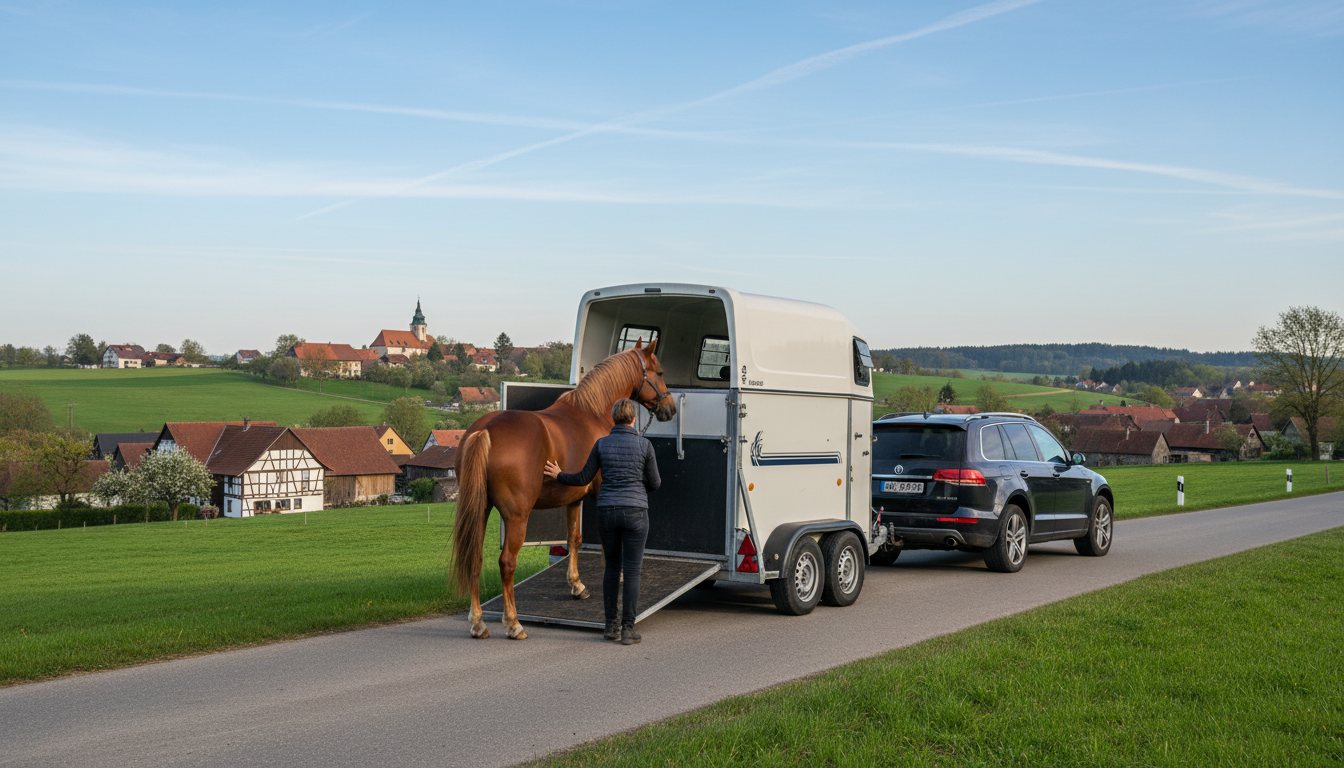
Transport stress in horses can manifest even before loading, for example, through vocalizations, pawing, increased movement, or trembling. You can prevent this with gradual preparation, regular loading training, an adapted driving style, and planned feed and water breaks. Even if your horse loads without issues, observe its behavior throughout the entire journey. If you have doubts about its fitness for travel, seek veterinary advice.
Recognizing Transport Stress Before and During Loading
The review article in the journal Animals describes various signs of fear and transport-related problem behavior. It summarizes studies available up to its publication. Pay attention to the situation in which these signs appear.
- Before loading, vocalizations, pawing, increased movement, and trembling may occur.
- During loading, avoidance may manifest as rearing or pulling away sideways or backwards.
- Also during loading, stress-related behaviors such as pawing, kicking, bolting, and head shaking may occur.
The stress, therefore, doesn't just begin on the road. A study evaluated by the review article found elevated hematocrit, heart rates, and respiratory rates immediately after loading. It described loading as consistently stressful, regardless of the distance traveled.
A horse that loads without apparent issues is not automatically prepared for the entire journey. The British animal welfare organization World Horse Welfare also points this out. They advise continuing to observe behavior throughout the entire journey.
Preparation: More Than Just Loading
According to World Horse Welfare, you should gradually prepare your horse physically and mentally for transport. This includes more than just loading. Practice unloading and standing quietly regularly, even when no journey is planned.
The review article in Animals recommends preparatory groundwork where horse and human work according to correctly applied learning principles. Acclimatization to loading and travel, as well as self-loading, also seem to reduce the risk of transport-related problem behaviors. However, this is not a guarantee for a stress-free journey.
According to World Horse Welfare, many horses travel better with a familiar, calm companion. Therefore, if possible, you can take such a companion horse, especially during early training phases.
Check Before Every Journey
World Horse Welfare recommends checking your horse's fitness for travel before every journey. A previous trouble-free journey does not replace this check.
- Seek veterinary advice if you have concerns.
- Provide your horse with access to forage before starting the journey.
- Ensure it has unrestricted and continuous access to clean drinking water before starting the journey.
During the Journey: Driving Style, Temperature, and Head Movement
Observe how your horse reacts to different road conditions and adjust your driving style accordingly. World Horse Welfare suggests slow acceleration, avoiding harsh braking, and careful driving around bends and roundabouts.
Motion stress and sensory overload, according to the European Food Safety Authority, or EFSA, begin as soon as the vehicle moves and persist throughout the journey. They can lead to fatigue, anxiety, and significant stress. Therefore, in its scientific opinion on horse transport, EFSA recommends limiting journey duration to a minimum. The following EFSA details are from this opinion.
Conditions inside the vehicle also deserve attention. According to the EFSA opinion, the temperature inside the vehicle should not exceed the upper critical temperature, which they estimate at 25 °C dry bulb temperature. This is a scientific recommendation, not a legal limit.
Horses must also be able to lower their heads below wither height to clear their airways. Therefore, EFSA recommends not tying them on both sides or with a rope shorter than 60 cm. According to World Horse Welfare, there is an increased risk of respiratory problems during transport, especially with poor ventilation or if the horse cannot move its head freely for an extended period.
Plan Breaks for Feed and Water
EFSA recommends providing feed and water ad libitum during transport or at least at regular intervals of no more than four hours. In the latter case, feed and water should be offered for 30 minutes each while the vehicle is stationary.
The four hours are not a period without stress: According to EFSA, behavioral signs of thirst were reported after three hours, and physiological indicators of dehydration were observed after just one to three hours of transport.
Therefore, plan for provisions as an integral part of the journey. According to EFSA, problems due to a lack of rest also increase with longer journey durations, which can lead to fatigue.
Observation remains important but has its limits. EFSA has identified behavioral, clinical, and physiological indicators for assessing welfare. However, their utility inside a transport vehicle is limited.
After Arrival: Allow Access to Water and Movement
According to World Horse Welfare, after the journey, your horse should have unrestricted access to water. It should also be able to stretch its head, neck, and legs. Hand grazing or turnout, if possible and safe, are suitable for this.
Common questions
How can I recognize transport stress even before loading?
According to the review article in the journal Animals, vocalizations, pawing, increased movement, and trembling can be signs of anxiety even before loading.
Is it enough if my horse loads without issues?
Not necessarily. According to World Horse Welfare, even horses that seem to load easily may not yet be ready for transport. Therefore, observe your horse throughout the entire journey.
How often does my horse need feed and water during the journey?
EFSA recommends in its scientific opinion that feed and water be provided ad libitum or at least at intervals of no more than four hours for 30 minutes each while the vehicle is stationary. This is a recommendation, not a legal requirement.
What should I practice regularly, regardless of a planned journey?
World Horse Welfare recommends regularly practicing loading, unloading, and standing quietly, even when no journey is planned. Preparation should be gradual, both physically and mentally.
Sources
- Fachzeitschrift Animals: How to minimise the incidence of transport-related problem behaviours in horses: a review – Übersichtsarbeit zu Ver (20.09.2017)
- Travelling safely: is your horse fit to travel? - World Horse Welfare (17/7/2026)
- Europäische Behörde für Lebensmittelsicherheit (EFSA): Wohlergehen von Pferden beim Transport – Empfehlungen zu Platz, Temperatur, Fahrtdaue (07.09.2022)
- Welfare of equine during transport | EFSA (07.09.2022)
Written by Equidara editorial team. Last checked: 17 October 2026.
- Loading Your Horse: Avoiding Stress and Training Safely — Loading training works best in short, calm steps. Preparation, the right equipment, and knowing your horse's limits are key.
- Choosing a Horse Transport Company: What Credentials Matter? — Check the company's authorization, the drivers' and attendants' certificates of competence, and vehicle documents for long journeys. The route, transport duration, and applicable exemptions are crucial.
- Horse Trailer and TÜV: Technical Inspection Deadline, Sticker, and Inspected Components — When does your horse trailer need its technical inspection in Germany? Here you'll find out where to check the date, how to read the inspection sticker, which components are checked, and how to pre-check your trailer for defects.
- Bringing a Horse to a Non-EU Country: Certificates, TRACES, and Import Regulations — When exporting a horse, you need to consider the destination country's requirements and the procedures at the place of origin. Using Germany, Switzerland, and Luxembourg as examples, find out which certificates are necessary and what you need to know about TRACES, inspections, and deadlines.
Related
- Request horse transport — Route, horse, date: carriers send you a quote.
- Find animal transport — Move your animal arranges transports in Europe.
- Trailers and transporters — Horse trailers, trucks, carriages and accessories.