
Innovations
Modern Open Stable Concepts: Smart Planning of Paths, Footing, and Technology
Free movement, suitable footing, and access to feed and resting areas: Here's how to plan group housing, incorporate mechanical track systems, and integrate complementary automation.
Equidara editorial team · 21 October 2026 · 5 min read
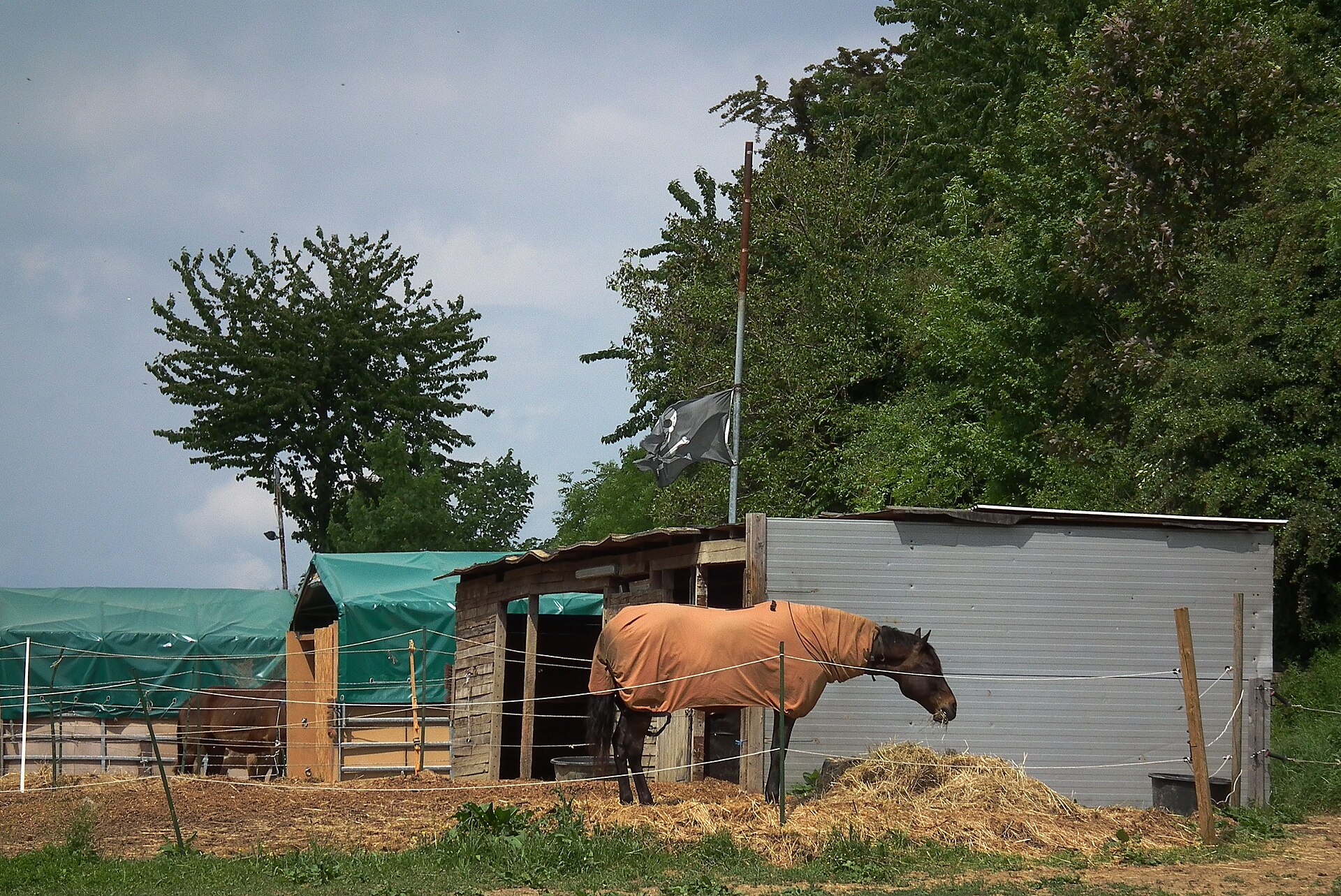
A modern open stable doesn't necessarily require computer-controlled technology. You can also organize horse movement with mechanical paddock trail systems. Key planning considerations include ample free movement, appropriate footing, and easily accessible feeding and resting areas. The Deutsche Landwirtschafts-Gesellschaft (DLG) provides recommendations for designing turnout areas. A Bachelor's thesis from the Hochschule für Wirtschaft und Umwelt Nürtingen-Geislingen describes track concepts without computer control and categorizes complementary automation.
Prioritize Free Movement and Space in Your Planning
According to DLG-Merkblatt 499, even horses that are regularly exercised need additional free movement. Overall, they should be able to move freely for at least two hours a day. The DLG generally recommends several hours of free movement for all horses, regardless of weather, ideally in groups, allowing for all three gaits.
If pasture and turnout areas compete for the same space, the DLG advises prioritizing year-round, weather-independent turnout.
For the size of the area, the leaflet mentions two approaches from Germany. Both are planning recommendations, not legal requirements:
- Based on the 2009 guidelines from the Federal Ministry of Food and Agriculture (BMEL), the leaflet recommends a minimum of 150 m² for turnout areas for free movement for up to two horses. An additional 40 m² should be provided for each subsequent horse. Rectangular or round shapes are recommended.
- As a more extensive recommendation, the DLG cites the 2021 position paper from the Tierärztliche Vereinigung für Tierschutz (TVT): a minimum of 200 m² for up to two large horses, plus an additional 80 m² for each subsequent horse.
The TVT's values are thus more generous. According to the DLG, a small turnout area under 150 m² does not offer sufficient free movement due to its size. The DLG also includes individual paddocks attached to outdoor stalls in this category.
Designing Movement Tracks Without Computer Control
The Bachelor's thesis on mechanical paddock trails from the Hochschule für Wirtschaft und Umwelt Nürtingen-Geislingen investigates concepts without computer-controlled technology. It is based on visits to eight reference farms, all built by the same planner. Therefore, its statements regarding system choice, costs, and labor time can only be applied to other operations to a limited extent. The thesis describes three track systems.
Loop, One-Way, or Controlled Track Systems
In a loop track system, hay feeding areas are distributed along the trail. Horses can move freely between them.
In a one-way system, feeding and resting areas are centrally located but spatially separated, requiring horses to use the trail when moving between them.
The controlled track system is similar to the one-way system. Here, a one-way gate connects the feeding and resting areas.
According to the Bachelor's thesis, the choice of system depends on location, herd size, and personal preference. Complementary automated systems increase investment and maintenance costs. The thesis equates the labor requirement of a paddock trail with that of an active stable. According to the study, labor time can primarily be saved with good ground reinforcement, as it allows for more machine use.
The thesis itself notes that there has been little research on paddock trails so far. It identifies further research needs in areas such as movement, herd management, labor requirements, and cost calculation.
Harmonizing Footing and Feeding Areas
The DLG recommends reinforcing heavily used areas, including turnout entrances, feed racks, and water troughs. At the same time, it warns against excessive hoof wear if the ground is exclusively hard.
According to the DLG, varying hard and soft ground, as well as inclines and declines, train the musculoskeletal system. Additionally, horses should be able to roll on unpaved ground. Therefore, a turnout area consisting solely of reinforced surfaces does not comply with these recommendations.
Feeding also needs to be included in the turnout area planning. The DLG stipulates providing roughage in the turnout area if horses would otherwise go without food for four hours or longer. If roughage is offered there, every horse must be able to eat without stress.
Considering Shelter and Resting Areas for the Group
Additional guidance is provided by the Scottish Government's Code of Practice for the Welfare of Equidae. This applies in Scotland, not in Germany.
For compatible groups in communal stables, the Code requires that each animal has adequate access to hay, feed, and water. There must also be enough space for all animals to move freely and lie down simultaneously. It recommends forming compatible groups and separating particularly aggressive animals.
The Code describes year-round outdoor housing as possible for some robust, thick-coated horse and pony breeds. The prerequisite is protection from prevailing wind, summer sun, and flies. Less robust, clipped, very young, or old animals may require a stable or other shelter to protect them from cold and wet conditions or extreme heat.
For shelters, the Code recommends:
- adequately level, non-slip flooring with good drainage that directs waste away from the animal,
- windows and ventilation openings that ensure sufficient air circulation without creating drafts,
- non-toxic, dust-free, and mold-free bedding that keeps the resting area dry through drainage or good absorbency and promotes fresh air,
- even on rubber mats, some bedding that absorbs urine and is subsequently disposed of.
If horses cannot be removed from pastures that have become muddy, the Scottish Code still requires them to have a comfortable, well-drained area for standing, lying, feeding, and drinking. For stabled horses, it also provides for a pre-arranged evacuation plan so that they can be quickly moved outdoors in case of fire or other emergencies.
Common questions
Does a modern open stable require computer-controlled technology?
Not necessarily. The Bachelor's thesis from the Hochschule für Wirtschaft und Umwelt Nürtingen-Geislingen describes mechanical paddock trails without computer control. According to the study, complementary automated systems increase investment and maintenance costs. The thesis is based on eight farms designed by the same planner, so its results can only be generalized to a limited extent.
Does riding replace free movement?
According to DLG-Merkblatt 499, no. Even horses that are regularly exercised need additional free movement, so they can move freely for at least two hours a day in total.
What is the difference between a loop track and a one-way system?
According to the Bachelor's thesis, in a loop track system, hay feeding areas are distributed along the trail. In a one-way system, feeding and resting areas are centrally located but separated in such a way that horses must use the trail when moving between them.
Should the entire turnout area be reinforced?
No. The DLG recommends reinforcing heavily used areas such as entrances, feed racks, and water troughs. At the same time, it warns against excessive hoof wear from exclusively hard surfaces. Rolling on unpaved ground should also be possible.
Sources
- Deutsche Landwirtschafts-Gesellschaft: DLG-Merkblatt 499 – Planungsempfehlungen zur Gestaltung von Pferdeausläufen – dlg.org (11/2024)
- Hochschule für Wirtschaft und Umwelt Nürtingen-Geislingen: Planungshinweise für einen mechanischen Paddock-Trail & Offenstall – hfwu.bsz-bw. (23.07.2022)
- Schottische Regierung: Welfare of equidae – The need for a suitable environment; Sicherheit, Entwässerung und Belüftung – gov.scot
- Titelfoto: 4028mdk09, Wikimedia Commons
- Lizenz des Fotos: CC BY-SA 3.0

Written by Equidara editorial team. Last checked: 24 October 2026.
Fachlich geprüft von Melissa Hinze, Pferdezüchterin und Pferdehändlerin, Gründerin von Equidara.
- Digital Equine Passport: What Has Been Tested and Announced, and What the Law States — Digital equine records and platforms do not replace the mandatory equine passport. Find out what EU law requires, how a previous pilot project in Baden-Württemberg operated, and what has been announced for Equipass.
- Artificial Insemination, Embryo Transfer, and OPU in Horses: What You Should Know When Buying a Foal — Artificial insemination is an integral part of modern horse breeding. Learn how it differs from embryo transfer and in-vitro fertilization, and what information you should clarify when purchasing a foal.
- Electric Car as a Towing Vehicle for Your Horse Trailer: Technology, Range, and Charging — Modern electric cars are capable of towing heavy horse trailers. Whether one is right for your hauling needs depends on the vehicle's towing limits, its range with a trailer, and available charging options on your route.
Related
- HorseFinder — Browse horses for sale by swiping, on your phone.
- Buy horses — Horses for sale from all over the world, with transport search.
- All articles in the journal — From guides to breed portraits.