
Transport
Horse Trailers: Driving Licence, Nose Weight, Safety in Germany, Austria & Switzerland
Find out which driving licence you need for a horse trailer or lorry, what nose weight means, and how to travel safely – with rules for Germany, Austria and Switzerland.
Equidara editorial team · 27 September 2026 · 4 min read
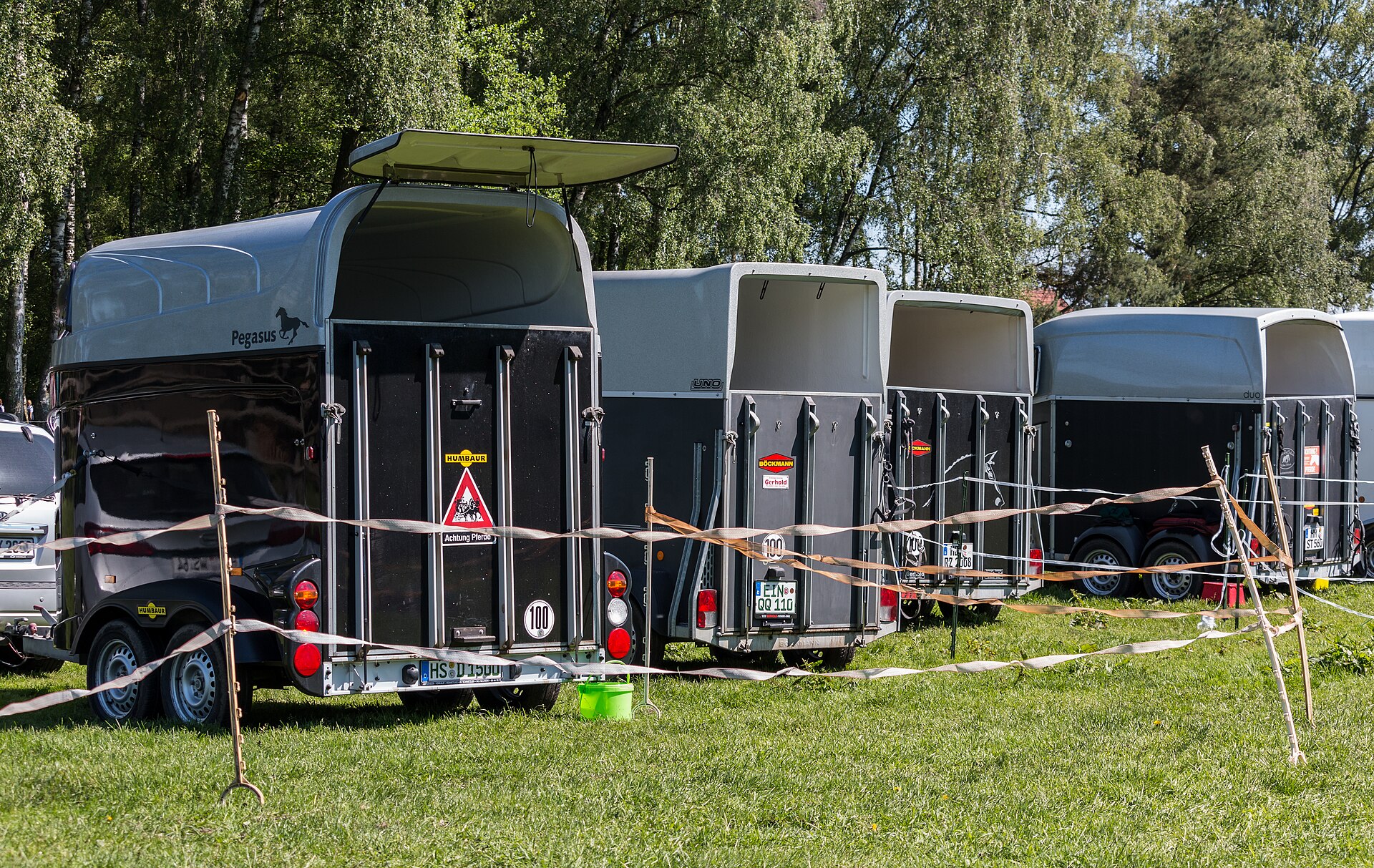
Whether you're heading to a show, out on a hack or to the vet: if you transport your horse in a trailer, you not only need to secure the animal, but also have the correct driving licence and know how the vehicle works. The regulations differ in Germany, Austria and Switzerland. Here's what matters.
Driving Licence: Which Class for Horse Trailers and Lorries?
The licence you need depends on the permissible maximum mass of the combination – that is, towing vehicle plus trailer. For a lorry, the licence classes are based on weight; vehicles over 3.5 t require a lorry licence (C1 or C). Check with your driving licence authority.
Germany
With a standard car licence Class B, you may drive a towing vehicle up to 3,500 kg permissible maximum mass (PMM) and tow a trailer up to 750 kg. You can also tow a heavier trailer as long as the total PMM of car and trailer does not exceed 3,500 kg.
If that's not enough, you have two options:
- Code B96: Allows a combination up to 4,250 kg PMM. A one-day training course without a test is sufficient.
- Class BE: The trailer may have a PMM of up to 3,500 kg. You need practical lessons and a test (covering country roads, motorway, night driving).
Austria
In Austria, you need licence E to B (now Class BE) if the sum of the maximum permissible masses of towing vehicle and trailer exceeds 3,500 kg or if the actual weight of the trailer exceeds the maximum permissible mass of the towing vehicle. Old Class E licences remain valid.
Switzerland
With the new credit-card-style driving licence (issued from 1 April 2003):
- Category B: Trailers up to 750 kg total weight.
- Category BE: Trailers over 750 kg (i.e., all standard horse trailers).
Holders of the old blue licence (issued before 2003) were allowed to tow trailers over 750 kg with Category B. These licences had to be exchanged by 31 January 2024.
Nose Weight and Towing Capacity: What to Look Out For
Besides the licence, the technical specifications determine whether your combination is safe and legal.
- Towing capacity: The towing vehicle may only pull a trailer whose actual weight (unladen weight plus load) does not exceed the registered towing capacity. You'll find this value in the vehicle registration document Part I under O.1 (technically permissible braked towing capacity) and O.2 (unbraked).
- Nose weight: The vertical force exerted by the drawbar on the towball. It must be within the limits specified by the vehicle manufacturer – neither too high nor too low. The permissible nose weight is given in the vehicle registration document (in Germany often under point 13) and on the coupling's rating plate.
- Actual weight: Don't forget to include the weight of the horses, feed and equipment. A 1.5-horse trailer often weighs between 650 and 1,200 kg empty; with two horses it quickly adds up to 1,500 kg or more.
You'll find the exact values for your vehicle in the vehicle registration document (Part I). If in doubt, consult a specialist workshop or your vehicle dealer.
Staying Safe on the Road with a Horse Trailer
The following points help reduce the risk of accidents – many of them are legally required in Switzerland.
- Speed: In Switzerland, the maximum speed for trailer combinations is 80 km/h, even on motorways. Similar limits apply in Germany and Austria. Always adjust your speed to road and weather conditions.
- Mirrors: Both exterior mirrors must be adjusted so you can see the road beside the trailer and at least 100 m behind you.
- Brakes: Trailers over 750 kg require their own service brake (e.g., overrun brake) and a parking brake. The breakaway cable must be attached so that the brake applies automatically if the trailer becomes detached.
- Tyres: Even with little tread wear, tyres become brittle over time. Replace them after five years at the latest and check tyre pressure regularly (often up to 5 bar).
- Load: The load must not protrude sideways from the trailer. Windows and doors must be closed while driving; when parked unattended with horses inside, also close the rear ramp and service door, but leave windows open for fresh air.
- Parking: Never unhitch a trailer containing horses. Always secure the combination with wheel chocks when stationary – even on level ground, as wind can move the trailer.
- Maintenance: Regularly check the lights (indicators, brake lights), have brakes and coupling serviced.
Costs for Licence and Equipment
The cost of the B96 training course or the practical BE test varies by region and driving school. A B96 course in Germany usually costs between €350 and €600. Also budget for your own trailer liability insurance – it is inexpensive and protects you if the trailer causes damage while unhitched.
In Switzerland, trailers over 750 kg require their own motorway vignette, even if the towing vehicle already has one.
For commercial horse transport, additional certificates of competence or transport licences are required in all three countries. Private individuals transporting their own horse generally do not need these.
Common questions
What is the difference between code B96 and a BE licence?
With B96 you may drive a combination up to 4,250 kg permissible maximum mass in Germany. A one-day training course without a test is sufficient. With BE, the trailer may weigh up to 3,500 kg, but you must pass a practical test.
Do I need to buy a motorway vignette for my horse trailer in Switzerland?
Yes, trailers over 750 kg gross weight require their own vignette – even if the towing vehicle already has one.
What do I need to watch out for regarding nose weight?
The nose weight must not exceed the maximum specified by the vehicle manufacturer, but it also shouldn't be too low, or the combination will become unstable. The permissible nose weight is listed in the vehicle registration document (in Germany under point 13) and on the coupling's rating plate.
Do I need a special licence for a lorry?
For a lorry up to 3.5 t, a standard car licence Class B is sufficient. Heavier vehicles require Class C1 (up to 7.5 t) or C. Check with your driving licence authority.
Sources
- Welcher Führerschein ist für das Fahren eines Pferdeanhängers erforderlich?
- Pferde und Recht - Pferdetransport
- Fahren mit Pferdeanhänger
- Handbuch
- Merkblatt Pferdetransporte
- Titelfoto: Dietmar Rabich, Wikimedia Commons
- Lizenz des Fotos: CC BY-SA 4.0

Written by Equidara editorial team. Last checked: 24 October 2026.
Fachlich geprüft von Melissa Hinze, Pferdezüchterin und Pferdehändlerin, Gründerin von Equidara.
- Loading Your Horse: Avoiding Stress and Training Safely — Loading training works best in short, calm steps. Preparation, the right equipment, and knowing your horse's limits are key.
- Electric Car as a Towing Vehicle for Your Horse Trailer: Technology, Range, and Charging — Modern electric cars are capable of towing heavy horse trailers. Whether one is right for your hauling needs depends on the vehicle's towing limits, its range with a trailer, and available charging options on your route.
- Choosing a Horse Transport Company: What Credentials Matter? — Check the company's authorization, the drivers' and attendants' certificates of competence, and vehicle documents for long journeys. The route, transport duration, and applicable exemptions are crucial.
- Horse Trailer and TÜV: Technical Inspection Deadline, Sticker, and Inspected Components — When does your horse trailer need its technical inspection in Germany? Here you'll find out where to check the date, how to read the inspection sticker, which components are checked, and how to pre-check your trailer for defects.
Related
- Request horse transport — Route, horse, date: carriers send you a quote.
- Find animal transport — Move your animal arranges transports in Europe.
- Trailers and transporters — Horse trailers, trucks, carriages and accessories.