
Law & Safety
Your Horse Purchase Agreement: What to Include and Where Templates Fall Short
Even a verbal agreement is legally binding when buying a horse. But putting it in writing is crucial for proving what was agreed upon later. We'll cover the eight essential points for every horse purchase agreement, explain why a warranty disclaimer isn't a catch-all, and when it's smart to consult an attorney.
Equidara editorial team · 6 October 2026 · 5 min read
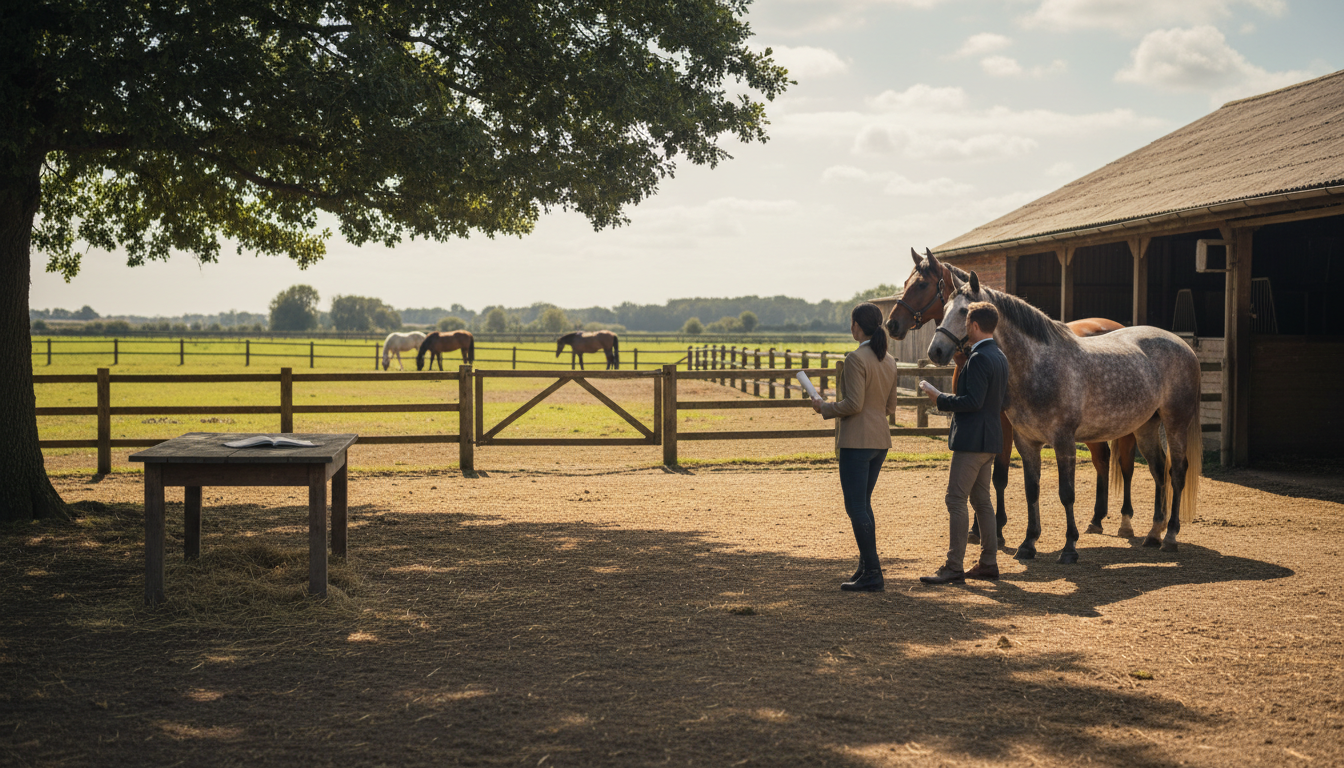
Legally speaking, buying a horse is just like any other purchase: it's finalized as soon as both parties agree on the horse and the price. A handshake can even suffice! However, a written contract serves a crucial purpose. If lameness appears six weeks down the line, or the horse's passport is nowhere to be found, it's not what was said that matters, but what can be proven.
The Eight Essential Points
- Full Details of Both Parties. Include names, addresses, phone numbers, and email addresses. If someone is selling on behalf of another, this must be clearly stated in the contract.
- Clear Identification of the Horse. This means its name, UELN (Unique Equine Life Number), transponder number (microchip), breed, year of birth, color and markings, and height. The microchip number is the most foolproof identifier.
- Purchase Price and Payment Method. Also, include a retention of title clause: the horse remains the seller's property until the full purchase price has been paid. German law addresses this in § 449 BGB.
- Date and Location of Handover. Specify who is responsible for transport costs and when the risk of loss or damage transfers from seller to buyer.
- Agreed-Upon Qualities and Purpose. This specifies what the horse is being sold for: as a pleasure horse, a dressage horse at L-level, or a broodmare, for example. This is arguably the most crucial point in the entire contract – more on this below.
- Known Defects and Pre-existing Conditions. The seller should list everything they know. This protects them more than it protects the buyer.
- The Pre-Purchase Examination (PPE): State whether a PPE was performed, consciously waived, or agreed upon as a condition. If a PPE was done, the vet report should be attached as an appendix.
- Documents. The horse's Equine Passport must accompany it and be handed over in original form. Also include the Certificate of Ownership and vaccination records.
Why Agreed-Upon Qualities Outweigh a Warranty Disclaimer
Between private individuals, it's permissible to exclude warranties, and almost every template includes such a clause. However, it covers less than many people believe.
In 2006, the German Federal Court of Justice (Bundesgerichtshof) ruled that if parties have agreed upon specific qualities, a general warranty disclaimer does not override this agreement. Otherwise, the promise would be worthless to the buyer, which was clearly not the parties' intention (Judgment of November 29, 2006, VIII ZR 92/06).
For your contract, this means: If you write "easy to load" or "good with the farrier," you are liable for these qualities, even with a disclaimer. If you write nothing, you're selling a horse without assured characteristics. Both approaches are valid, but you should understand the implications.
Also never covered by a disclaimer: defects the seller knew about and concealed. This is stipulated in § 444 BGB.
Free or Purchased?
The Deutsche Reiterliche Vereinigung (German Equestrian Federation) sells a "private" horse purchase agreement as a download in their shop for 4.00 Euros. It's three pages long and current as of May 2022; according to the description, it's suitable for sales between private individuals, between businesses, and from a private seller to a business.
However, a contract isn't more effective just because a well-known name is associated with it. In court, what matters is the content and whether it fits the specific case. Our template contracts are free, can be filled out and printed directly in your browser, and if you start from an ad, the horse's details are already pre-filled in the form.
Deposit, Reservation, and Withdrawal
Often, weeks pass between "we've agreed" and the actual handover: the pre-purchase exam is scheduled, transport needs to be organized, or the money hasn't arrived yet. During this time, both parties want security, and this is where most disputes arise.
A separate preliminary contract is rarely necessary. In most cases, the purchase agreement itself is sufficient, supplemented by three pieces of information: the amount of the deposit, the deadline for the remaining payment, and what happens to the deposit if the sale doesn't go through. Without this third point, you'll likely dispute it later.
It's important to note: there is no general right of return for horse purchases. The right of withdrawal, familiar to many from online shopping, applies to consumers ordering from a business, not to purchases between two private individuals. If you want a trial period, you must agree upon it, including its duration, return location, and who is liable for and insures the horse during that time.
The Papers: Two Documents Often Confused
The Equine Passport belongs to the horse. It must accompany the horse and be handed over with it, in original form. A horse cannot be transported without its passport, and obtaining a new one later is a complicated process.
The Certificate of Ownership, on the other hand, is a document from the breeding association. It states who is registered as the owner and is handed over and re-registered upon sale. If you don't receive it, you should inquire why before making payment.
Additionally, there are vaccination records, findings from previous examinations, and, for sport horses, competition papers. The contract should include a list of what documents are actually being handed over. This takes two minutes and saves phone calls later.
A Quick Checklist Before Signing
- Does the transponder number in the contract match the one in the passport? Read the microchip before you pay.
- Does the contract state what the horse is being sold for?
- Are known pre-existing conditions listed, and are both parties in agreement?
- Is it regulated when ownership transfers and who insures the horse until then?
- Does each party have a signed copy?
Checking these five points off your list will help you avoid most common disputes before they even begin.
When an Attorney Should Review the Contract
- The purchase price is in the five-figure range.
- The pre-purchase examination revealed findings that you are negotiating.
- The buyer or seller is located abroad, and the contract needs to be bilingual.
- The sale is commercial (business) to a private individual. In this case, the warranty cannot be excluded.
- The purchase price is paid in installments, and the horse is already with the buyer.
A template covers the normal case. It does not replace legal advice, and it certainly doesn't replace the conversation about what both parties actually want to agree upon.
Common questions
Does a horse purchase agreement have to be in writing?
No. A purchase agreement is concluded as soon as both parties agree on the horse and the price, even verbally. However, a written agreement allows you to later prove what was agreed upon: price, condition, pre-purchase examination, and warranty. This is precisely what matters in case of a dispute.
Can I, as a private individual, sell without a warranty?
Yes, between private individuals, an exclusion is permissible. However, it does not apply to defects you knew about and concealed (§ 444 BGB), nor, according to the BGH's jurisprudence, to qualities you explicitly agreed upon.
What does "agreed-upon qualities" mean in a horse purchase?
Everything you guarantee about the horse in the contract: its intended use, its level of training, qualities like being easy to load or good with the farrier. If an assured quality is missing, a general warranty disclaimer does not help the seller (BGH, VIII ZR 92/06).
Who owns the horse before the purchase price is fully paid?
If you agree on a retention of title, the horse remains the seller's property until full payment (§ 449 BGB). This is particularly important for deposits and installment payments and should therefore be included in the contract.
Is a purchased template contract worthwhile?
Legally, the publisher makes no difference; the content is what matters. The FN sells its contract for 4 Euros as a download, while Equidara offers free templates that you can fill out. For high purchase prices, international sales, or commercial sales, neither replaces legal review by an attorney.
Sources
- § 433 BGB – Vertragstypische Pflichten beim Kaufvertrag (gesetze-im-internet.de, Bundesministerium der Justiz)
- § 444 BGB – Haftungsausschluss (gesetze-im-internet.de, Bundesministerium der Justiz)
- § 449 BGB – Eigentumsvorbehalt (gesetze-im-internet.de, Bundesministerium der Justiz)
- BGH, Urteil vom 29.11.2006 – VIII ZR 92/06 (BGHZ 170, 86): Reichweite eines allgemeinen Gewährleistungsausschlusses neben einer Beschaffenheitsvereinbarung (29.11.2006)
- Beschaffenheitsvereinbarung; Reichweite eines allgemeinen Gewährleistungsausschlusses (Deutsches Notarinstitut)
- Pferdekaufvertrag „privat" (Download, 4,00 €, Stand Mai 2022) im Shop der Deutschen Reiterlichen Vereinigung (FN)
Written by Equidara editorial team. Last checked: 6 October 2026.
- Buying a Horse Abroad: Essential Questions to Ask Before Your Deposit — Within the EU, the paperwork is straightforward: an equine passport, health certificate, and TRACES. But the questions you ask *before* that are far more critical. Clarifying who is selling you the horse, which legal jurisdiction applies, who arranges the pre-purchase exam, and the payment schedule will determine your legal standing should a dispute arise.
- Buying a Horse Online: What Your Contract Must Include When No One Has Test Ridden — A right of withdrawal is almost never applicable when buying a horse. If you're buying or selling without an in-person viewing, your contract is your safeguard. Four key points truly mitigate the risk: defining the intended use, a pre-purchase examination with a clear deadline, staggered payments, and an honest video.
- Selling a Horse on Installments: What Retention of Title Achieves and Where Its Gaps Lie — The horse moves to its new home, but the payments trickle in over months. While retention of title keeps ownership with you until the final installment, it doesn't protect against every resale. Plus, there's the question of liability, as the keeper and owner are not always the same.
- Warranty in Horse Sales: Private, Commercial, and When You're Considered a Professional Seller — Between private individuals, warranties can be excluded, but not when selling to a consumer. The grey area lies in determining when someone is considered a professional seller, a decision not made by a form, but by the overall circumstances.
Related
- Purchase contract template — Template for horse and saddle to fill out.
- Buy and pay safely — How to recognize fraud schemes.
- Buy horses — Horses for sale from all over Europe, with transport search.