
Law & Safety
How to spot a fake horse ad: check the listing before you pay
The horse looks perfect, so does the price, and the seller happens to be abroad. Using an example ad we built ourselves, we show the six typical warning signs and how to check a listing in ten minutes.
Equidara editorial team · 19 September 2026 · 4 min read
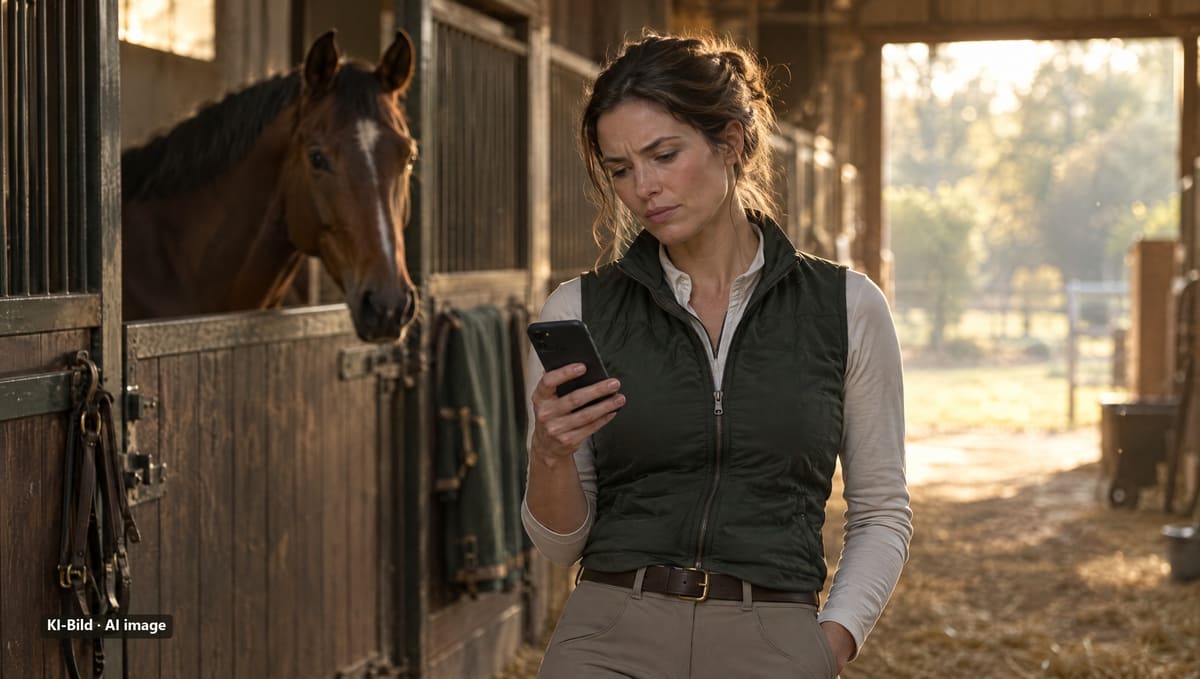
You rarely spot a fake horse ad by its photo. You spot it by what happens next: you are asked to send money before you have seen the horse. If you never pay before you have stood in front of the horse, read its microchip and held its passport, almost every one of these scams comes to nothing.
The example ad
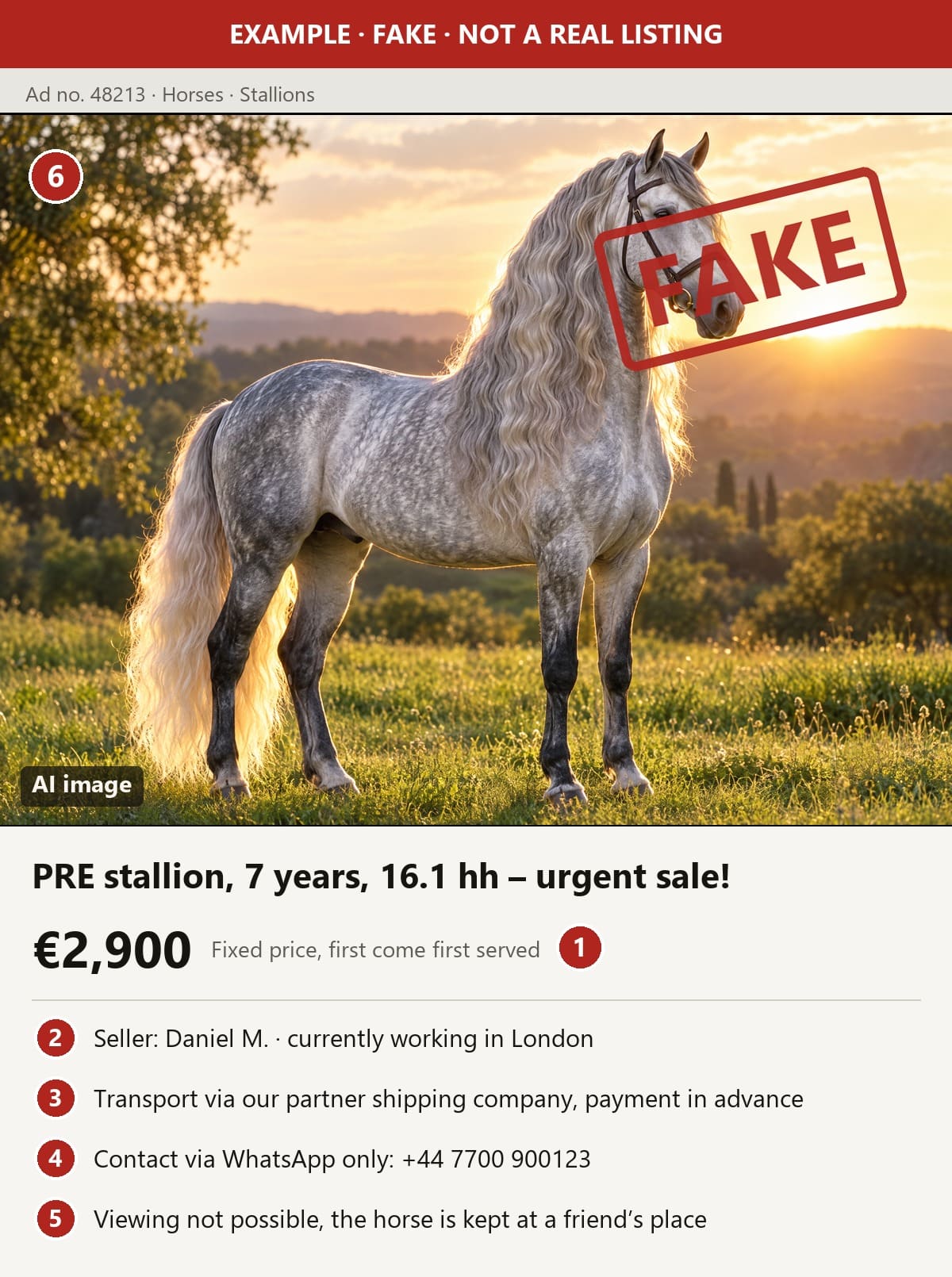
We built this ad ourselves. The horse does not exist; the photo was made by an AI. Everything else is put together from scams that police and horse marketplaces have been warning about for years. The numbers match the markers in the picture.
Six warning signs
- The price is too good. A trained PRE stallion for €2,900. Compare it with similar horses on Equidara and other marketplaces: if an offer is far below them, the seller has a reason, and it is never in the ad.
- The seller happens to be abroad. A move, a new job, illness in the family. The story explains why you cannot visit the horse. Swiss police in Schaffhausen described the pattern back in 2018: first a deposit, then money for transport, then for insurance, and the animal never arrived.
- Transport only through “their” shipping company, paid in advance. The company has a website and answers quickly. After the first payment come insurance, customs or quarantine fees. You choose a genuine transporter yourself and don't pay before the horse is loaded.
- Contact only via WhatsApp or email, often in another language. German police advise caution when an ad written in one language gets a reply in English or another language.
- No viewing, no video, no appointment. The horse is supposedly at a friend's place, in quarantine or already at the transport yard.
- The photo is perfect or shows up elsewhere. AI images used to give themselves away with blurred hooves or reins that end in thin air. Newer models rarely make those mistakes. You can no longer rely on the picture alone, so check differently.
How to check a listing in ten minutes
- Run a reverse image search. Upload the photo to Google Lens or TinEye. If it turns up in another ad, under another name, country or price, you have your answer.
- Ask for a dated video. Ask for a short clip at walk and trot with a note showing your name and today's date. An honest seller needs five minutes for that.
- Match the passport and the chip. Every horse in the EU has an equine passport and a transponder in its neck, as required by Implementing Regulation (EU) 2021/963. Ask to see the passport page with the chip number and read the chip when you view the horse. The vet does this anyway during the pre-purchase exam. If the numbers don't match, it is not the horse in the passport.
- Look up the seller. Put the name, yard and phone number into a search engine. For registered breeding horses you can ask the studbook who is listed as the owner.
- Pay nothing in advance. No deposit, no reservation fee and no transport costs to third parties before you have seen the horse.
A deposit is not unusual in the horse trade, but only after the viewing, in writing and with a receipt. Before that, every payment is a risk you don't have to take.
And if the horse really is abroad?
Plenty of good horses stand in Spain, Portugal or the Netherlands, and buying abroad is nothing suspicious. It just needs more care:
- Go yourself or send someone you trust.
- Book a vet of your own choosing for the pre-purchase exam, not the one the seller recommends.
- Arrange the transport yourself. On Move-your-animal you can find licensed transporters and compare quotes.
- Pay the purchase price to the seller named in the passport and the contract, never to a third company.
Already paid? Do this now
- Call your bank straight away. Sometimes a transfer can still be recalled if you are quick.
- Save everything: the ad, the chat, bank details, names, phone numbers. Screenshots are enough.
- Report it to the police. In many countries you can do this online.
- Report the ad to the marketplace so it doesn't catch anyone else.
What Equidara does
Every ad has a “Report listing” button. We review reported listings and take them offline if we suspect fraud. In your inbox you can block other users. Anyone auctioning a horse on Equidara confirms their ID first, and anyone bidding deposits a card and a security deposit.
Equidara will never ask you by email, text or WhatsApp to send money to a shipping company, an escrow service or someone else's account. If you get a message like that in our name, it is fake.
Common questions
How can I tell if a horse ad uses an AI image?
Often not from the picture itself any more, because newer AI models rarely get hooves or tack wrong. A reverse image search with Google Lens or TinEye and a video showing a note with your name and today's date are far more reliable.
Can a seller ask for a deposit?
After a viewing, a deposit to reserve the horse is common. Agree it in writing, get a receipt and pay it to the seller named in the passport and the contract. Before the viewing, pay nothing.
What should I do if I have already paid?
Call your bank at once and ask whether the transfer can be recalled. Save the ad, the chat and the bank details, and report it to the police; in many countries you can do this online.
Does a horse need a passport and a microchip?
Yes. In the EU every horse needs an equine passport and a transponder. The chip number in the passport must match the chip in the horse; don't buy a horse without a passport.
Sources
- Polizei warnt vor Betrug beim Tierkauf (Schaffhauser Polizei), TierWelt (02.07.2018)
- Tierverkauf über Kleinanzeigen, Ratgeber Internetkriminalität der Polizei (21.09.2020)
- Durchführungsverordnung (EU) 2021/963 zur Kennzeichnung und Registrierung von Equiden (10.06.2021)
Written by Equidara editorial team. Last checked: 30 September 2026.
- Scams Targeting Horse Sellers: How to Protect Yourself — Almost all scams boil down to one thing: getting you to hand something over – be it a refund, your horse, or your personal data – before any legitimate payment has actually landed in your account. Learn how to spot red flags in suspicious inquiries early and the golden rules to keep yourself safe.
- Commission on Horse Purchases: When it Arises, Who Pays It, and When It's Forfeited — A commission isn't simply earned because someone offered assistance. It requires a brokerage agreement, a clear link between the activity and the successful sale, and a contract that is actually concluded. If you're working for both parties, you must disclose this, or your claim to the commission is at risk.
- Rescinding a Horse Purchase: Deadlines, Burden of Proof, and How the Reversal Process Works — Rescinding a contract requires a defect that was already present at the time of handover. This is almost always preceded by a deadline for the seller to remedy the defect, followed by a reversal process where the buyer doesn't just return the horse. Learn what applies when, and which mistakes can cost you your claim.
- Warranty in Horse Sales: Private, Commercial, and When You're Considered a Professional Seller — Between private individuals, warranties can be excluded, but not when selling to a consumer. The grey area lies in determining when someone is considered a professional seller, a decision not made by a form, but by the overall circumstances.
Related
- Purchase contract template — Template for horse and saddle to fill out.
- Buy and pay safely — How to recognize fraud schemes.
- Buy horses — Horses for sale from all over Europe, with transport search.