
Events
Breeding Show and Studbook Entry: Process, Evaluation, and Breeding Potential
What is evaluated at a breeding show, what are the requirements for studbook entry, and what does the result tell you about breeding potential? We'll use two association procedures as examples.
Equidara editorial team · 20 October 2026 · 5 min read
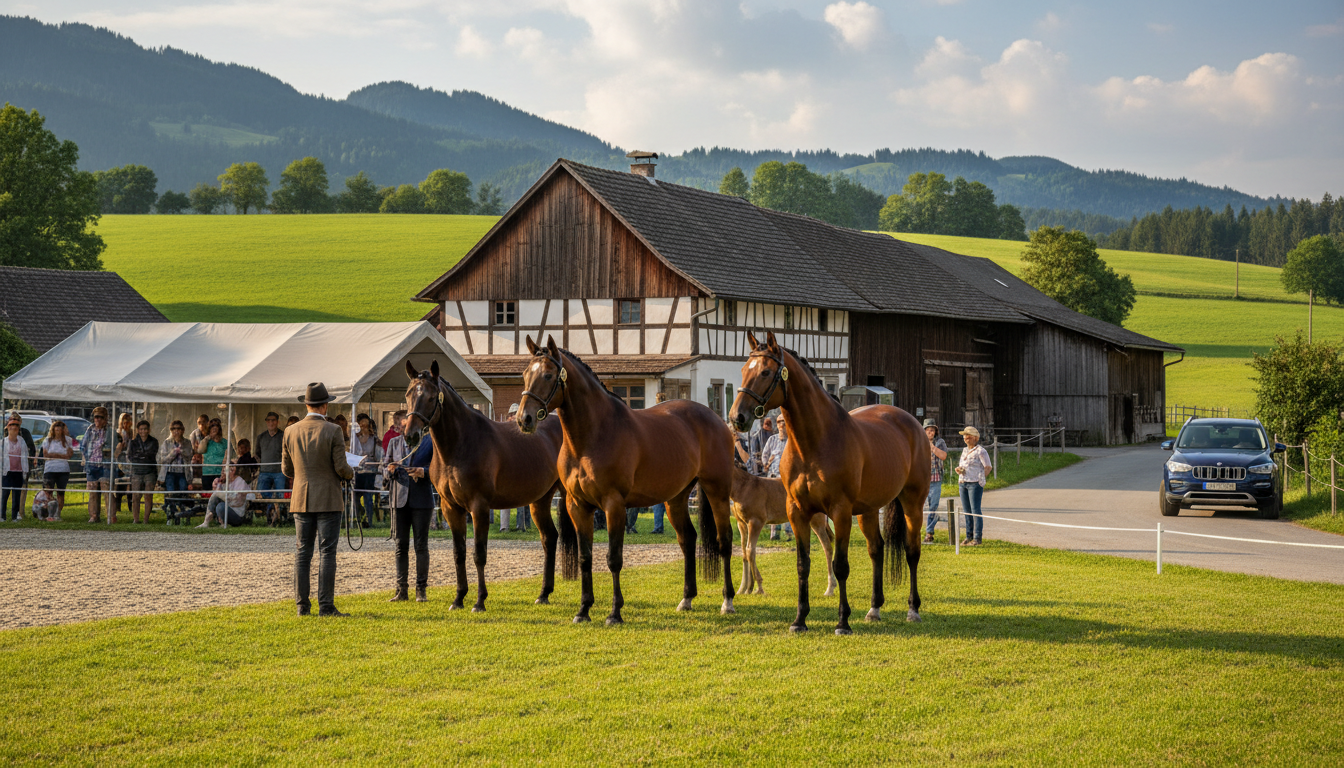
At a breeding show, a horse is assessed on how well it meets the breeding goal. Requirements for studbook entry depend on the respective association and breeding program. Evaluation criteria include type, conformation, and movement. The results can provide guidance for future breeding use. According to the German Friesian Horse Breeders in K.F.P.S. (DFZ), the evaluation offers insight into a horse's quality, as well as its breeding and sport potential. The following examples refer to the Bavarian Association for Small Horse and Special Breeds and the DFZ's procedure for Friesian horses.
The Process: Requirements, Assessment, and Results
Prerequisites Precede Entry
An evaluation and studbook entry are not the same thing. The KFPS is the Dutch main studbook for Friesian horses, and the DFZ outlines the procedure for its members in Germany. The process may differ in other countries. The DFZ uses the terms 'Stammbuch' (main studbook) and 'Stutbuch' (mare book) interchangeably for the entry of Friesian mares. In the described procedure, entry into the main studbook requires an assessment by the inspection committee. Additionally, the owner must be registered as a member of the DFZ and, consequently, of the KFPS.
According to the German Friesian Horse Breeders in K.F.P.S., Friesian mares must meet the following requirements for main studbook entry:
- They must be at least three years old.
- They must be registered in the Foal Book.
- They must measure at least 154 cm at the withers.
The DFZ states that the jury makes the decision regarding entry. At the DFZ breeding show, it is assessed whether the horse possesses the required quality and to what extent it conforms to the KFPS breeding goal. These specific requirements apply to this procedure and not generally to other breeds.
The Evaluation is Documented
All horses applying for mare book entry in the DFZ procedure undergo linear scoring. Individual traits are recorded on a form.
The upper section of this two-part form covers 25 traits, including head expression, shoulder position, rib shape, leg quality, and feathering. The lower section lists five characteristics: breed type, conformation, legs, walk, and trot.
The premium awarded during mare book entry is based on this evaluation sheet. Owners receive it after the breeding show. This means you get not only the premium but also a detailed assessment of your horse.
Evaluation Criteria: What the Association Looks For
The Bavarian Association for Small Horse and Special Breeds outlines criteria for conformation, gaits, and overall impression for its evaluations in Bavaria. Breed-specific characteristics depend on the respective breeding program.
Type and Functional Conformation
For mares, type includes breed and gender type, among other aspects. When assessing conformation, the Bavarian Association particularly examines the head, neck, shoulder, saddle position, back, croup, and limbs. It evaluates them based on their functionality and how well they suit the intended use or breeding goal. Therefore, when interpreting your mare's assessment, the relevant breeding program is essential.
Correctness and Quality of Gaits
Regarding gait correctness, the Bavarian Association desires a straight, even gait from both front and rear. Pacing, uneven movements, and twisting joints are considered undesirable.
For individual gaits, the association describes the following ideals:
- Walk: A clear, even four-beat sequence is desired, along with a ground-covering, diligent, elastic walk in balance. Pacing, irregular, uneven, short, stiff, or powerless movements are undesirable.
- Trot: The association mentions, among other things, a distinct impulsion, a two-beat gait with cadence, swing, elasticity, ground cover, and balance. This also includes active hindquarters and an uphill tendency in the forehand with shoulder freedom. Depending on the breeding goal, these ideals also apply to tölt or other gaits.
- Canter: If recorded during registration, the association expects a clearly sprung three-beat canter. This includes cadence, swing, elasticity, ground cover, balance, and hindquarters that step well under the center of gravity.
Overall Impression and Total Score
For the overall impression, the Bavarian Association considers factors such as willingness to perform, expression, character, temperament, and age-appropriate development. The total score for the general mare evaluation is the arithmetic mean of the individual scores.
For the registration evaluation of Icelandic Horses, however, the association's published evaluation criteria specify a weighting: interior and type count for 20 percent, conformation for 30 percent, and gaits for 50 percent. For Icelandic mares, a total score of at least 7.5 is a prerequisite for entry into Studbook I. This limit is not a general requirement for all mares. The applicable breeding program of the association is always decisive.
Significance for Breeding Use and Pairing
The show provides an assessment of the presented horse. According to the DFZ, the results can also influence market value to some extent.
The evaluation sheet is important for specific pairings: According to the DFZ, it supports the selection of a stallion for breeding. For this purpose, you have access to the individual traits, not just the premium awarded.
Offspring also help to classify a pairing. The DFZ recommends presenting all Friesian foals at a breeding show to objectively assess the chosen breeding decision. Foals are individually evaluated based on breed type, conformation, development, walk, and trot. The jury can award a first, second, or third premium.
State Premium Candidacy is Not Yet a State Premium
At the Bavarian Association, mares designated as State Premium Candidates at the regional show require at least one healthy foal and a successfully completed performance test to receive the State Premium. For small horse breeds under 87 cm at the withers, the performance test requirements are waived, according to the association. The title is only awarded upon application. Here too, the current breeding program applies.
Common questions
What are the requirements for main studbook entry for a Friesian mare?
In the procedure described by the German Friesian Horse Breeders in K.F.P.S. for their members in Germany, she must be at least three years old, registered in the Foal Book, and at least 154 cm at the withers. Additionally, an assessment by the inspection committee and the owner's registered membership in the DFZ and thus in the Dutch main studbook KFPS are required. According to the DFZ, the jury decides on the entry.
What score does an Icelandic mare need for Studbook I?
The Bavarian Association for Small Horse and Special Breeds states in its published evaluation criteria for Icelandic mares that a total score of at least 7.5 is a prerequisite for entry into its Studbook I. The applicable breeding program is decisive.
What is the benefit of the evaluation sheet for breeding pairings?
According to the DFZ, the evaluation sheet in the Friesian horse procedure supports stallion selection for breeding. It is sent to owners after the breeding show.
Does State Premium Candidacy automatically lead to a State Premium?
No. At the Bavarian Association for Small Horse and Special Breeds, at least one healthy foal and a successfully completed performance test are required. For small horse breeds under 87 cm at the withers, the performance test requirements are waived, according to the association. The title is only awarded upon application.
Sources
- Bayerischer Zuchtverband für Kleinpferde und Spezialpferderassen – Bewertungskriterien für Körperbau, Gangarten und Gesamteindruck; kleinpfe (2026)
- Deutsche Friesenpferdezüchter im K.F.P.S. – Zuchtschauen, lineare Bewertung und Bedeutung für Zuchteinsatz und Anpaarung; mein-dfz.de
Written by Equidara editorial team. Last checked: 24 October 2026.
Fachlich geprüft von Melissa Hinze, Pferdezüchterin und Pferdehändlerin, Gründerin von Equidara.
- Stallion Show and Licensing: How it Works and What the Results Tell Buyers — Presented in-hand, free-moving, and free-jumping, plus a commission with scores: How a stallion show unfolds and what you, as a buyer, can glean from the results.
- As a Spectator or Companion at a Show: Access and Conduct in the Warm-Up Arena — Not every warm-up arena is accessible to pedestrians. Here's what you should clarify before entering and how to be considerate as a spectator or companion.
- Equestrian Federations in Germany: How the FN, State Associations, and Clubs are Connected — The FN is the umbrella organization for equestrian sport in Germany. Its federation includes the state associations, which advise clubs and equestrian businesses. Here, you'll learn how these levels are connected and what responsibilities the FN takes on.
- Stallion Licensing and Horse Purchase: What Breeding Value, Registration, and Papers Tell You — In Germany, a licensed riding horse stallion is not yet definitively approved for breeding. Here's how to understand licensing, studbook registration, performance tests, breeding certificates, and breeding value when buying a stallion.
Related
- Auctions — Ongoing auctions and individual lots.
- Riding holidays and courses — Trail rides, clinics, farm holidays.