
Sport & Results
Working Equitation: Events, Horses, and Getting Started Explained
Working Equitation combines dressage, trail, and cattle work into a versatile competition sport. All information on the four phases, suitable horses, and how to get started for riders.
Equidara editorial team · 30 September 2026 · 3 min read
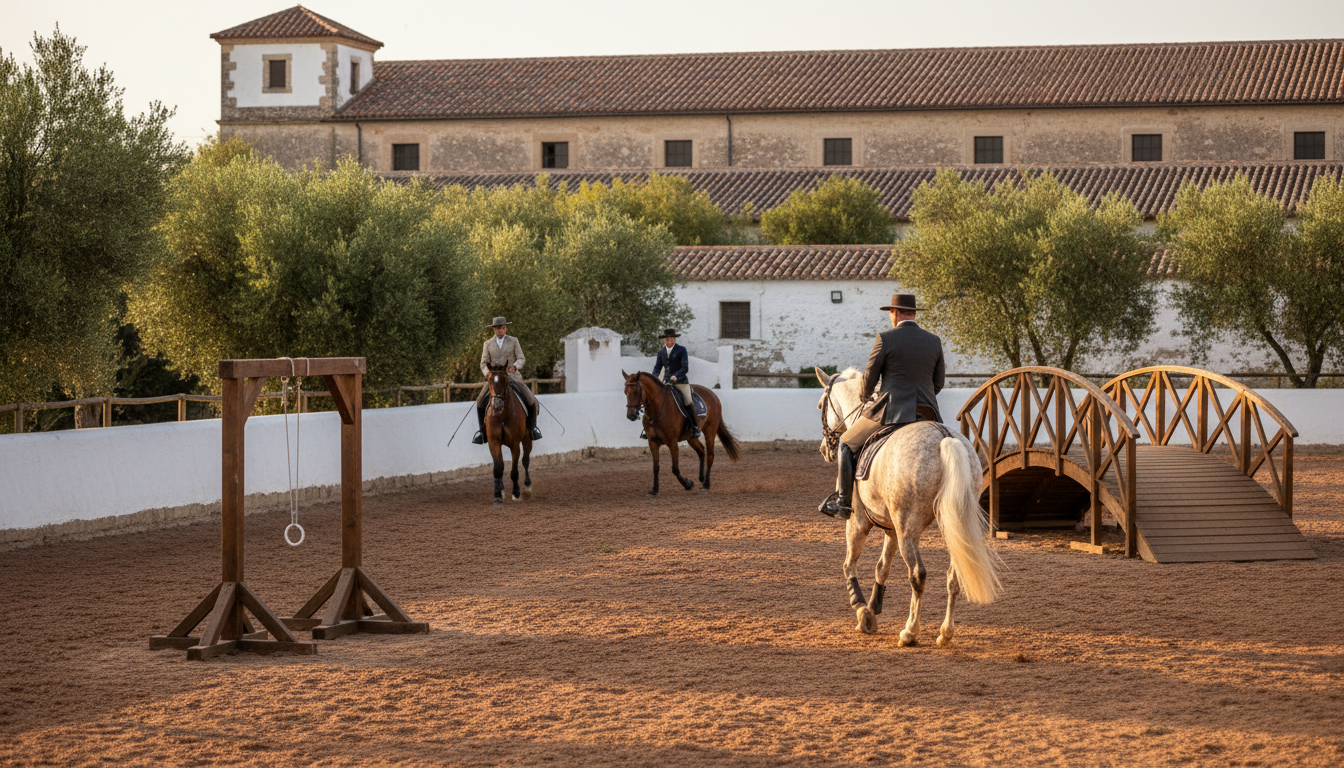
Working Equitation is an equestrian discipline that originated from the working riding styles of Southern Europe's cattle herders. Today, you and your horse can compete in up to four phases: dressage, stiltrail, speed trail, and – at certain competitions – cattle work. The discipline is open to all horse breeds and is offered in several performance levels. The appeal lies in the combination of precision, speed, and composure.
The Four Phases of Working Equitation
Each competition consists of up to four individual tests, though national competitions often only include dressage, stiltrail, and speed trail.
Dressage
A ridden test that assesses collection, transitions, and lightness. The arena is marked, and movements such as figures and tempo changes are judged. Dressage forms the foundation of the partnership.
Stiltrail (Ease of Handling)
A course of at least 15 obstacles – including a gate, bridge, bell corridor, barrels, and a pen – is navigated with calmness and precision. It's not the time, but the style and execution that count.
Speed Trail
The same obstacle course as in the stiltrail, but against the clock. Penalty points are converted into time seconds. The fastest clear round wins. Here, speed and control come together.
Cattle Work (Cow Trial)
A team of three to four riders must separate a designated cow from the herd and pen it on the opposite side of the arena. The time limit is three minutes including penalty seconds. Cattle work only counts towards the team score and is not a required component at many national competitions.
Suitable Horses
Working Equitation is open to all small and large horse breeds as well as ponies. What matters are health, obedience, and nerve strength on the course. Internationally, horses must be at least 5 years old according to FITE regulations. Some national regulations require a minimum age of 6 years. A valid equine passport and a veterinary examination before the competition are mandatory.
Getting Started in Working Equitation
The discipline is divided into seven test classes that allow for an easy start:
- Lead Rein Class (ages 4 to 8): The horse is led by hand, and an accompanying person assists the rider.
- Children's Class (ages 8 to 12): Dressage at walk and trot, trail with permitted assistance from a trainer.
- E – Beginner: License-free class, rider's pass or WRC sufficient.
- A – Light Class, L – Medium Class, M – Advanced Class: Here the WE 1 license is required.
- S – Master Class: requires the WE 2 license and is ridden one-handed.
Additionally, there are age categories: general class from 19 years, youth class 10 to 18 years. The best way to get started is through a club that offers Working Equitation. There you'll learn the obstacles and build the foundation for the trail. For the higher classes, a license from the respective national association (e.g., WED e. V. in Germany) is required.
Competition Attire and Equipment
The dress code emphasizes a neat, traditional style. Natural-colored or dark riding breeches, boots or paddock boots with chaps, and a jacket, coat, or blazer are customary. Bridles and saddles may correspond to the respective riding style – the diversity of cultural traditions is expressly preserved in Working Equitation.
Common questions
What horse breeds can I compete with in Working Equitation?
There is no breed restriction. Both ponies and large horses of all breeds are permitted, as long as they are healthy, adequately trained, and at least 5 years old (internationally) or 6 years old (in some national regulations).
Do I need a special license for Working Equitation?
For the beginner class, a rider's pass or comparable basic certification is usually sufficient. From the light class (A) onward, the Working Equitation license WE 1 is required, and for the master class, the WE 2 license.
Does my horse need special training?
Basic obedience and riding through dressage exercises are the foundation. Obstacles like the gate, bridge, or bell corridor can be practiced step by step in training. Many clubs offer clinics and practice evenings so you can learn together with your horse.
When does cattle work take place?
Cattle work is part of team competitions and is especially held at international championships. In national competitions, it is usually not included; there, only dressage, stiltrail, and speed trail count towards the individual score.
Sources
- Offizielles Reglement – Working Equitation | WED e. V. (2026-09-28)
- The Sport – WAWE Working Equitation (2026-09-28)
- FITE 2026 Working Equitation Regulation (2026-01)
- Österreichische Turnierordnung für Working Equitation 2026 (2026-09-28)
- APPROVED IN THE GENERAL ASSEMBLY of 7 MAY 2024
- Working Equitation Deutschland e. V. | WED
Written by Equidara editorial team. Last checked: 4 October 2026.
- Asian Games Dressage to Feature Grand Prix for the First Time in Tokyo — From 25 to 27 September 2026, 45 combinations from 16 nations will compete. For the first time, Grand Prix will be ridden at Asian Games dressage.
- Abi Lyle Finishes Second in Her Eventing Debut — Olympic dressage rider Abi Lyle secured second place with Nice Try II in the GoBE80 class at Little Gatcombe. Four time penalties on the cross-country course cost the pair the win.
- Buying an Andalusian (PRE): ANCCE Studbook, Difference from Lusitano, Prices — A PRE is more than an Andalusian: the ANCCE studbook, the split from the Lusitano, and what to look for when buying.
- Competing in Germany: Entries, Licenses, and Timetables — From making your entry to post-competition care: Here's how to prepare for a competition in Germany according to FN rules, meet entry deadlines, and plan your arrival and warm-up.
Related
- Buy horses — Horses for sale from all over Europe, with transport search.
- Auctions — Ongoing auctions and individual lots.
- Selling a horse — Post listings for free, visible in eight languages.